Skip to content

TechDirectArchive

Hands-on IT, Cloud, Security, Veeam & DevOps

  • Home
  • About
  • Advertise With US
  • Reviews
  • Contact
  • Toggle search form

How to Remove the All Apps Option from Windows Start Menu via GPO /Registry

Posted on 31/01/202022/09/2023 IT Expert By IT Expert No Comments on How to Remove the All Apps Option from Windows Start Menu via GPO /Registry
  1. Home
  2. Windows
  3. How to Remove the All Apps Option from Windows Start Menu via GPO /Registry

Windows 10 the Start menu is so unique, modern and touch-friendly and gives the recently used programs along with other quick access options and the All Apps option.

Remove All Apps

When you click on the All Apps option from the Start menu, it will display all the installed apps on your system. To remove the “All Apps” option from the Start menu, follow these steps.

This can be done via the registry and group policy

For Group Policy Editor (GPO)
To start, press “Win + R,” to launch the run dialog box (or simply type run in the search window)

Windows Start Menu

-type gpedit.msc and press the Enter button.

Alternatively, you can also search for it in the Start menu. (by simple typing gpedit.msc, it will appear, just click on it to open).

 GPO

Furthermore, Any of the methods above will open up the Group Policy Editor.
– Navigate to the User Configuration
– Administrative Templates
– Start Menu and Taskbar
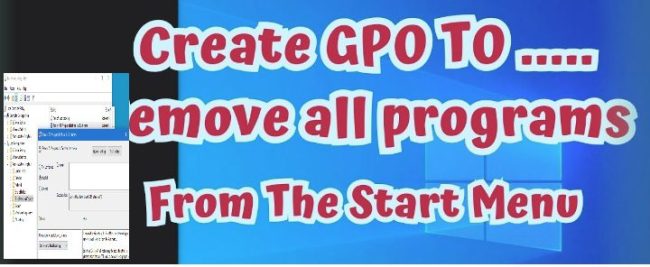
– Search for and double-click on the policy “Remove All Programs list from the Start menu” appearing on the right panel to open the properties window.

Registry

Double click to open the Policy Properties window select the “Enabled” radio button, and
– Choose an option as you wish
– Click on the “Ok” button to save the changes.
This will show the policy is enabled.

To apply this policy immediately, launch the command prompt and type gpupdate /force

Remove All Apps

When completed, it will display the policy was successfully completed (applied)

Windows Start Menu

Alternatively, have the device restarted or sign out and sign in to your device again, This will apply the Settings and the All Apps option in the Start Menu will no longer be available.

To revert back, follow the steps above and select “Not configured” or “Disabled” in the Policy Properties window.

Do comment below sharing your thoughts and experiences about using the above methods to remove or disable the All Apps option in the start menu.

To Remove the All Apps Option from Windows Start Menu via the Registry Settings

- HKEY_CURRENT_USER\SOFTWARE\Microsoft\ Windows\CurrentVersion\Policies
-  right-click on the key “Policies,” select “New” and then “key.”
will create a new blank key;
- Simply rename the key to “Explorer.”
After renaming, right-click on the right panel and then select the “New” option and then “DWORD (32-bit) Value” to create a new DWORD value.
- rename the newly-created value to “NoStartMenuMorePrograms,” and press the Enter button.
- You will have to change the value set, by default, this is set to the Value Data “0;”. This needs to change. To accomplish this;
- Double-click on the newly-created value to open the Value window.
- Enter the new value data as “1,” and click on the “Ok” button to save the changes.
Rate this post

Thank you for reading this post. Kindly share it with others.

  • Share on X (Opens in new window) X
  • Share on Reddit (Opens in new window) Reddit
  • Share on LinkedIn (Opens in new window) LinkedIn
  • Share on Facebook (Opens in new window) Facebook
  • Share on Pinterest (Opens in new window) Pinterest
  • Share on Tumblr (Opens in new window) Tumblr
  • Share on Telegram (Opens in new window) Telegram
  • Share on WhatsApp (Opens in new window) WhatsApp
  • Share on Mastodon (Opens in new window) Mastodon
  • Share on Bluesky (Opens in new window) Bluesky
  • Share on Threads (Opens in new window) Threads
  • Share on Nextdoor (Opens in new window) Nextdoor
Windows

Post navigation

Previous Post: Allow Password change for specific users in Exchange Server
Next Post: Setup Kiosk Mode on Windows 10 with AD User Account

Related Posts

  • Run Android Apps on Windows with BlueStacks
    How to Run Android Apps on Windows with BlueStacks Windows
  • Featured Image 3
    How to enable Secure Boot on PC to install Windows 11 Windows
  • Missing ADML File
    Fix an appropriate resource file could not be found for LAPS Windows
  • Ubuntu on Windows
    Install Ubuntu 20.04 LTS on Windows via WSL Linux
  • Featured Image
    Restore Point Creation in Windows 10 and Windows 11 Windows
  • Cannot Start Proctored Exam
    DbxSvc Process: How to Fix “Cannot Start Proctored Exam” Windows

More Related Articles

Run Android Apps on Windows with BlueStacks How to Run Android Apps on Windows with BlueStacks Windows
Featured Image 3 How to enable Secure Boot on PC to install Windows 11 Windows
Missing ADML File Fix an appropriate resource file could not be found for LAPS Windows
Ubuntu on Windows Install Ubuntu 20.04 LTS on Windows via WSL Linux
Featured Image Restore Point Creation in Windows 10 and Windows 11 Windows
Cannot Start Proctored Exam DbxSvc Process: How to Fix “Cannot Start Proctored Exam” Windows

Leave a Reply Cancel reply

You must be logged in to post a comment.

Microsoft MVP

VEEAMLEGEND

vexpert-badge-stars-5

Virtual Background

GoogleNews

Categories

veeaam100

Veeam Vanguard

  • cimInstance wmi
    How to fix Get-CimInstance Access PermissionDenied Windows
  • veeamONE integration with VBR
    Install Veeam ONE and Add VBR: Fix failed to connect to VBR Backup
  • Delete AWS EBS Volume
    How to delete an Elastic Block Store Volume on AWS AWS/Azure/OpenShift
  • How to Convert Google Forms Into Microsoft Forms banner
    Convert Google Forms Into Microsoft Forms Microsoft Exchange/Office/365
  • disableFaceTime567u
    Sign out of FaceTime: How to disable or enable FaceTime on Mac Mac
  • install python 3 and pip
    How to upgrade and downgrade PIP on Windows Windows
  • MFA
    Rolling out Multi-factor Authentication – Recommendations Security | Vulnerability Scans and Assessment
  • image 16
    How to Fix Windows Error 0x80070057 Windows

Subscribe to Blog via Email

Enter your email address to subscribe to this blog and receive notifications of new posts by email.

Join 1,803 other subscribers
  • RSS - Posts
  • RSS - Comments
  • About
  • Authors
  • Write for us
  • Advertise with us
  • General Terms and Conditions
  • Privacy policy
  • Feedly
  • Telegram
  • Youtube
  • Facebook
  • Instagram
  • LinkedIn
  • Tumblr
  • Pinterest
  • Twitter
  • mastodon

Tags

AWS Azure Bitlocker Microsoft Windows PowerShell WDS Windows 10 Windows 11 Windows Deployment Services Windows Server 2016

Copyright © 2025 TechDirectArchive

Loading Comments...

You must be logged in to post a comment.