Skip to content

TechDirectArchive

Hands-on IT, Cloud, Security & DevOps Insights

  • Home
  • About
  • Advertise With US
  • Reviews
  • Contact
  • Toggle search form
Home » Windows Server » How to create a capture image on Windows Deployment Services

How to create a capture image on Windows Deployment Services

Posted on 27/05/202008/09/2024 Christian By Christian No Comments on How to create a capture image on Windows Deployment Services
capture image

A capture Image is required for an environment where you are deploying similar Operating Systems that contain the same basic applications. The image is used to create a capture image. For the differences between Capture image, Discover image, Install and Boot images (Windows PE). In this article, you will learn about How to create a capture image on Windows Deployment Services. Please see how to add images to WDS and configure Multicast transmission via the GUI.

Create a capture image

Follow the steps to have this done. Click on the boot image. Right-click on the boot image on the right pane of the window and select Create Capture Image as shown below. This is the first step to create a capture image on Windows Deployment Services.

Note: In this Window, you can do a lot of stuff, as shown below. Furthermore, Here, we want to create a Captured Image

Windows Deployment Services

Enter the Image Name

However, Enter the image’s name and description as well to proceed with creating a capture image.

image creation

For more information on this, see ” how to configure Windows Deployment Services on Windows Server 2019“

Browse to the RemoteInstall Directory

For location and file name, click on browse and browse to the path where the RemoteInstall” folder is when we installed WDS role.

create image
Screenshot 2020 05 27 at 22.36.14

Moreover, This will ensure we have the Capture Image folder created under the RemoteInstall Directory, crucial for creating a capture image on Windows Deployment Services.

Windows Deployment Services
capture image
Screenshot 2020 05 27 at 22.43.25

In addition, The Metadata and location will be like this as shown below. Click on Next

image creation

This will continue the installation process and when done

capture image

Click on Finish (Now the Capture Image has been created)

create image

Now we have successfully created a captured image. Now we can see the captured file in the RemoteInstall location as shown below

image creation

Next, you will have to upload this image to WDS. This can be done by following the steps below. See how to add the Lite-Touch Images to WDS for a similar example.

Launch the WDS console

Launch the WDS console and right-click on the Boot image to effectively create a capture image on Windows Deployment Services.

capture image

In the Add Image Wizard, browse to the image file as shown below

Screenshot 2020 06 06 at 23.52.45
Screenshot 2020 06 06 at 23.53.09

Click on Next to proceed when the image file has been selected.

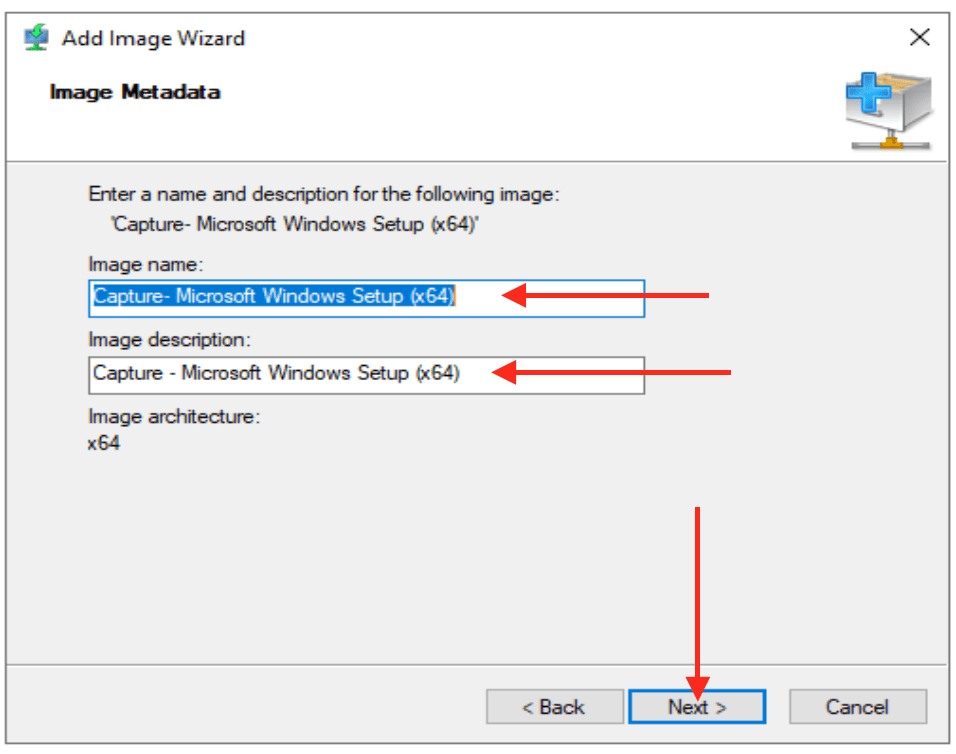
In the Image Metadata window, click on Next. You can add a descriptive name in your environment when you create a capture image.
Review the summary as shown below and click on Next

When the image upload is completed, click on Finish as shown below.

Screenshot 2020 06 06 at 23.57.35
Screenshot 2020 06 06 at 23.59.08

As we can see on the WDS console, under the boot images, the Capture image we created has been uploaded successfully.

Nonetheless, I hope you found this blog post on how to create a capture image on Windows Deployment Services helpful. Consequently, Please let me know in the comment session if you have any questions.

5/5 - (1 vote)

Thank you for reading this post. Kindly share it with others.

  • Share on X (Opens in new window) X
  • Share on Reddit (Opens in new window) Reddit
  • Share on LinkedIn (Opens in new window) LinkedIn
  • Share on Facebook (Opens in new window) Facebook
  • Share on Pinterest (Opens in new window) Pinterest
  • Share on Tumblr (Opens in new window) Tumblr
  • Share on Telegram (Opens in new window) Telegram
  • Share on WhatsApp (Opens in new window) WhatsApp
  • Share on Mastodon (Opens in new window) Mastodon
  • Share on Bluesky (Opens in new window) Bluesky
  • Share on Threads (Opens in new window) Threads
  • Share on Nextdoor (Opens in new window) Nextdoor
Windows Server Tags:WDS, WDSUTIL, Windows Deployment Services, Windows Server 2016

Post navigation

Previous Post: How to remove WDS role via the GUI and PowerShell
Next Post: Windows Deployment Services: WDSUTIL CommandLine Options on Windows Server 2019

Related Posts

  • vtpm 1
    Enable vTPM and BitLocker HyperV VM: Fix the device that cannot use a TPM module Virtualization
  • Expired Evaluation Configuration Manager to Full Version
    Upgrade Expired Evaluation Configuration Manager to Full Version Windows Server
  • dfefeq
    Error 740: Elevated permissions are required to run DISM Windows Server
  • MBAM Reports
    Microsoft BitLocker Administration and Monitoring Report Fields Windows Server
  • MSIEXEC returned 1602
    Fix MSIEXEC returned 1602: Trellix Setup cannot use this account Windows Server
  • KMS server setup
    How to set up and configure the Key Management System (KMS) Windows Server

More Related Articles

vtpm 1 Enable vTPM and BitLocker HyperV VM: Fix the device that cannot use a TPM module Virtualization
Expired Evaluation Configuration Manager to Full Version Upgrade Expired Evaluation Configuration Manager to Full Version Windows Server
dfefeq Error 740: Elevated permissions are required to run DISM Windows Server
MBAM Reports Microsoft BitLocker Administration and Monitoring Report Fields Windows Server
MSIEXEC returned 1602 Fix MSIEXEC returned 1602: Trellix Setup cannot use this account Windows Server
KMS server setup How to set up and configure the Key Management System (KMS) Windows Server

Leave a Reply Cancel reply

You must be logged in to post a comment.

Microsoft MVP

VEEAMLEGEND

vexpert-badge-stars-5

Virtual Background

GoogleNews

Categories

veeaam100

sysadmin top30a

  • sonarcloud
    How to Integrate SonarCloud with Azure DevOps Pipeline AWS/Azure/OpenShift
  • Locate Find and Grep Required 1
    A Brief Introduction to Linux and How to Create Disk Partition in Ubuntu Linux Linux
  • Feature image msert tool
    How to remove malware using Microsoft Safety Scanner on Windows 10 and 11 Security | Vulnerability Scans and Assessment
  • BLOG LOGO
    How to create a static pod in Kubernetes AWS/Azure/OpenShift
  • Screenshot 1
    Migrating SAP HANA Plugin to Veeam Backup
  • Case Of Internal Sabotage And Recovery
    A real case of Internal Sabotage and Recovery Network | Monitoring
  • azure
    Enter connection information for your on-premise directory or forests: Azure AD connect unable to connect directory, forest not available AWS/Azure/OpenShift
  • AzureAD
    Azure Active Directory integration with on-premise AD using PTA AWS/Azure/OpenShift

Subscribe to Blog via Email

Enter your email address to subscribe to this blog and receive notifications of new posts by email.

Join 1,823 other subscribers
  • RSS - Posts
  • RSS - Comments
  • About
  • Authors
  • Write for us
  • Advertise with us
  • General Terms and Conditions
  • Privacy policy
  • Feedly
  • Telegram
  • Youtube
  • Facebook
  • Instagram
  • LinkedIn
  • Tumblr
  • Pinterest
  • Twitter
  • mastodon

Tags

Active Directory Azure Bitlocker Microsoft Windows PowerShell WDS Windows 10 Windows 11 Windows Deployment Services Windows Server 2016

Copyright © 2025 TechDirectArchive


Loading Comments...
 

You must be logged in to post a comment.