Skip to content

TechDirectArchive

Hands-on IT, Cloud, Security, Veeam & DevOps

  • Home
  • About
  • Advertise With US
  • Reviews
  • Contact
  • Toggle search form

How to create a capture image on Windows Deployment Services

Posted on 27/05/202005/09/2026 Christian By Christian No Comments on How to create a capture image on Windows Deployment Services
  1. Home
  2. Windows Server
  3. How to create a capture image on Windows Deployment Services
capture image

A capture Image is required for an environment where you are deploying similar Operating Systems that contain the same basic applications. The image is used to create a capture image. For the differences between Capture image, Discover image, Install and Boot images (Windows PE). In this article, you will learn about How to create a capture image on Windows Deployment Services. Please see how to add images to WDS and configure Multicast transmission via the GUI.

Create a capture image

Follow the steps to have this done. Click on the boot image. Right-click on the boot image on the right pane of the window and select Create Capture Image as shown below. This is the first step to create a capture image on Windows Deployment Services.

Note: In this Window, you can do a lot of stuff, as shown below. Furthermore, Here, we want to create a Captured Image

Windows Deployment Services

Enter the Image Name

However, Enter the image’s name and description as well to proceed with creating a capture image.

image creation

For more information on this, see ” how to configure Windows Deployment Services on Windows Server 2019“

Browse to the RemoteInstall Directory

For location and file name, click on browse and browse to the path where the RemoteInstall” folder is when we installed WDS role.

create image
Screenshot 2020 05 27 at 22.36.14

Moreover, This will ensure we have the Capture Image folder created under the RemoteInstall Directory, crucial for creating a capture image on Windows Deployment Services.

Windows Deployment Services
capture image
Screenshot 2020 05 27 at 22.43.25

In addition, The Metadata and location will be like this as shown below. Click on Next

image creation

This will continue the installation process and when done

capture image

Click on Finish (Now the Capture Image has been created)

create image

Now we have successfully created a captured image. Now we can see the captured file in the RemoteInstall location as shown below

image creation

Next, you will have to upload this image to WDS. This can be done by following the steps below. See how to add the Lite-Touch Images to WDS for a similar example.

Also, see SizeTrend: A Fast Windows Disk Space Analyzer for Storage Analysis, Veeam ONE 13.1.0.7034 Upgrade: Complete Pre-flight and Step-by-Step Guide, and Upgrading Veeam Backup Enterprise Manager to v13.1 and Applying System Updates.

Launch the WDS console

Launch the WDS console and right-click on the Boot image to effectively create a capture image on Windows Deployment Services.

capture image

In the Add Image Wizard, browse to the image file as shown below

Screenshot 2020 06 06 at 23.52.45
Screenshot 2020 06 06 at 23.53.09

Click on Next to proceed when the image file has been selected.

Screenshot of the 'Add Image Wizard' in Windows, showing the file location path for a Windows image file with options to navigate or proceed.

In the Image Metadata window, click on Next. You can add a descriptive name in your environment when you create a capture image.
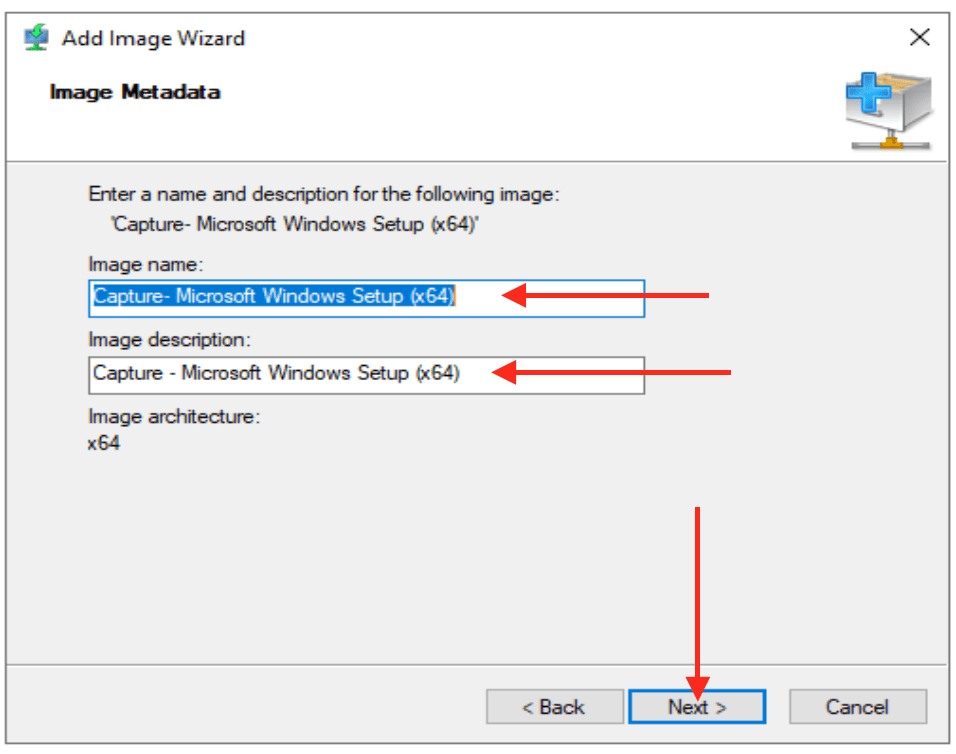
Screenshot of the 'Add Image Wizard' interface displaying fields for Image Name, Image Description, and Image Architecture for a Microsoft Windows Setup (x64).

Review the summary as shown below and click on Next

Add Image Wizard summary page showing selected images for Microsoft Windows Setup (x64) with a highlighted 'Next' button.

When the image upload is completed, click on Finish as shown below.

Screenshot 2020 06 06 at 23.57.35
Screenshot 2020 06 06 at 23.59.08

As we can see on the WDS console, under the boot images, the Capture image we created has been uploaded successfully.

Screenshot of Windows Deployment Services interface showing 'Boot Images' section with a list of bootable images and their details.

Nonetheless, I hope you found this blog post on how to create a capture image on Windows Deployment Services helpful. Consequently, Please let me know in the comment session if you have any questions.

Thank you for reading this post. Kindly share it with others.

  • Share on X (Opens in new window) X
  • Share on Reddit (Opens in new window) Reddit
  • Share on LinkedIn (Opens in new window) LinkedIn
  • Share on Facebook (Opens in new window) Facebook
  • Share on Pinterest (Opens in new window) Pinterest
  • Share on Tumblr (Opens in new window) Tumblr
  • Share on Telegram (Opens in new window) Telegram
  • Share on WhatsApp (Opens in new window) WhatsApp
  • Share on Mastodon (Opens in new window) Mastodon
  • Share on Bluesky (Opens in new window) Bluesky
Windows Server Tags:WDS, WDSUTIL, Windows Deployment Services, Windows Server 2016

Post navigation

Previous Post: How to remove WDS role via the GUI and PowerShell
Next Post: Windows Deployment Services: WDSUTIL CommandLine Options on Windows Server 2019

Related Posts

  • dfggg 2
    Installing and configuring SimpleSAMLphp [Part 2] Windows Server
  • image 9
    Fix Error 853: The remote access connection completed, but authentication failed because the certificate that authenticates the client to the server is not valid Network | Monitoring
  • Set Microsoft Defender AV to Passive mode on a Windows Server
    Set Microsoft Defender AV to Passive mode on a Windows Server Security | Vulnerability Scans and Assessment
  • diag7
    How to run Windows Memory Diagnostics Tool on Windows Windows
  • dism failed errors windows thumbnail 1
    Error 0x800f0830: Discard the modified Image and start again, no operation was performed Windows Server
  • HighA
    Virtual Machine Scale Set: Demonstrating High Availability in Azure AWS/Azure/OpenShift

More Related Articles

dfggg 2 Installing and configuring SimpleSAMLphp [Part 2] Windows Server
image 9 Fix Error 853: The remote access connection completed, but authentication failed because the certificate that authenticates the client to the server is not valid Network | Monitoring
Set Microsoft Defender AV to Passive mode on a Windows Server Set Microsoft Defender AV to Passive mode on a Windows Server Security | Vulnerability Scans and Assessment
diag7 How to run Windows Memory Diagnostics Tool on Windows Windows
dism failed errors windows thumbnail 1 Error 0x800f0830: Discard the modified Image and start again, no operation was performed Windows Server
HighA Virtual Machine Scale Set: Demonstrating High Availability in Azure AWS/Azure/OpenShift

Leave a Reply Cancel reply

You must be logged in to post a comment.

Microsoft MVP

vexpert-badge-stars-5

Virtual Background

VEEAMLEGEND

Categories

veeaam100

Veeam Vanguard

  • Feautured image DualBoot
    How to create a dual-boot setup on Windows 11 Windows
  • Remote desktop connection over udp and tcp
    Remote Desktop Connection behavior over UDP and TCP Windows Server
  • AWS Scheduled Events
    View Scheduled Events on AW using AWS Web Console and CLI AWS/Azure/OpenShift
  • vmwarevinchin
    3 Ways to Convert VMware VMs to Hyper-V Backup
  • feature image
    How to install PostgreSQL on Ubuntu Linux
  • Check Hard Drive Health (SMART) in Windows
    How to check Hard Drive Health (SMART) in Windows Windows
  • SU
    How to switch users in Linux Linux
  • maxresdefault
    How to add one or more external displays with your Mac Mac

Subscribe to Blog via Email

Enter your email address to subscribe to this blog and receive notifications of new posts by email.

Join 1,757 other subscribers
  • RSS - Posts
  • RSS - Comments
  • About
  • Authors
  • Write for us
  • Contact
  • Advertise with us
  • General Terms and Conditions
  • Privacy policy
  • Feedly
  • Telegram
  • Youtube
  • Facebook
  • Instagram
  • LinkedIn
  • Tumblr
  • Pinterest
  • Twitter
  • mastodon
  • Bsky

Tags

Active Directory Azure Bitlocker Microsoft Windows PowerShell WDS Windows 10 Windows 11 Windows Deployment Services Windows Server 2016

Copyright © 2026 TechDirectArchive

Loading Comments...

You must be logged in to post a comment.