Skip to content

TechDirectArchive

Hands-on IT, Cloud, Security & DevOps Insights

  • Home
  • About
  • Advertise With US
  • Contact
  • Reviews
  • Toggle search form
Home » Windows » Failure 5456: Unable to determine destination disk, partition, and/or drive, see BDD Log

Failure 5456: Unable to determine destination disk, partition, and/or drive, see BDD Log

Posted on 09/03/202121/09/2023 Christian By Christian No Comments on Failure 5456: Unable to determine destination disk, partition, and/or drive, see BDD Log
destination disk

The BDD.log is an aggregated MDT log file that is copied to a network location at the end of the deployment if you specify the SLShare property in the Customsettings.ini file. Deployment Toolkit (MDT) provides information on current known issues, possible workarounds for those issues, and troubleshooting guidance. The MDT log file format is designed to be read by CMTrace. Use this tool whenever possible to read the log files, because it makes finding errors much easier.

Kindly refer to the following guides for more information on WDS and MDT. How to setup and install WDS role, how to configure DHCP Server option 60, 66, and 67 for WDS, how to remove Windows Deployment Services role via the GUI and PowerShell, how to add boot and install images to WDS and configure Multicast transmission via the GUI and WDSUTIL, and how to deploy images to computers or virtual machines using WDS.

Lite Touch Installation (LTI): LTI is a high-volume deployment strategy for small to midsized organisations that combine the use of MDT with WDS which allows Administrators to deploy devices via network-based installation. 

Destination Disk Determination Failure

Furthermore, The following error below will be prompted when MDT is unable to install the Windows operating system (OS) on your device due to not being able to format the drive.

Failure 5456: Unable to determine destination disk, partition, and/or drive. See BDD.LOG. LiteTouch deployment failed, return code = -2147467259 0x80004005. Failed to run the action: inject drivers

Solution: However, This actually depends on your environment setup. If you have a disk partitioning tool (script) integrated into your wimpe in the path below, you do not have to perform the steps below as the installation will run smoothly. In this approach, you must mount the wimpe file and then unmount afterward. I will be discussing these steps in the future.

C:\Program Files (x86)\Windows Kits\10\Assessment and Deployment Kit\Windows Preinstallation Environment\amd64\en-us

For those that do not have a disk partitioning tool (script) capable of formatting the drive for Windows installation, kindly follow the steps below.
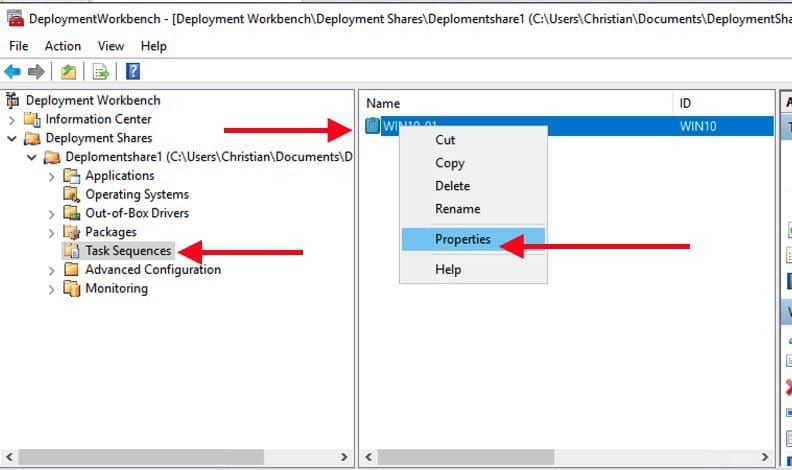
– Launch Deployment Workbench, and expand the deployment share
– Navigate to the Task Sequence and right-click on the properties window to open it as shown below.
partition

Uncheck the “Disable this step” as shown below: This will activate the Formate and disk Partition (UEFI) as shown below.
– Click on Apply and OK.

Task-seq-1

Henceforth, you should be able to configure and complete your deployment without further issues. If you wish to proceed from here, kindly refer to this guide “how to deploy Windows using ADK, MDT, and WDS“.

For some related articles, please see the following guides: No bootable media found system halted: Unable to PXE boot WDS to Virtualbox, how to configure DHCP Server option 60, 66 and 67 for Windows Deployment Services, how to remove Windows Deployment Services role via the GUI and PowerShell.

I hope you found this blog post helpful. If you have any questions, please let me know in the comment session.

Rate this post

Thank you for reading this post. Kindly share it with others.

  • Share on X (Opens in new window) X
  • Share on Reddit (Opens in new window) Reddit
  • Share on LinkedIn (Opens in new window) LinkedIn
  • Share on Facebook (Opens in new window) Facebook
  • Share on Pinterest (Opens in new window) Pinterest
  • Share on Tumblr (Opens in new window) Tumblr
  • Share on Telegram (Opens in new window) Telegram
  • Share on WhatsApp (Opens in new window) WhatsApp
  • Share on Mastodon (Opens in new window) Mastodon
  • Share on Bluesky (Opens in new window) Bluesky
  • Share on Threads (Opens in new window) Threads
  • Share on Nextdoor (Opens in new window) Nextdoor
Windows Tags:Microsoft Deployment Tool kit, Microsoft Deployment Toolkit (MDT), WDS, Windows 10, Windows Deployment Services

Post navigation

Previous Post: Add and remove IIS Web Server on Windows Server 2019 via the Server Manager and PowerShell
Next Post: Create and access a hidden share folder on Windows

Related Posts

  • image 63
    Protect Remote Desktop credentials with Windows Defender Remote Credential Guard or Restricted Admin Mode Windows
  • VMware workstation networking issues
    Network cable Unplugged: Fix VMware “Warning – Multiple default gateways are intended to provide redundancy to a single network Virtualization
  • image 6
    Set Browers and Windows to reopen Apps on Startup Windows
  • How to keep Apps up to date on Windows
    How to keep Apps up to date on Windows devices Windows
  • Driver Automation Tool
    Windows Driver Management: Upgrade Driver Automation Tool Windows
  • windows 10 creators
    Various methods on how to launch Windows Task Manager Windows

More Related Articles

image 63 Protect Remote Desktop credentials with Windows Defender Remote Credential Guard or Restricted Admin Mode Windows
VMware workstation networking issues Network cable Unplugged: Fix VMware “Warning – Multiple default gateways are intended to provide redundancy to a single network Virtualization
image 6 Set Browers and Windows to reopen Apps on Startup Windows
How to keep Apps up to date on Windows How to keep Apps up to date on Windows devices Windows
Driver Automation Tool Windows Driver Management: Upgrade Driver Automation Tool Windows
windows 10 creators Various methods on how to launch Windows Task Manager Windows

Leave a Reply Cancel reply

You must be logged in to post a comment.

Microsoft MVP

VEEAMLEGEND

vexpert-badge-stars-5

Virtual Background

GoogleNews

Categories

veeaam100

Veeam Vanguard

  • Hide or Show User Accounts from Login Screen on Windows 10 and 11
    How to Hide or Show User Accounts from Login Screen on Windows 10 and 11 Windows
  • images 1 3
    Failed to create a new scheduled task name RemoteException: Cannot create the file when that file already exists Windows Server
  • microsoft confirms some pcs freeze after windows 10 2
    Information on BOOTP Vendor Extensions and DHCP Options Windows Server
  • CMtrace
    How to install and debug logs with the CMTrace Tool Windows Server
  • winSEARCH
    Hide or Remove Search Button from Windows 10 Taskbar Windows
  • HighA
    Virtual Machine Scale Set: Demonstrating High Availability in Azure AWS/Azure/OpenShift
  • xyxc
    How to link a removable media to a Deployment Share: Replicate Deployment share to a removable device Windows Server
  • PersonalHow to Create Symbolic Links in Linux
    All You Need to Know About Symbolic Links in Linux Linux

Subscribe to Blog via Email

Enter your email address to subscribe to this blog and receive notifications of new posts by email.

Join 1,808 other subscribers
  • RSS - Posts
  • RSS - Comments
  • About
  • Authors
  • Write for us
  • Advertise with us
  • General Terms and Conditions
  • Privacy policy
  • Feedly
  • Telegram
  • Youtube
  • Facebook
  • Instagram
  • LinkedIn
  • Tumblr
  • Pinterest
  • Twitter
  • mastodon

Tags

AWS Azure Bitlocker Microsoft Windows PowerShell WDS Windows 10 Windows 11 Windows Deployment Services Windows Server 2016

Copyright © 2025 TechDirectArchive

Loading Comments...

You must be logged in to post a comment.