Skip to content

TechDirectArchive

Hands-on IT, Cloud, Security, Veeam & DevOps

  • Home
  • About
  • Advertise With US
  • Reviews
  • Contact
  • Toggle search form

How to change the default user password in PostgreSQL

Posted on 26/05/202513/11/2025 IT Expert By IT Expert No Comments on How to change the default user password in PostgreSQL
  1. Home
  2. Oracle/MSSQL/MySQL
  3. How to change the default user password in PostgreSQL
Change default postgreSQL database password

In this guide, we shall discuss how to change the default user password in PostgreSQL. PostgreSQL is a relational database management system (RDBMS) that provides an open-source solution for storing and managing data. It offers a variety of features for database administration, queries, and security. This blog post was birthed by the following question: “Resetting the Veeam built-in PostgreSQL Database password” in the Veeam Forum. Please, see how to install PostgreSQL on Ubuntu, and how to migrate Veeam Configuration Database to PostgreSQL Server.

PostgreSQL supports complex queries, indexes, and transactions. It also has an active developer community that is constantly bringing new features and improvements. It’s a popular choice for businesses and developers who need a high-performance, reliable, and scalable database.

Note: Unlike some database systems, PostgreSQL does not assign a default password to the database superuser account (postgres) during installation. Instead, it follows a secure approach, requiring the user to create and manage passwords explicitly

Therefore, when the password field is prompted. You can just click on OK to connect to your PostgreSQL server as shown below. Please, see how to upgrade PostgreSQL Engine used by VBR

PostgreSQL default password is null

You can also connect via the Command Line (psql) with the command below.

$ sudo -u postgres psql

Now that you are aware that the default PostgresSQL user neither requires nor uses a password for authentication. Instead, depending how Postgres was originally installed and what version you are using. Please, see how to install PostgreSQL on Windows server as Veeam Database Engine. The default authentication method will either be ident or peer.

  • ident authentication uses the operating system’s identification server running at TCP port 113 to verify the user’s credentials.
  • peer authentication on the other hand. Is used for local connections and verifies that the logged in username of the operating system matches the username for the Postgres database.

Set the Default User Password via Command Line (psql)

Note: Maintaining strong security in PostgreSQL is a critical responsibility for database administrators. One of the first steps is to set a strong, unique password for the default superuser account. By default, PostgreSQL creates a user named postgres, which has full administrative privileges. To enhance security and prevent unauthorized access, log in as the postgres user and assign a secure password to this account.

To changeset the default PostgreSQL user (postgres) password via command line on Windows using psql. Follow the steps below. If yo run into issues “SSPI authentication failed for user” after changing the VBR hostname, you will need to update the pg_ident.conf file with the new hostname for all local user accounts.

Launch SQL Shell

Launch Command Prompt as Administrator, and connect to the PostgreSQL via psql. The psql is available in the system PATH. If not, locate it (usually in C:\Program Files\PostgreSQL\<version>\bin) or run commands from the SQL Shell (psql) as previously suggested.

psql -U postgres -d postgres

Note: You will be prompted to enter the current password for the postgres user. As you already know, I do not have a password. If you have also never set a password and the authentication method is trust, it may let you in without one.

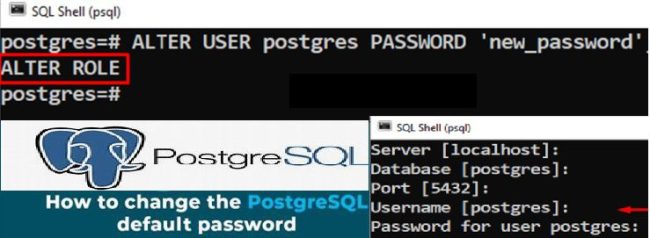
With a connection now established to Postgres at the psql prompt. Issue the ALTER USER command to change the password for the postgres user:

postgres=# ALTER USER postgres PASSWORD 'myPassword';
set postgresql password

Alternatively, you can execute the “ALTER ROLE” statement as shown below.

ALTER ROLE postgres PASSWORD 'my_new_password';
set the default postgresql user password

Please, see “Veeam backup for aws Processing postgres rds failed: No valid combination of the network settings was found for the worker configuration“, and how to upgrade Microsoft SQL Server 2019 to 2022

Exit the psql Shell

If successful, Postgres will output a confirmation of ALTER ROLE. Finally, exit the psql client by using the \q command.

postgres=# \q

The default PostgreSQL user now has a password associated with the account for use in your other applications.

Note: If you run into Trust authentication issues, you may have to modify the Postgres authentication config file (pg_hfa.conf).

I hope you found this article very useful on how to change the default user password in PostgreSQL. Please feel free to leave a comment below.

5/5 - (1 vote)

Thank you for reading this post. Kindly share it with others.

  • Share on X (Opens in new window) X
  • Share on Reddit (Opens in new window) Reddit
  • Share on LinkedIn (Opens in new window) LinkedIn
  • Share on Facebook (Opens in new window) Facebook
  • Share on Pinterest (Opens in new window) Pinterest
  • Share on Tumblr (Opens in new window) Tumblr
  • Share on Telegram (Opens in new window) Telegram
  • Share on WhatsApp (Opens in new window) WhatsApp
  • Share on Mastodon (Opens in new window) Mastodon
  • Share on Bluesky (Opens in new window) Bluesky
  • Share on Threads (Opens in new window) Threads
  • Share on Nextdoor (Opens in new window) Nextdoor
Oracle/MSSQL/MySQL Tags:Microsoft Windows, PostgreSQL, Windows 10, Windows 11, Windows Server 2016, Windows Server 2025

Post navigation

Previous Post: How to upgrade PostgreSQL Engine used by VBR
Next Post: Guide to Remote Desktop Connection Properties for Secure Access

Related Posts

  • Screenshot 2020 06 22 at 22.46.00
    How to use a dedicated MsSQL Db for Pleasant Password Oracle/MSSQL/MySQL
  • How to visualize MBAM Recovery Audit Report with Python
    Visualize MBAM Recovery Audit Report with Python Automation
  • Database Collation
    Change SQL Database Collation: ePO events DB and SQL server should match with ePO core collation Oracle/MSSQL/MySQL
  • Screenshot 2020 06 23 at 10.52.52
    How to uninstall Microsoft SQL Server on Windows Oracle/MSSQL/MySQL
  • xp cmdshell MSSQL
    How to verify whether the xp_cmdshell feature is enabled or disabled in MSSQL Server Oracle/MSSQL/MySQL
  • azure app service with office 365 and yammer sharepoint saturday florence 2015 session 8 638
    WordPress site on Azure: How to create a website hosted in Azure Oracle/MSSQL/MySQL

More Related Articles

Screenshot 2020 06 22 at 22.46.00 How to use a dedicated MsSQL Db for Pleasant Password Oracle/MSSQL/MySQL
How to visualize MBAM Recovery Audit Report with Python Visualize MBAM Recovery Audit Report with Python Automation
Database Collation Change SQL Database Collation: ePO events DB and SQL server should match with ePO core collation Oracle/MSSQL/MySQL
Screenshot 2020 06 23 at 10.52.52 How to uninstall Microsoft SQL Server on Windows Oracle/MSSQL/MySQL
xp cmdshell MSSQL How to verify whether the xp_cmdshell feature is enabled or disabled in MSSQL Server Oracle/MSSQL/MySQL
azure app service with office 365 and yammer sharepoint saturday florence 2015 session 8 638 WordPress site on Azure: How to create a website hosted in Azure Oracle/MSSQL/MySQL

Leave a Reply Cancel reply

You must be logged in to post a comment.

Microsoft MVP

VEEAMLEGEND

vexpert-badge-stars-5

Virtual Background

GoogleNews

Categories

veeaam100

Veeam Vanguard

  • jhgfx
    How to make Cortana use your default web browser such as Google Chrome Windows
  • article 1280x720.192a2586 1
    How to apply Windows Updates from WSUS to AWS Instances AWS/Azure/OpenShift
  • Snapshot Replication Failed
    Inbound connection Error: Failed to Perform Scheduled Replication [Part 2] Storage
  • SQL Error
    Fix “the server was not found or was not accessible: Verify that the instance name is correct and that SQL Server is configured to allow remote connections” Oracle/MSSQL/MySQL
  • windows 10 hert
    Windows Management Instrumentation Commands Scripts
  • upgrading Veeam BAckup and Replication to v13
    Upgrade Path and In-Place Upgrade for VBR v13 and Known Fixes Backup
  • microsoft ntlm2
    NT LAN Manager: How to prevent NTLM credentials from being sent to remote servers Security | Vulnerability Scans and Assessment
  • Synology Diskstaion update to latest version 7.3
    Download and update Synology DiskStation NAS to DSM 7.3 Storage

Subscribe to Blog via Email

Enter your email address to subscribe to this blog and receive notifications of new posts by email.

Join 1,796 other subscribers
  • RSS - Posts
  • RSS - Comments
  • About
  • Authors
  • Write for us
  • Advertise with us
  • General Terms and Conditions
  • Privacy policy
  • Feedly
  • Telegram
  • Youtube
  • Facebook
  • Instagram
  • LinkedIn
  • Tumblr
  • Pinterest
  • Twitter
  • mastodon

Tags

Active Directory Azure Bitlocker Microsoft Windows PowerShell WDS Windows 10 Windows 11 Windows Deployment Services Windows Server 2016

Copyright © 2025 TechDirectArchive

Loading Comments...

You must be logged in to post a comment.