Skip to content

TechDirectArchive

Hands-on IT, Cloud, Security, Veeam & DevOps

  • Home
  • About
  • Advertise With US
  • Reviews
  • Contact
  • Toggle search form

Resolve DISM unspecified error when removing preinstalled packages(Error code 15601)

Posted on 14/09/202030/09/2023 IT Expert By IT Expert No Comments on Resolve DISM unspecified error when removing preinstalled packages(Error code 15601)
  1. Home
  2. Windows Server
  3. Resolve DISM unspecified error when removing preinstalled packages(Error code 15601)
resolve DISM unspecified error

Deployment Image Servicing and Management (DISM) is a command-line tool that is used to mount and service Windows images before deployment. See the following guides for articles relating to WDS “how to install Dynamic Host Configuration Protocol on Windows Server 2019″, and “how to configure Post-deployment of Dynamic Host Configuration Protocol“. When prompted with the following error above, most times, you may find little or no information in the log file. Here are some possible errors you can encounter while resolving this issue Error 0xc1570103: The license file was not found in the specified path, and how to fix error 0xc1510114: The wim file needs to be remounted.

This error was prompted when I wanted to mount packages to install.wim file using DISM. 
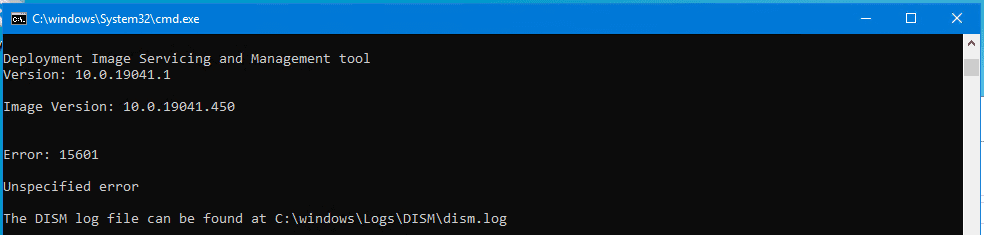
To resolve this DISM unspecified error, you would have to know what the meaning of the Error code: 15601 means. This error means
-ERROR_INSTALL_PACKAGE_NOT_FOUND
– 15601 (0x3CF1) Package was not found.

Solution: This could be due to the path not correct etc. Go through your script to have this issue corrected.
- You can also get this error if you wish to remove provisioned packages that are not available.

Run DISM to get features to see the package ID (GUID) name and compare this that has changed in the mounted image. See this article on how to get an application GUID. Also see, Application User Model ID: How to find the AUMID of an installed UWP App
– Note, These GUID changes from one Windows version to another. For a list of other Error Code, see the following link. See how to resolve “Error 740: Elevated permissions are required to run DISM“.

That’s how you can resolve DISM unspecified error. I hope you found this blog post helpful. If you have any questions, please let me know in the comment session.

Rate this post

Thank you for reading this post. Kindly share it with others.

  • Share on X (Opens in new window) X
  • Share on Reddit (Opens in new window) Reddit
  • Share on LinkedIn (Opens in new window) LinkedIn
  • Share on Facebook (Opens in new window) Facebook
  • Share on Pinterest (Opens in new window) Pinterest
  • Share on Tumblr (Opens in new window) Tumblr
  • Share on Telegram (Opens in new window) Telegram
  • Share on WhatsApp (Opens in new window) WhatsApp
  • Share on Mastodon (Opens in new window) Mastodon
  • Share on Bluesky (Opens in new window) Bluesky
  • Share on Threads (Opens in new window) Threads
  • Share on Nextdoor (Opens in new window) Nextdoor
Windows Server Tags:DISM, Microsoft Deployment Toolkit (MDT), WDS

Post navigation

Previous Post: Fix Error 0xc1420127: The specified image in the specified wim is already mounted for read and write access
Next Post: Error 0x80070002: When trying to mount an image file

Related Posts

  • image 1
    Install and License Devolutions Remote Desktop Manager on Mac Mac
  • maxresdefault
    The following errors occurred attempting to join the domain: The specified domain either does not exist or could not be contacted Windows Server
  • DC creation as recommended by Microsoft
    Setup a Domain Controller as Recommended by Microsoft Windows Server
  • Server Manager
    How to reinstall Server Manager and disable Server Manager at startup for all users and login users Windows Server
  • appp
    How to automatically reopen Windows Apps and Folders upon Startup Windows
  • recovery
    Perform System State Restore of Active Directory via Windows Server backup utility Windows Server

More Related Articles

image 1 Install and License Devolutions Remote Desktop Manager on Mac Mac
maxresdefault The following errors occurred attempting to join the domain: The specified domain either does not exist or could not be contacted Windows Server
DC creation as recommended by Microsoft Setup a Domain Controller as Recommended by Microsoft Windows Server
Server Manager How to reinstall Server Manager and disable Server Manager at startup for all users and login users Windows Server
appp How to automatically reopen Windows Apps and Folders upon Startup Windows
recovery Perform System State Restore of Active Directory via Windows Server backup utility Windows Server

Leave a Reply Cancel reply

You must be logged in to post a comment.

Microsoft MVP

VEEAMLEGEND

vexpert-badge-stars-5

Virtual Background

GoogleNews

Categories

veeaam100

Veeam Vanguard

  • Screenshot 1
    Using IBM Library with Veeam Network | Monitoring
  • Azure Virtual Desktop
    How to deploy Azure Virtual Desktop in Azure Portal Virtualization
  • image 36
    Keepalive Settings: Understanding keepalive configuration Linux
  • wds and dns l
    What happens when WDS and DNS are installed on the same Windows Server? DNS issues with WDS Windows Server
  • image 22
    How to clone a Windows Server running on VirtualBox Virtualization
  • WDSMDT
    What are the differences between MDT and WDS Windows Server
  • How to Activate Full-Screen (Kiosk Mode) in Internet Explorer Windows
  • Windows10 SCCM 20161
    What is ADK, MDT, Microsoft Endpoint Configuration Manager (SCCM), Intune, Autopilot, and WSUS Windows Server

Subscribe to Blog via Email

Enter your email address to subscribe to this blog and receive notifications of new posts by email.

Join 1,796 other subscribers
  • RSS - Posts
  • RSS - Comments
  • About
  • Authors
  • Write for us
  • Advertise with us
  • General Terms and Conditions
  • Privacy policy
  • Feedly
  • Telegram
  • Youtube
  • Facebook
  • Instagram
  • LinkedIn
  • Tumblr
  • Pinterest
  • Twitter
  • mastodon

Tags

Active Directory Azure Bitlocker Microsoft Windows PowerShell WDS Windows 10 Windows 11 Windows Deployment Services Windows Server 2016

Copyright © 2025 TechDirectArchive

Loading Comments...

You must be logged in to post a comment.