Skip to content

TechDirectArchive

Hands-on IT, Cloud, Security & DevOps Insights

  • Home
  • About
  • Advertise With US
  • Reviews
  • Contact
  • Toggle search form
Home » Linux » Linux Machine: Is it Virtual or a Physical server

Linux Machine: Is it Virtual or a Physical server

Posted on 11/10/202031/08/2023 Christian By Christian No Comments on Linux Machine: Is it Virtual or a Physical server
Virtualization technology

Sometimes, as a Linux Administrator, you want to know if a server you are working on remotely is a Physical device or a Virtual machine. This tutorial explains some simple command which will help you determine the nature of the machine you are working on.

SAMPLE 1  The dmidecode tool


This is the Desktop Management Interface table decoder and it retrieves comprehensive system information of your systems hardware components and presents it in a readable format.

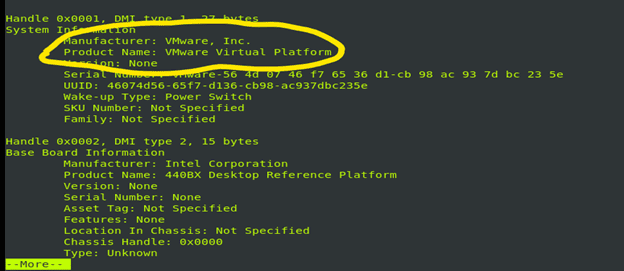
Below are two images from the command: sudo dmidecode | more

Server hardware
Hypervisor

You can download the dmidecode package from: https://centos.pkgs.org/6/centos-x86_64/dmidecode-2.12-7.el6.x86_64.rpm.html
– Other derivatives of the dmidecode command are:

Sudo dmidecode –s system-manufacturer
Cloud computing

My machine is a Virtual Machine. If it were a physical device, the output will be the name of the company that developed the device e.g. Dell Inc, Lenovo, Asus Inc.

Other virtualization tools exist such as innotek , which is German based company that develops Virtualbox.

sudo dmidecode –t system

Virtualization technology
sudo dmidecode | egrep -i 'manufacturer|product'
Hypervisor
sudo dmidecode -s system-product-name
Cloud computing

Their outputs will differ in format but they will tell the Physical or Virtual nature of the Linux machine.

SAMPLE 2 : hostnamectl
If you have system installed, hostnamectl is a very good good command to determine if the machine is physical or virtual.

Hotsnamectl status
Virtualization technology

SAMPLE 3 : Viewing the /sys/class/dmi/id/product_name using the cat command

cat /sys/class/dmi/id/product_name

Server hardware

However, this particular command has a certain peculiarity: a libvirt-kvm-VM will be displayed as Standard PC (i440fx +/PIIX) which is a common fingerprint for QEMU/KVM VITUAL virtual machines.

Another derivative of this command is;

pr –t /sys/class/dmi/id/sys-vendor/sys/class/dmi//id/product_name

Cloud computing

SAMPLE 4: Using the dmesg tool with the following command;

 Sudo dmesg | grep “Hypervisor detected” 

What this dmesg does is to control the kernel buffer. If the machine is virtual, the output will be something like the image below. If it is a physical device, the command will return nothing

SAMPLE 5: virt-what
You will need to install this utility. And the command is just that. If the machine is virtual, the output will look like the image below:

If the machine is physical, it will return nothing or exit the script with code0.

SAMPLE 6: lshw
This utility is included in the epel-release. if you don’t have it already, you need to install it and then install the lshw utility.

If this were a physical device, the output under the product tag will be the model of the device.

SAMPLE 7: systemd-detect-virt
This command is unique in a way in that it can tell the difference in the virtualization tehnology if the system is on a virtual machine

If this were a physical device, the output to the command will be none. However, if it is a virtual machine on VirtualBox, the output will be “Is it Virtual or a Physical server.

Rate this post

Thank you for reading this post. Kindly share it with others.

  • Share on X (Opens in new window) X
  • Share on Reddit (Opens in new window) Reddit
  • Share on LinkedIn (Opens in new window) LinkedIn
  • Share on Facebook (Opens in new window) Facebook
  • Share on Pinterest (Opens in new window) Pinterest
  • Share on Tumblr (Opens in new window) Tumblr
  • Share on Telegram (Opens in new window) Telegram
  • Share on WhatsApp (Opens in new window) WhatsApp
  • Share on Mastodon (Opens in new window) Mastodon
  • Share on Bluesky (Opens in new window) Bluesky
  • Share on Threads (Opens in new window) Threads
  • Share on Nextdoor (Opens in new window) Nextdoor
Linux Tags:Virtual Machine, VirtualBox, virtualization

Post navigation

Previous Post: How to pause a PowerShell script
Next Post: Keepalive Settings: Understanding keepalive configuration

Related Posts

  • systemd services
    How to use Systemd Timers on Linux Linux
  • FimageUbuntuUpgrade
    How to Upgrade From Ubuntu 20.04 LTS to 22.04 LTS Linux
  • AADSTS900144
    Fix AADSTS900144: The request body must contain the parameter Linux
  • ubuntu 1479782 1280
    Ubuntu Linux post installation of Network Properties, Guest Integration and Web Administration using Cockpit Linux
  • featureunions
    How to Install Unison on Linux System Linux
  • final tomcat feature
    How to install Apache Tomcat on Ubuntu Linux

More Related Articles

systemd services How to use Systemd Timers on Linux Linux
FimageUbuntuUpgrade How to Upgrade From Ubuntu 20.04 LTS to 22.04 LTS Linux
AADSTS900144 Fix AADSTS900144: The request body must contain the parameter Linux
ubuntu 1479782 1280 Ubuntu Linux post installation of Network Properties, Guest Integration and Web Administration using Cockpit Linux
featureunions How to Install Unison on Linux System Linux
final tomcat feature How to install Apache Tomcat on Ubuntu Linux

Leave a Reply Cancel reply

You must be logged in to post a comment.

Microsoft MVP

VEEAMLEGEND

vexpert-badge-stars-5

Virtual Background

GoogleNews

Categories

veeaam100

Veeam Vanguard

  • Featured image
    Latest Improvement to File Explorer on Windows 11 Windows
  • How To Upgrade Windows 11 Pro to Enterprise
    Upgrade Windows 11 Pro to Enterprise and vice Versa Windows
  • PIN9 1
    How to increase Windows PIN complexity Windows
  • Webp.net resizeimage 2
    Add or Remove Network Interface from a VM in Azure AWS/Azure/OpenShift
  • banner 2
    Why is Google moving from Universal Analytics (UA) property to GA4 property JIRA|Confluence|Apps
  • MBAM Reports
    Microsoft BitLocker Administration and Monitoring Report Fields Windows Server
  • FimageUbuntuUpgrade
    How to Upgrade From Ubuntu 20.04 LTS to 22.04 LTS Linux
  • How to Install Windows Admin Center on Windows 10 11​
    Install Windows Admin Center on Windows 10 and Windows 11 Windows

Subscribe to Blog via Email

Enter your email address to subscribe to this blog and receive notifications of new posts by email.

Join 1,811 other subscribers
  • RSS - Posts
  • RSS - Comments
  • About
  • Authors
  • Write for us
  • Advertise with us
  • General Terms and Conditions
  • Privacy policy
  • Feedly
  • Telegram
  • Youtube
  • Facebook
  • Instagram
  • LinkedIn
  • Tumblr
  • Pinterest
  • Twitter
  • mastodon

Tags

Active Directory Azure Bitlocker Microsoft Windows PowerShell WDS Windows 10 Windows 11 Windows Deployment Services Windows Server 2016

Copyright © 2025 TechDirectArchive


Loading Comments...
 

You must be logged in to post a comment.