Skip to content

TechDirectArchive

Hands-on IT, Cloud, Security & DevOps Insights

  • Home
  • About
  • Advertise With US
  • Reviews
  • Contact
  • Toggle search form
Home » Virtualization » Quarantine state in Windows Failover Clusters: How to resolve quarantined Cluster Node on Hyper-V
  • powershell01 1
    Create a self-signed certificate and export it in PFX format via PowerShell [Part 1] Scripts
  • How To Upgrade Windows 11 Pro to Enterprise
    Upgrade Windows 11 Pro to Enterprise and vice Versa Windows
  • telnet
    Could not open a connection to the host, on the port, connect failed Windows Server
  • Featured image batch file.
    Retrieve Recent Windows Update: How to create batch script files Scripts
  • Move Resources On Azure
    Move Azure Resources between Subscriptions AWS/Azure/OpenShift
  • Featured image 2
    How to delete Windows old folder in Windows 11 Windows
  • fix 0x00400d error
    Fix the request to add or remove features failed 0x00400d Windows Server
  • portainer feature
    How to Install Docker Portainer on Linux Containers

Quarantine state in Windows Failover Clusters: How to resolve quarantined Cluster Node on Hyper-V

Posted on 15/07/202110/04/2024 Christian By Christian 2 Comments on Quarantine state in Windows Failover Clusters: How to resolve quarantined Cluster Node on Hyper-V
Windows Failover Clusters

In this artilce, we shall discuss “Quarantine state in Windows Failover Clusters: How to resolve quarantined Cluster Node on Hyper-V”. Windows Server 2016 introduced some “Node states” and one of which is the Quarantine state. Please see  A boot image was not found for HyperV Virtual Machine, and Pass-Through Authentication Authentication and ADFS environment setup on Hyper-V for Hybrid Identity integration.

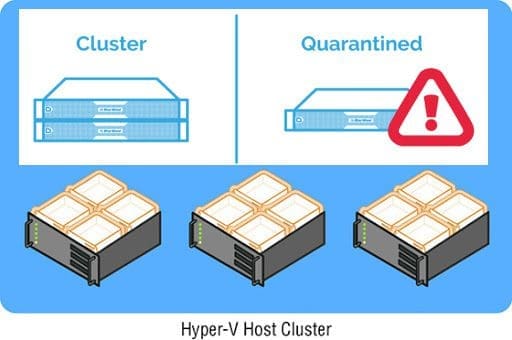
The Quarantined nodes are roles that are drained to other nodes in the cluster and they are not allowed to rejoin the cluster for about two hours.  The notion behind this is to stop failing nodes from bouncing up and down (flapping), joining, and leaving the cluster over and over again causing performance issues.

Here is the error message that is being generated "Cluster node '%1' has been quarantined. The node experienced '%2' consecutive failures within a short amount of time and has been removed from the cluster to avoid further disruptions. The node will be quarantined until '%3' and then the node will automatically attempt to re-join the cluster. Refer to the System and Application event logs to determine the issues on this node. When the issue is resolved, quarantine can be manually cleared to allow the node to rejoin with the 'Start-ClusterNode –ClearQuarantine' Windows PowerShell cmdlet. 

See the following guide on how to install and configure iSCSI Target Server and iSCSI Initiator on a Windows Server, Below are some related HyperV guides: HyperV – Unable to create a new VM, Unable to shutdown a HyperV Virtual Machine, Backup: How to create a HyperV checkpoint, and Unable to PXE boot a HyperV VM: F12 key does not work anymore, 

Enhancing Virtual Machine Resilience: Understanding the Quarantine Feature in WS 2016

As discussed before, this is a new feature which was implemented in WS 2016 and relates to Virtual Machine Compute Resiliency. Basically, after 3 failure events, the problem node becomes quarantined instead of isolated. QuarantineThreshold is configurable meaning, by default, it is 3.

During cluster flapping, the cluster restricts quarantining to a maximum of 25% nodes.  The exception to this rule is if you have a 2 or 3 node cluster. In that case, the cluster will allow quarantining one node.

The screenshot below displays: Node Name – %1, Consecutive cluster membership losses – %2, Automatic quarantine clearance time – %3. For all Failover Clustering system log events.

Quarantine Cluster Node

In cluster events, you can see the following event details.

When the node experience disruption three (3) times which is the default value of QuarantineThreshold within consecutive failures in an hour.The cluster removes the node to prevent disruptions and provides an automatic quarantine clearance timestamp.

Solution to resolve quarantined Cluster Node on Hyper-V

To view force clear a quarantined node, we can use the Failover Cluster Manager or PowerShell as shown below.

Failover Cluster

Click on the Node as shown below, right click on the Quanrantined node and select “More Actions” and Click on Start Cluster Service.

Hyper-V

Power Shell

You can also clear the Quantine node via the PowerShell with the following command below. View and change the default 2-hour setting using PowerShell commands.

Import-Module FailoverClusters Start-ClusterNode –ClearQuarantine
Screenshot-2021-07-13-at-02.49.51

I hope you found this blog post on “Quarantine state in Windows Failover Clusters: How to resolve quarantined Cluster Node on Hyper-V” helpful. Furthermore, If you have any questions, please let me know in the comment session.

Rate this post

Thank you for reading this post. Kindly share it with others.

  • Share on X (Opens in new window) X
  • Share on Reddit (Opens in new window) Reddit
  • Share on LinkedIn (Opens in new window) LinkedIn
  • Share on Facebook (Opens in new window) Facebook
  • Share on Pinterest (Opens in new window) Pinterest
  • Share on Tumblr (Opens in new window) Tumblr
  • Share on Telegram (Opens in new window) Telegram
  • Share on WhatsApp (Opens in new window) WhatsApp
  • Share on Pocket (Opens in new window) Pocket
  • Share on Mastodon (Opens in new window) Mastodon
  • Share on Bluesky (Opens in new window) Bluesky
  • Share on Threads (Opens in new window) Threads
  • Share on Nextdoor (Opens in new window) Nextdoor
Virtualization Tags:Microsoft Windows, Windows 10, Windows Server 2016

Post navigation

Previous Post: Install and configure iSCSI Target Server and iSCSI Initiator on a Windows Server
Next Post: Domain Name System: How to create a DNS record

Related Posts

  • VM Disk
    Initialize and format a virtual disk: How to add and remove a new virtual disk from a VM on VMware Workstation Virtualization
  • MAP virtual disk error
    Install Workstation Pro 17: Fix failed to initialise library for mounting and unmounting virtual disks Virtualization
  • Docker Guide
    Pull and Deploy Nginx Container Images from Docker Hub AWS/Azure/OpenShift
  • vSwitches
    vSwitches: How to delete Virtual Switches from Hyper-V Virtualization
  • Amazon EC2 and S3
    How to sync S3 Bucket with an EC2 instance AWS/Azure/OpenShift
  • sandbox
    How to Configure Windows Sandbox Virtualization

More Related Articles

VM Disk Initialize and format a virtual disk: How to add and remove a new virtual disk from a VM on VMware Workstation Virtualization
MAP virtual disk error Install Workstation Pro 17: Fix failed to initialise library for mounting and unmounting virtual disks Virtualization
Docker Guide Pull and Deploy Nginx Container Images from Docker Hub AWS/Azure/OpenShift
vSwitches vSwitches: How to delete Virtual Switches from Hyper-V Virtualization
Amazon EC2 and S3 How to sync S3 Bucket with an EC2 instance AWS/Azure/OpenShift
sandbox How to Configure Windows Sandbox Virtualization

Comments (2) on “Quarantine state in Windows Failover Clusters: How to resolve quarantined Cluster Node on Hyper-V”

  1. Avatar photo Nitin Pandey says:
    01/03/2022 at 11:11 AM

    Nicely explained. Thanks mate.

    Log in to Reply
    1. chris Christian says:
      12/03/2022 at 7:20 AM

      You are welcome!

      Log in to Reply

Leave a Reply Cancel reply

You must be logged in to post a comment.

Microsoft MVP

VEEAMLEGEND

vexpert-badge-stars-5

Virtual Background

GoogleNews

Categories

veeaam100

sysadmin top30a

  • powershell01 1
    Create a self-signed certificate and export it in PFX format via PowerShell [Part 1] Scripts
  • How To Upgrade Windows 11 Pro to Enterprise
    Upgrade Windows 11 Pro to Enterprise and vice Versa Windows
  • telnet
    Could not open a connection to the host, on the port, connect failed Windows Server
  • Featured image batch file.
    Retrieve Recent Windows Update: How to create batch script files Scripts
  • Move Resources On Azure
    Move Azure Resources between Subscriptions AWS/Azure/OpenShift
  • Featured image 2
    How to delete Windows old folder in Windows 11 Windows
  • fix 0x00400d error
    Fix the request to add or remove features failed 0x00400d Windows Server
  • portainer feature
    How to Install Docker Portainer on Linux Containers

Subscribe to Blog via Email

Enter your email address to subscribe to this blog and receive notifications of new posts by email.

Join 1,834 other subscribers
  • RSS - Posts
  • RSS - Comments
  • About
  • Authors
  • Write for us
  • Advertise with us
  • General Terms and Conditions
  • Privacy policy
  • Feedly
  • Telegram
  • Youtube
  • Facebook
  • Instagram
  • LinkedIn
  • Tumblr
  • Pinterest
  • Twitter
  • mastodon

Tags

Active Directory AWS Azure Bitlocker Microsoft Windows PowerShell WDS Windows 10 Windows 11 Windows Server 2016

Copyright © 2025 TechDirectArchive


Loading Comments...
 

You must be logged in to post a comment.