Skip to content

TechDirectArchive

Hands-on IT, Cloud, Security & DevOps Insights

  • Home
  • About
  • Advertise With US
  • Contact
  • Reviews
  • Toggle search form
Home » Virtualization » vSwitches: How to delete Virtual Switches from Hyper-V
  • Featured image new 1
    Detect if an application was uninstalled on Windows: Find out who has uninstalled an application via Windows Event Viewer Windows
  • ChatGPT on Linux
    Set Up and Use ChatGPT in Linux Terminal Linux
  • vmware
    Windows Startup Error: VMware Status 0xc000014c – Missing Boot Data Windows
  • screenshot 2020 03 21 at 22.44.04 1
    How to create a Microsoft HyperV checkpoint Virtualization
  • docker desktop 1
    Failed to remove network for build: Error during connect in the default daemon configuration on Windows, the Docker client must be run with elevated privileges Containers
  • Featured image IE mode.
    How to Enable Internet Explorer Mode in Edge in Windows 11 Windows
  • Featured image 2
    Microsoft Account Password Reset via Web and Windows Windows
  • Slide2 1
    Create and Delete AD DS Partition with NTDSUTIL.EXE Windows Server

vSwitches: How to delete Virtual Switches from Hyper-V

Posted on 16/07/202131/08/2023 Christian By Christian No Comments on vSwitches: How to delete Virtual Switches from Hyper-V
vSwitch management

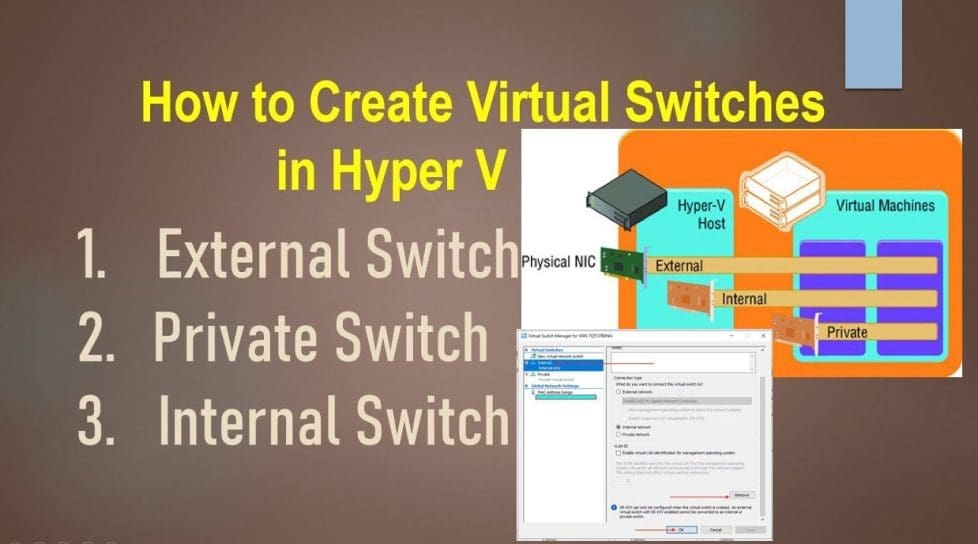
Virtual Switch (vSwitch) are software constructs that are responsible for receiving and transmitting Ethernet frames into and out of their assigned virtual machine or the management operating system. vSwitch allows communication between virtual machines and they d not just forward packets, they also intelligently direct the communication on a network by checking packets before moving them to a destination. Kindly refer to the following related guides: How to install and configure iSCSI Target Server and iSCSI Initiator on a Windows Server, and how to install and Configure Hyper-V on Windows Server on Windows Server 2019, and 2022 via the Server Manager, PowerShell or DISM.

vSwitch Modes for the Hyper-V: The Hyper-V virtual switch presents three different operational modes.

- Private Virtual Switch: A Hyper-V virtual switch in private mode allows communications only between virtual adapters connected to virtual machines.
- Internal Virtual Switch: A Hyper-V virtual switch in internal mode allows communications only between virtual adapters connected to virtual machines and the management operating system.
- External Virtual Switch: A Hyper-V virtual switch in external mode allows communications between virtual adapters connected to virtual machines and the management operating system. It uses single or teamed physical adapters to connect to a physical switch, thereby allowing communications with other systems.

Kindly refer to the following guides: Why does the legacy PXE not does work on Generation 2 VM, How to set up a VM via PXE boot on a Generation 1 VM, and Generation 2 VM: How to set up a Hyper-V Virtual Machine through PXE boot.

Virtual Machine Network Adapters

The most prevalent virtual network adapters are found in virtual machines and they can be seen in both PowerShell (Get-VMNetworkAdapter) and in Hyper-V Manager’s GUI.
– Furthermore, To delete Virtual Switches from Hyper-V, kindly follow the same steps used in creating vSwitches. To do this, launch the Server Manager, click on Tools and click on the Hyper-V Manager as shown below.

Hyper-V network

However, Click on the Virtual Switch Manager as shown below to proceed.

Virtual switch removal

This will open the Virtual Switch Manager for the server. Under the Virtual Switches, click on the External vSwitch and click on Remove.

Hyper-V networking

As you can see, the virtual switch is being deleted. The External vSwitch is deleted.

vSwitch management

To delete the Internal vSwitch, click on the Internal vSwitch and click on Remove.

Hyper-V network

To delete the Private Switch, select the Private vSwitch and click on Remove as shown below.

Screenshot-2021-07-12-at-23.10.18

In the Virtual Switch Properties window, click on External and click on Ok as shown below.

Screenshot-2021-07-12-at-23.21.16

In the Apply Networking change window, click on YES as shown below. Afterward, a new dialog window will appear showing the settings are being applied.

Screenshot-2021-07-12-at-23.41.11-1024x843-1

I hope you found this blog post helpful. If you have any questions, please let me know in the comment session.
Rate this post

Thank you for reading this post. Kindly share it with others.

  • Share on X (Opens in new window) X
  • Share on Reddit (Opens in new window) Reddit
  • Share on LinkedIn (Opens in new window) LinkedIn
  • Share on Facebook (Opens in new window) Facebook
  • Share on Pinterest (Opens in new window) Pinterest
  • Share on Tumblr (Opens in new window) Tumblr
  • Share on Telegram (Opens in new window) Telegram
  • Share on WhatsApp (Opens in new window) WhatsApp
  • Share on Pocket (Opens in new window) Pocket
  • Share on Mastodon (Opens in new window) Mastodon
  • Share on Bluesky (Opens in new window) Bluesky
  • Share on Threads (Opens in new window) Threads
  • Share on Nextdoor (Opens in new window) Nextdoor
Virtualization Tags:Microsoft Windows, Windows 10, Windows Server 2016

Post navigation

Previous Post: Failover Cluster Manager failed while managing one or more clusters, the error was unable to determine if the computer exists in the domain
Next Post: DNS Bad key 9017: The Cluster Name registration failed of one or more associated DNS names

Related Posts

  • proxmox
    Clone a Proxmox Container: CT Restoration Guide Virtualization
  • Delete VM and Storage in Proxmox
    How to delete a VM and Storage in Proxmox Virtualization
  • Proxmox 9
    How to update Proxmox VE 9.0 now Supported by Veeam Virtualization
  • Burn ISO on MAC   Proxmox installation
    Create a bootable USB on Mac: Proxmox VE Setup Virtualization
  • Clone SysPrep
    Clone and Sysprep a Windows Server running on a VMware Workstation Virtualization
  • Proxmox Installation
    Install Proxmox VE on a Beelink EQ12 Mini PC Virtualization

More Related Articles

proxmox Clone a Proxmox Container: CT Restoration Guide Virtualization
Delete VM and Storage in Proxmox How to delete a VM and Storage in Proxmox Virtualization
Proxmox 9 How to update Proxmox VE 9.0 now Supported by Veeam Virtualization
Burn ISO on MAC   Proxmox installation Create a bootable USB on Mac: Proxmox VE Setup Virtualization
Clone SysPrep Clone and Sysprep a Windows Server running on a VMware Workstation Virtualization
Proxmox Installation Install Proxmox VE on a Beelink EQ12 Mini PC Virtualization

Leave a Reply Cancel reply

You must be logged in to post a comment.

Microsoft MVP

VEEAMLEGEND

vexpert-badge-stars-5

Virtual Background

GoogleNews

Categories

veeaam100

sysadmin top30a

  • Featured image new 1
    Detect if an application was uninstalled on Windows: Find out who has uninstalled an application via Windows Event Viewer Windows
  • ChatGPT on Linux
    Set Up and Use ChatGPT in Linux Terminal Linux
  • vmware
    Windows Startup Error: VMware Status 0xc000014c – Missing Boot Data Windows
  • screenshot 2020 03 21 at 22.44.04 1
    How to create a Microsoft HyperV checkpoint Virtualization
  • docker desktop 1
    Failed to remove network for build: Error during connect in the default daemon configuration on Windows, the Docker client must be run with elevated privileges Containers
  • Featured image IE mode.
    How to Enable Internet Explorer Mode in Edge in Windows 11 Windows
  • Featured image 2
    Microsoft Account Password Reset via Web and Windows Windows
  • Slide2 1
    Create and Delete AD DS Partition with NTDSUTIL.EXE Windows Server

Subscribe to Blog via Email

Enter your email address to subscribe to this blog and receive notifications of new posts by email.

Join 1,834 other subscribers
  • RSS - Posts
  • RSS - Comments
  • About
  • Authors
  • Write for us
  • Advertise with us
  • General Terms and Conditions
  • Privacy policy
  • Feedly
  • Telegram
  • Youtube
  • Facebook
  • Instagram
  • LinkedIn
  • Tumblr
  • Pinterest
  • Twitter
  • mastodon

Tags

Active Directory AWS Azure Bitlocker Microsoft Windows PowerShell WDS Windows 10 Windows 11 Windows Server 2016

Copyright © 2025 TechDirectArchive


Loading Comments...
 

You must be logged in to post a comment.