Adding Registry Keys via DISM in Windows involves modifying the default Windows install image, the install.wim file, which includes servicing an offline image, mounting an image, and committing changes made to the image. The offline image is serviced using DISM (Deployment Image Servicing and Management), a native Windows program. DISM is a command-line program for servicing and preparing Windows images, including those needed for Windows Preinstallation Environment (PE), Windows Recovery Environment (RE), and Windows Setup.
Please see: Install Wim: How to Add Packages to Windows image the DISM Tool and Remove Windows 10 Apps with DISM: How to remove pre-provisioned apps from Windows Image.
Using the DISM command options in Windows, you can not only manage registry keys but also make impactful changes. Add Registry Keys via DISM in Windows to modify drivers, install language packs for multilingual Windows, and ensure your installation stays updated with Windows Updates.
Here are other related guides: Install Wim: How to Add Packages to Windows image the DISM Tool, Remove Windows 10 Apps with DISM: How to remove pre-provisioned apps from Windows Image, for common DISM errors see: Error 183: The specified image is currently being serviced by another DISM operation, and DISM Error 87: The package is unknown.
In this guide, I will show you how to service or modify the Windows Registry on an offline image. I will be using a Windows 11 ISO image file in this example, but the technique is the same whether you use a Windows 10 ISO image.
Step 1: Adding Registry Keys via DISM in Windows for Offline Image Mounting
Extract the ISO image to a folder and name it whatever you want.

In this example, after extracting, I move it to the root folder on disk C: and name the folder ISO.

Alternatively, you can Add Registry Keys via DISM in Windows by mounting a Windows ISO image as a virtual DVD. Begin by double-clicking, opening the ISO in Explorer. Select all, then copy and paste content into the ISO folder.
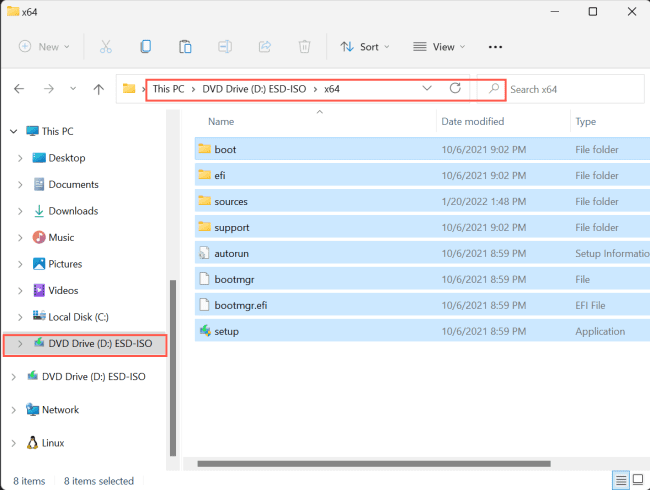
If you have Windows install media on a USB flash drive, no need for the steps above.
Craft a dedicated space for the offline image by setting up a directory. I creatively made a ‘Mount’ folder in C:\Mount. This is crucial when exploring Adding Registry Keys via DISM in Windows.

Open the Windows Start Menu and search for PowerShell, then run as administrator.

Enter the following command to check what editions are included in the image:
Dism /Get-WimInfo /WimFile:C:\ISO\Sources\install.wim

Add Registry Keys via DISM in Windows: Note your chosen PRO edition’s index number (e.g., 6) for registry editing.
Mount the image of your preferred Windows edition using its index number, index 6 in this example:
Dism /Mount-Wim /WimFile:C:\ISO\Sources\install.wim /index:6 /MountDir:C:\Mount

The mounting image process will take some time to complete. You can check the Mount folder in C: Mount to see the offline image files.

Please keep in mind that the disk where the Mount folder is situated requires some free space. It is recommended to utilize a machine with a disk that has more than 15 GB of free space.
Step 2: Add Registry Keys via DISM in Windows: Offline Registry Editing
To edit an offline registry hive, first import it to a temporary hive in your host registry. In this example, I will import the HKLM\Hardware hive from the offline registry to a temporary hive called OFFLINE in the host registry:
reg load HKLM\OFFLINE C:\Mount\Windows\System32\Config\Hardware

The command above creates a new hive HKLM\OFFLINE in the host registry and imports the HKLM\HARDWARE hive from the offline image into it. You can import SOFTWARE, DEFAULT, DRIVERS, SAM, or SYSTEM hives.
To see the changes, open the Windows Start Menu and search for Registry Editor, then run as administrator on the host computer.
You will notice it now contains a temporary hive HKLM\HARDWARE\OFFLINE:

Step 3: Commit (save) changes
When you’re ready to apply the changes made through Add Registry Keys via DISM in Windows, use the following command to unload the temporary hive:
reg unload HKLM\OFFLINE

The Add Registry Keys via DISM in Windows process involves unloading the temporary hive from the host registry.

Unmount the offline image and commit (save) changes using the following command:
Dism /Unmount-Image /MountDir:C:\mount /Commit

The /Commit switch saves all modifications to the install.wim file. You’re done if you were using a Windows image on an USB drive. You may now install Windows, which includes your modification by default. If you were using an image transferred from an ISO image to an ISO folder, you can now make a new ISO with your preferred utility.
I trust you found this guide on how to add registry keys via DISM in Windows valuable. If you have any questions, please feel free to share in the comment section.