Skip to content

TechDirectArchive

Hands-on IT, Cloud, Security, Veeam & DevOps

  • Home
  • About
  • Advertise With US
  • Reviews
  • Contact
  • Toggle search form

How to enable and use Diagnostic Data Viewer on Windows

Posted on 23/07/202216/08/2026 Temitope Odemo By Temitope Odemo No Comments on How to enable and use Diagnostic Data Viewer on Windows
  1. Home
  2. Windows
  3. How to enable and use Diagnostic Data Viewer on Windows
diagnostic6

Whether you are using Windows 11 or Windows 10 you may not be aware that Microsoft has a diagnostic system on your computer to collect diagnostic data for your system. But it is very important to know some of the diagnostic data that is collected from your computer which is why Microsoft released a new tool called Diagnostic Data Viewer. In this article, you will learn how to enable and use Diagnostic Data Viewer on Windows. Please see how to prevent your computers from sending Diagnostics & feedback off via Windows Settings and Group Policy.

This tool will help you with all the information you need concerning the diagnostic data that is sent to the Microsoft server directly from your computer. Here is a YouTube video on how to Enable and Use Diagnostic Data Viewer on Windows.

Read this if you want to know How to Delete Diagnostic Data in Windows 10 and Windows 11, Microsoft Support Diagnostic Tool Vulnerability Fix, and how to “Prevent your PC from sending Diagnostics Feedback off via Windows Settings and Group Policy“.

View the diagnostic data that Microsoft collects 

Some of the data sent to Microsoft are information about installed software, drivers, hardware configuration and showing their compatibility. This information helps Microsoft improve the user experience on their operating system.

If you want access to this Diagnostic Data Viewer then you need to enable it.

Enable and use Diagnostic Data Viewer

Follow this steps on how to enable and use Diagnostic Data Viewer

1: Go to your computer setting and search for Diagnostics & feedback. Toggle the View diagnostic data button to ON. Click on the Open Diagnostic Data Viewer to launch the Microsoft Store.

image-30
Diagnostic and Feedback

If you want to read more on some diagnostic tools you can read these: Workaround for Microsoft Support Diagnostic Tool Vulnerability, How to Improve Website Response using Traffic Manager, Setup up WatchGuard Log and Report Server in a VM, How to setup WatchGuard Log Server.

Download Diagnostic Data Viewer

2. Click Get in the Microsoft Store to download and install the Diagnostic Data Viewer. After installation click on Open.

image-31
Diagnostic Data Viewer

Note: Diagnostic Data Viewer stores a history of diagnostic data sent by your Windows device. Events are removed starting with the oldest once either the storage size or storage time capacity is reached.

3. You can see the diagnostic data below. It is very easy for you to analyze this data by exporting all your diagnostic data as a CSV file.

image-32
Diagnostic Data

Please see how to restrict additional Microsoft Support Diagnostic Tool download in Windows. Also, see Azure Virtual Machines: Windows Admin Center & Serial Console

Use the filter icon

4. You can click on the filter icon so that you can filter the type of data you want to view.
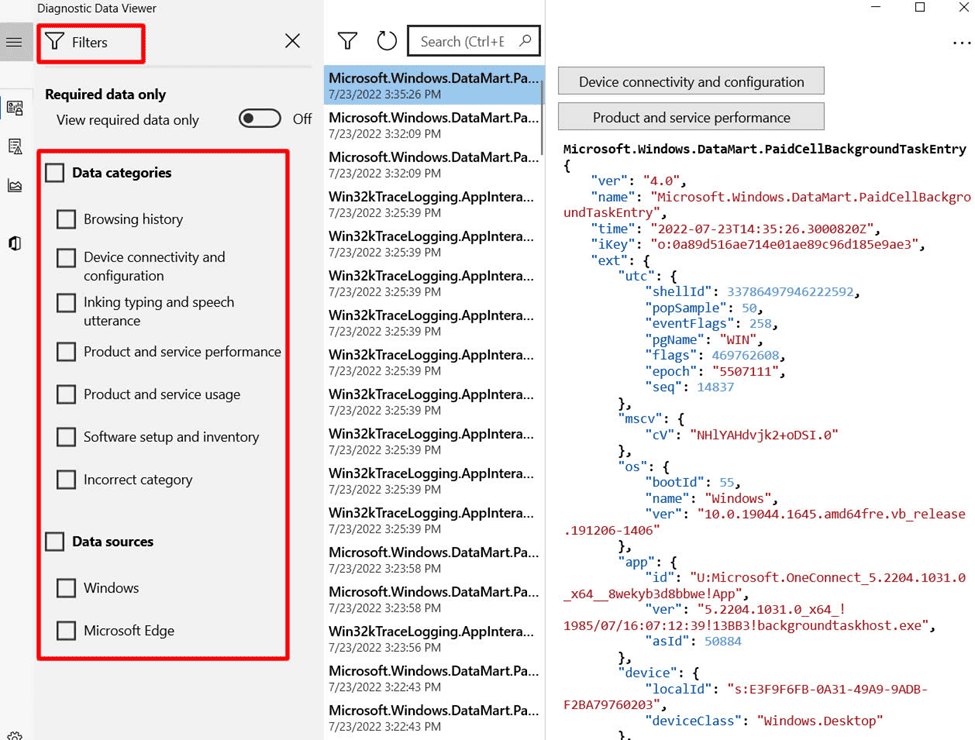
image-33
Diagnostic Data Filter

5. The CSV file contains the time stamp. The name of the log captured, and the JSON that shows all the data sent to Microsoft

image-34
CSV File

Please see How to run Windows Memory Diagnostics Tool on Windows. Also, see how to Install Windows Admin Center on Windows 10 and Windows 11, and “How to restrict additional Microsoft Support Diagnostic Tool Downloads on Windows“.

I hope you found this blog post on how to enable and use Diagnostic Data Viewer on Windows Interesting and helpful. In case you have any questions do not hesitate to ask in the comment section.

Thank you for reading this post. Kindly share it with others.

  • Share on X (Opens in new window) X
  • Share on Reddit (Opens in new window) Reddit
  • Share on LinkedIn (Opens in new window) LinkedIn
  • Share on Facebook (Opens in new window) Facebook
  • Share on Pinterest (Opens in new window) Pinterest
  • Share on Tumblr (Opens in new window) Tumblr
  • Share on Telegram (Opens in new window) Telegram
  • Share on WhatsApp (Opens in new window) WhatsApp
  • Share on Mastodon (Opens in new window) Mastodon
  • Share on Bluesky (Opens in new window) Bluesky
Windows Tags:data, Event Viewer, Microsoft Windows, Windows 10, Windows 11, Windows Server 2016

Post navigation

Previous Post: How to update the BIOS on your Dell system
Next Post: How to Delete Diagnostic Data in Windows 10 and Windows 11

Related Posts

  • Use PowerShell to View and Change BIOS Settings
    Use PowerShell to View and Change BIOS Settings Windows
  • Error 1069 Windows could not start
    Fix Error 1069: Windows could not start the Veeam backup service on local computer Backup
  • Featured Image 1
    How to enable or disable a Remote WMI Connection in Windows Windows
  • Secure Web Server
    How to secure a Web Server on a Windows VM in Azure using TLS/SSL Certificates Saved in Azure Key Vault AWS/Azure/OpenShift
  • sd 1
    How to link your Android or iPhone to your Windows PC Windows
  • Cyclic Redundancy
    Cyclic Redundancy: Resolve Data Error on Inaccessible Hard Drive Windows

More Related Articles

Use PowerShell to View and Change BIOS Settings Use PowerShell to View and Change BIOS Settings Windows
Error 1069 Windows could not start Fix Error 1069: Windows could not start the Veeam backup service on local computer Backup
Featured Image 1 How to enable or disable a Remote WMI Connection in Windows Windows
Secure Web Server How to secure a Web Server on a Windows VM in Azure using TLS/SSL Certificates Saved in Azure Key Vault AWS/Azure/OpenShift
sd 1 How to link your Android or iPhone to your Windows PC Windows
Cyclic Redundancy Cyclic Redundancy: Resolve Data Error on Inaccessible Hard Drive Windows

Leave a Reply Cancel reply

You must be logged in to post a comment.

Microsoft MVP

vexpert-badge-stars-5

Virtual Background

VEEAMLEGEND

Categories

veeaam100

Veeam Vanguard

  • Perform slfservice rBitLocker recovery
    Resolve Invalid Key ID when requesting BitLocker Recovery Key Windows
  • image 81
    How to Deploy Dynamic Website to AWS EC2 AWS/Azure/OpenShift
  • screenshot 2020 03 07 at 22.25.21
    How to configure the FrontFace Lockdown Tool Windows
  • Screenshot 2020 11 17 at 02.06.58
    The PA Server Monitor review and product details Reviews
  • Burn ISO on MAC Proxmox installation
    Create a bootable USB on Mac: Proxmox VE Setup Virtualization
  • The evolution of Windows authentication NTLM to Keberos
    Bidding Farewell to NTLM in favour of Kerberos Windows
  • connect GitHub and Build a CI:CD Pipeline with Vercel
    How to connect GitHub and Build a CI/CD Pipeline with Vercel Version Control System
  • Remote Desktop 2 1
    How to install RDS via Quick Start Deployment: Install, Publish, Update, and Uninstall Remote Desktop Web Client Web Server

Subscribe to Blog via Email

Enter your email address to subscribe to this blog and receive notifications of new posts by email.

Join 1,759 other subscribers
  • RSS - Posts
  • RSS - Comments
  • About
  • Authors
  • Write for us
  • Contact
  • Advertise with us
  • General Terms and Conditions
  • Privacy policy
  • Feedly
  • Telegram
  • Youtube
  • Facebook
  • Instagram
  • LinkedIn
  • Tumblr
  • Pinterest
  • Twitter
  • mastodon
  • Bsky

Tags

Active Directory Azure Bitlocker Microsoft Windows PowerShell WDS Windows 10 Windows 11 Windows Deployment Services Windows Server 2016

Copyright © 2026 TechDirectArchive

Loading Comments...

You must be logged in to post a comment.