Skip to content

TechDirectArchive

Hands-on IT, Cloud, Security, Veeam & DevOps

  • Home
  • About
  • Advertise With US
  • Reviews
  • Tech News
  • Contact
  • Toggle search form

How to Create Shared Folder in Windows Sandbox

Posted on 20/08/202322/01/2024 Temitope Odemo By Temitope Odemo No Comments on How to Create Shared Folder in Windows Sandbox
  1. Home
  2. Virtualization
  3. How to Create Shared Folder in Windows Sandbox
banner-1

One feature that I personally like from Microsoft is the Windows Sandbox which comes with the latest Windows 10 update. The value of this sandbox cannot be under-emphasized as it allows you to launch your Windows in a virtual environment so that you can test any untrusted applications before installing them on your system or where you can access some malicious websites. Though any changes you make to the sandbox get lost immediately you close the feature, but it keeps the system safe and secure from malicious attacks.

You can enable Windows Sandbox through the Windows Features and there is no difficulty in setting it up, but you can read How to Configure Windows Sandbox and How to Use Windows Sandbox as a security feature in Windows. Immediately you enable this feature you can launch it from the Start menu and you are ready to use it.

But there will always be instances of sharing files between the host and Windows Sandbox, you have the opportunity to create a shared folder in Windows Sandbox, and the shared folder will give you control over how and which files needed to be shared. In this guide, I will show you How to Create Shared Folder in Windows Sandbox.

You can also read about how to Create and access a hidden share folder on Windows.

Create Shared Folder in Windows Sandbox

Follow these steps on How to Create Shared Folder in Windows Sandbox

1: Create a folder and create a text file with any name but you must replace the .txt extension with .wsb.

wsb-file

2. Right-click on the .wsb file and open it with Notepad or any file editor.

open-with-notepad

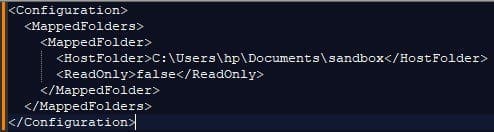
3. Copy the below code and paste it into the file editor and add the folder path to the code.
Shared-Folder-Code

4. You can make the folder to be read-only by changing the false value to true.

Shared-Folder-read-only-Code

5. After adding the code save the file and close it. Now double-click on the .wsb file to launch Windows Sandbox.

You will see the Shared Folder icon on the Windows Sandbox desktop and you can start adding other files you want to share between the host and the windows sandbox.

Start-sharing-file

I hope you found this blog post on How to Create Shared Folder in Windows Sandbox. Interesting and helpful. In case you have any questions do not hesitate to ask in the comment section.


Rate this post

Thank you for reading this post. Kindly share it with others.

  • Share on X (Opens in new window) X
  • Share on Reddit (Opens in new window) Reddit
  • Share on LinkedIn (Opens in new window) LinkedIn
  • Share on Facebook (Opens in new window) Facebook
  • Share on Pinterest (Opens in new window) Pinterest
  • Share on Tumblr (Opens in new window) Tumblr
  • Share on Telegram (Opens in new window) Telegram
  • Share on WhatsApp (Opens in new window) WhatsApp
  • Share on Mastodon (Opens in new window) Mastodon
  • Share on Bluesky (Opens in new window) Bluesky
  • Share on Threads (Opens in new window) Threads
  • Share on Nextdoor (Opens in new window) Nextdoor
Virtualization, Windows Tags:Folder, sandboxing solutions, Windows 10, Windows 11, Windows Server 2016

Post navigation

Previous Post: Mendeley Cite ECITE40001 Error: Fix issue using Microsoft Word Desktop application
Next Post: Why is Google moving from Universal Analytics (UA) property to GA4 property

Related Posts

  • Screenshot 2022 04 27 at 02.18.50
    Why does MBAM not automatically re-encrypt MBAM or Bitlocker-protected devices? Windows
  • Featured Image Windows Security
    How to protect your Windows PC from potentially unwanted applications Security | Vulnerability Scans and Assessment
  • unnamed
    Remove Xbox from automatic startup: How to enable and disable automatic startup in Windows 11 Windows
  • Featured image BitLocker AES XTX 256
    Enable BitLocker AES-XTX 256 Encryption Security | Vulnerability Scans and Assessment
  • Disable BitLocker
    Disable BitLocker: How to correctly disable MBAM-encrypted devices Windows
  • LDAP
    LDAP: What is Lightweight Directory Access Protocol Windows

More Related Articles

Screenshot 2022 04 27 at 02.18.50 Why does MBAM not automatically re-encrypt MBAM or Bitlocker-protected devices? Windows
Featured Image Windows Security How to protect your Windows PC from potentially unwanted applications Security | Vulnerability Scans and Assessment
unnamed Remove Xbox from automatic startup: How to enable and disable automatic startup in Windows 11 Windows
Featured image BitLocker AES XTX 256 Enable BitLocker AES-XTX 256 Encryption Security | Vulnerability Scans and Assessment
Disable BitLocker Disable BitLocker: How to correctly disable MBAM-encrypted devices Windows
LDAP LDAP: What is Lightweight Directory Access Protocol Windows

Leave a Reply Cancel reply

You must be logged in to post a comment.

Microsoft MVP

VEEAMLEGEND

vexpert-badge-stars-5

Virtual Background

GoogleNews

Categories

veeaam100

Veeam Vanguard

  • doc register profile 1
    How to Remove a profile on outlook Network | Monitoring
  • ESNAS Virtualization 01
    How to remove Recent vSphere Client Connections Virtualization
  • Featured image
    Tamper Protection for Microsoft Defender on Windows 10 [Part 1] Security | Vulnerability Scans and Assessment
  • microsoft edge
    How to configure static page in Microsoft Edge browser via Local Group Policy on Windows Windows
  • Active Directory migration
    Migrate Active Directory Domain and Forest with Veeam Replica Backup
  • Featured image Some Settings are managed by your organization
    How to Fix “Some Settings Are Managed by Your Organization” Error in Windows Update Windows
  • Bulk operations in Azure AD
    Perform Bulk User Operations in Azure AD AWS/Azure/OpenShift
  • screenshot 2020 02 08 at 17.31.28
    How to perform Password Change with OWA Network | Monitoring

Subscribe to Blog via Email

Enter your email address to subscribe to this blog and receive notifications of new posts by email.

Join 1,768 other subscribers
  • RSS - Posts
  • RSS - Comments
  • About
  • Authors
  • Write for us
  • Advertise with us
  • General Terms and Conditions
  • Privacy policy
  • Feedly
  • Telegram
  • Youtube
  • Facebook
  • Instagram
  • LinkedIn
  • Tumblr
  • Pinterest
  • Twitter
  • mastodon

Tags

Active Directory Azure Bitlocker Microsoft Windows PowerShell WDS Windows 10 Windows 11 Windows Deployment Services Windows Server 2016

Copyright © 2026 TechDirectArchive

Loading Comments...

You must be logged in to post a comment.