Skip to content

TechDirectArchive

Hands-on IT, Cloud, Security & DevOps Insights

  • Home
  • About
  • Advertise With US
  • Reviews
  • Contact
  • Toggle search form
Home » Windows » DNS manager console missing from RSAT tools on Windows 10
  • screenshot 2020 04 07 at 02.14.53
    SSH and Telnet on Cisco ASA 5505: Quick Setup Guide Network | Monitoring
  • images 6
    Important Areas to Master on WSUS Windows Server
  • a3a5a8be58fa09468cd4f70d36869e98
    Restore AD Objects: How to restore deleted user accounts in Active Directory with Microsoft LDP and PowerShell Windows Server
  • windows 10 creators update wallpaper 1
    How to locate and edit the host file on Windows Windows Server
  • Stellar Exchange
    Exchange Recovery: Repair EDB Files and Recover Mailboxes Reviews
  • Protech Synology NAS
    Cybersecurity Tips to Secure Synology NAS against Ransomware Reviews
  • self signed sslcert
    Generate self-signed certificate and export in PFX format via PowerShell [Part 2] Windows
  • Webp.net resizeimage 5
    How to create a Traffic Manager Profile in Azure AWS/Azure/OpenShift

DNS manager console missing from RSAT tools on Windows 10

Posted on 14/08/201926/05/2023 Christian By Christian No Comments on DNS manager console missing from RSAT tools on Windows 10
RSAT-678x381-1

Remote Server Administration Tool (RSAT) is a set of tools that help you manage the server remotely through a remote client. Using this tool, you can manage all your roles and features in Windows Server 2012 R2 to Windows Server 2022 from any device at the time of writing this article. You want to see the following articles: Why use RSAT: How to Install RSAT on Windows 10, Remote Server Administration Tools: To install RSAT on Windows Server, and Group Policy Object: What is Group Policy Object and how can it be launched in Windows. In this article, you will learn how to fix the following issue “DNS manager console missing from RSAT tools on Windows 10”.

Here are some very exciting reasons to use RSAT: RSAT reduces the overhead and introduces best practices and security measures in protecting the domain controller. Also, when people log on to a server, more profiles get created, and this results in utilizing disk space. Lastly, logging on to a server to perform a task means that people are more likely to do other things on the server as well and be a little less careful. This can lead to problems such as viruses getting onto the servers or someone accidentally shutting the server down because they forgot that they were on a DC.

Affected Windows version:   Windows 10, version 2004, Windows 10, version 1909, Windows 10, version 1803, Windows 10, version 1709.

Install RSAT Tool

Before proceeding to discuss how to install and uninstall RSAT Tools, I will be discussing how to resolve some missing tools such as the “DNS Manager Console”. The console is neither available from Cortana nor MMC on Windows 10 at the time of writing this article. The following workaround below fixed the issue for me. I will also append some links. The following steps below resolved my issue by providing alternative steps to install the RSATClient so that all tools are installed correctly.

1: Make sure that update KB 2693643 isn’t already installed on the computer. If the update is installed, uninstall the update by using these steps:

- Press Win key+R, type appwiz.cpl and then press Enter.
- Select View Installed Updates.
- Locate and uninstall the update.
- Restart the computer if it prompts.

2: Create a new directory. For example, temp.

3: For x64 versions of Windows, create files unattend_x64.xml and installx64.bat. For x86 versions of Windows, create files unattend_x86.xml and installx86.bat.

4: Download the WindowsTH-RSAT_WS_1709-x64.msu package for x64 versions of Windows or the WindowsTH-RSAT_WS_1709-x86.msu package for x86 versions of Windows, and save the package in the new directory.

5: Start a command prompt with administrative permissions and browse to the temp directory.

6: Run installx64.bat for x64 versions of Windows or run installx86.bat for x86 versions of Windows.

7: After installation, you can clear the contents of the temp directory and most times. No restart is required unless you are prompted. Alternatively, if these steps are a bit too much to follow. Kindly upgrade your device outside the versions mentioned that happen to have this bug.

Alternative RSAT Install Method

You can install RSAT Tools with the following steps from Windows Settings. Please see How to create a Mapped Drive via GPO Preferences, How to fix the “Error: Access denied to the hard-drive and the security tab missing under properties“, and how to fix “Windows Installation: Windows deployment cannot continue, the operating system is missing via MDT deployment“.

From Windows 10 1909, you do not have to install the RSAT tool to have this tool installed on your PC.

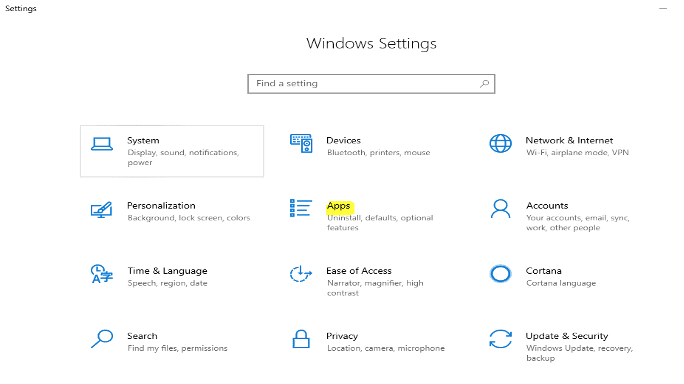
Launch the “Windows Settings” or via Win+I on your keyboard. Click on Apps
image

Click on Apps and Features and click on optional features as shown below
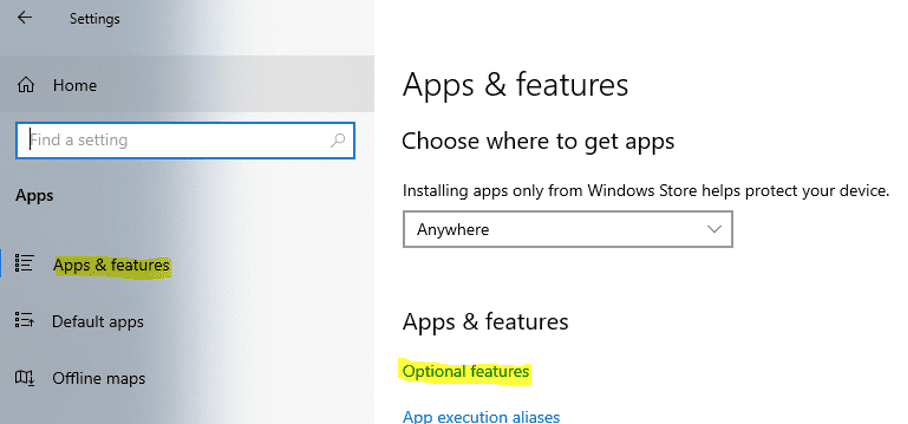
image-1

Under Optional features. Select RSAT: Group Policy Management Tools
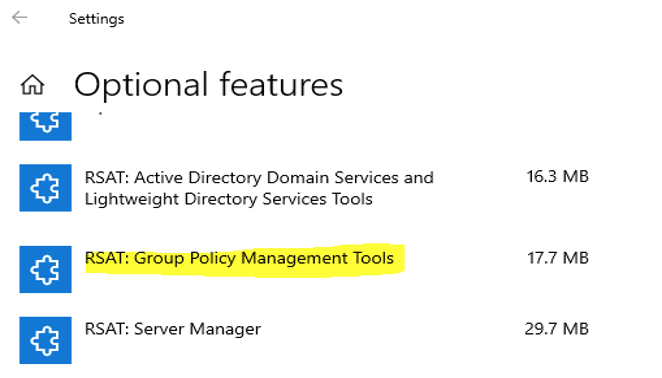
image-2

Uninstall RSAT Tool

Click on it and select Install. In my case I have it installed already so it prompts me to uninstall it. This is how to have the tool uninstalled also from your Device (PC).
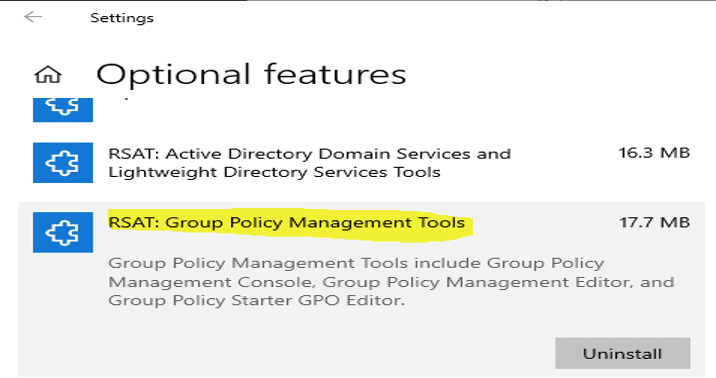
image-3

With Group Policy Object, administrators can administer (control) the number of PCs.  A set of Group Policy configurations is called a Group Policy Object (GPO). The Group Policy Editor is used to enforce GPOs and modify policies in standalone computers.

Note: When you modify a Group Policy object, these changes are automatically applied to Registry. But, when you modify the registry values while the Group Policy is enforced, the value will be overwritten to its original state until the Group Policy Editor specifically makes the changes.

Group policy on Windows 10 periodically refreshes the Registry at certain intervals. This help to keep the Registry values in check at all times which is an interval of 90 minutes. GPO can also be launched from PowerShell and Command Prompt as shown below.
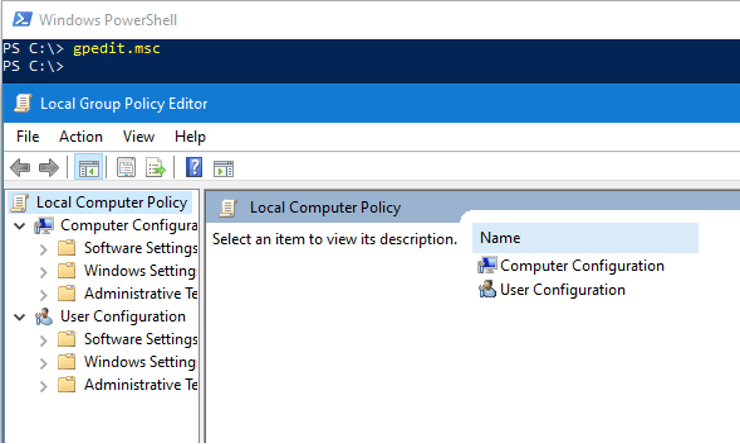
image-4


I hope you found this blog post helpful. If you have any questions, please let me know in the comment session.

Rate this post

Thank you for reading this post. Kindly share it with others.

  • Click to share on X (Opens in new window) X
  • Click to share on Reddit (Opens in new window) Reddit
  • Click to share on LinkedIn (Opens in new window) LinkedIn
  • Click to share on Facebook (Opens in new window) Facebook
  • Click to share on Pinterest (Opens in new window) Pinterest
  • Click to share on Tumblr (Opens in new window) Tumblr
  • Click to share on Telegram (Opens in new window) Telegram
  • Click to share on WhatsApp (Opens in new window) WhatsApp
  • Click to share on Pocket (Opens in new window) Pocket
  • Click to share on Mastodon (Opens in new window) Mastodon
  • Click to share on Bluesky (Opens in new window) Bluesky
  • Click to share on Threads (Opens in new window) Threads
  • Click to share on Nextdoor (Opens in new window) Nextdoor
Windows Tags:GPO, GPOs, Remote Server Administration Tools, RemoteConnection, RSAT, Windows 10

Post navigation

Previous Post: How to disable Spanning-Tree Globally
Next Post: How to use a dedicated MsSQL Db for Pleasant Password

Related Posts

  • Check Hard Drive Health (SMART) in Windows
    How to check Hard Drive Health (SMART) in Windows Windows
  • Featured image wifipass
    Find saved Wi-Fi Passwords in Windows 10 and 11 Network | Monitoring
  • windows 10 lock screen
    How to reset your lost or forgotten Windows 10 Password Windows
  • TPM 1
    How to fix unable to find compatible TPM Windows
  • VMware Error Fix
    How to fix “The process cannot access the file because another process has locked a portion of the file” Virtualization
  • Header picture 1
    Find BIOS Serial Number and System Information on Windows 11 Windows

More Related Articles

Check Hard Drive Health (SMART) in Windows How to check Hard Drive Health (SMART) in Windows Windows
Featured image wifipass Find saved Wi-Fi Passwords in Windows 10 and 11 Network | Monitoring
windows 10 lock screen How to reset your lost or forgotten Windows 10 Password Windows
TPM 1 How to fix unable to find compatible TPM Windows
VMware Error Fix How to fix “The process cannot access the file because another process has locked a portion of the file” Virtualization
Header picture 1 Find BIOS Serial Number and System Information on Windows 11 Windows

Leave a Reply Cancel reply

You must be logged in to post a comment.

Microsoft MVP

VEEAMLEGEND

vexpert-badge-stars-5

Virtual Background

GoogleNews

Categories

veeaam100

sysadmin top30a

  • screenshot 2020 04 07 at 02.14.53
    SSH and Telnet on Cisco ASA 5505: Quick Setup Guide Network | Monitoring
  • images 6
    Important Areas to Master on WSUS Windows Server
  • a3a5a8be58fa09468cd4f70d36869e98
    Restore AD Objects: How to restore deleted user accounts in Active Directory with Microsoft LDP and PowerShell Windows Server
  • windows 10 creators update wallpaper 1
    How to locate and edit the host file on Windows Windows Server
  • Stellar Exchange
    Exchange Recovery: Repair EDB Files and Recover Mailboxes Reviews
  • Protech Synology NAS
    Cybersecurity Tips to Secure Synology NAS against Ransomware Reviews
  • self signed sslcert
    Generate self-signed certificate and export in PFX format via PowerShell [Part 2] Windows
  • Webp.net resizeimage 5
    How to create a Traffic Manager Profile in Azure AWS/Azure/OpenShift

Subscribe to Blog via Email

Enter your email address to subscribe to this blog and receive notifications of new posts by email.

Join 1,841 other subscribers
  • RSS - Posts
  • RSS - Comments
  • About
  • Authors
  • Write for us
  • Advertise with us
  • General Terms and Conditions
  • Privacy policy
  • Feedly
  • Telegram
  • Youtube
  • Facebook
  • Instagram
  • LinkedIn
  • Tumblr
  • Pinterest
  • Twitter
  • mastodon

Tags

AWS Azure Bitlocker Microsoft Windows PowerShell WDS Windows 10 Windows 11 Windows Deployment Services Windows Server 2016

Copyright © 2025 TechDirectArchive


Loading Comments...
 

You must be logged in to post a comment.