Skip to content

TechDirectArchive

Hands-on IT, Cloud, Security & DevOps Insights

  • Home
  • About
  • Advertise With US
  • Reviews
  • Contact
  • Toggle search form
Home » Windows Server » How to disable the Microsoft Deployment Toolkit Task Sequence property sheet

How to disable the Microsoft Deployment Toolkit Task Sequence property sheet

Posted on 06/12/202009/09/2023 Christian By Christian No Comments on How to disable the Microsoft Deployment Toolkit Task Sequence property sheet
disable Microsoft Deployment Toolkit

Microsoft Deployment Toolkit (MDT) provides a unified collection of tools, processes, and guidance for automating desktop and server deployments. Task sequences are basic XML files that call on a series of scripts to run parameters chosen by the user when the task was created. Here are a few different types of task sequence tasks, some for capturing images, deploying software, deploying an operating system image to computer hardware and building, installing Drivers, and many other applications. To install and configure MDT, see the following guide “ADK, MDT, and WDS: How to configure and deploy Windows using MDT, and WDS in Windows 10 and “what is ADK, MDT, Microsoft Endpoint Configuration Manager (SCCM), Intune, Autopilot, and WSUS“. For more articles relating to MDT, see the following link.

Disable Microsoft Deployment Toolkit Task Sequence

I would like to disable driver injection. To do this, please follow the steps described below. Disabling a driver task sequence property sheet (step) is easy, just right-click it in the MDT workbench and choose the appropriate option. Drivers must be disabled from their property sheet (step). Disabling a driver is a safe approach before it is determined that deletion is necessary.

Note: If you must delete a Driver, do it over MDT Workbench. Do not delete a driver from the driver store via the file system (Deployment Share). The scenario discussed here is different from deleting a driver on a Windows device as discussed in this guide “How to delete obsolete drivers from the Driver Store in Windows 10″.

To perform this operation, launch The Microsoft Deployment Toolkit (MDT)
– Navigate to your deployment share
– Expand and click on the Task sequence
– On the middle pane of the window, select your task sequence.

Task Sequence property sheet
Note: If you have multiple task sequences, be sure to select the right one.

Right-click on the task sequence and select properties. This will open up the Task Sequence properties window as shown below
– Select the task sequence menu, and navigate to the desired property sheet (step) and click on it.

On the right pane of the Window, click on Option, select Disable as shown below, and click on Apply
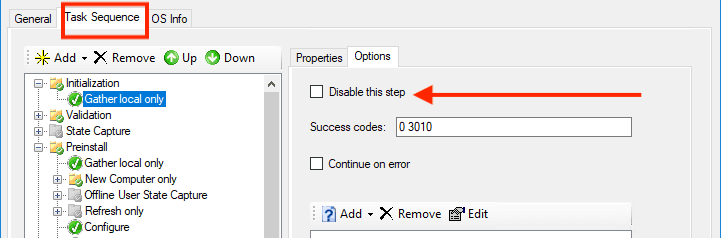
That is all that is needed to disable a task from MDT property sheet (step). I hope you found this blog post helpful. If you have any questions, please let me know in the comment session

Rate this post

Thank you for reading this post. Kindly share it with others.

  • Share on X (Opens in new window) X
  • Share on Reddit (Opens in new window) Reddit
  • Share on LinkedIn (Opens in new window) LinkedIn
  • Share on Facebook (Opens in new window) Facebook
  • Share on Pinterest (Opens in new window) Pinterest
  • Share on Tumblr (Opens in new window) Tumblr
  • Share on Telegram (Opens in new window) Telegram
  • Share on WhatsApp (Opens in new window) WhatsApp
  • Share on Mastodon (Opens in new window) Mastodon
  • Share on Bluesky (Opens in new window) Bluesky
  • Share on Threads (Opens in new window) Threads
  • Share on Nextdoor (Opens in new window) Nextdoor
Windows Server Tags:Microsoft Deployment Tool kit, Microsoft Deployment Toolkit (MDT), WDS, Windows 10, Windows Deployment Services

Post navigation

Previous Post: Windows cannot connect to the printer: Operation Failed with error 0x000004f8
Next Post: MDT Driver injection: How to import drivers in .exe format into Microsoft Deployment Toolkit

Related Posts

  • windows server 2019 logo
    How to create a Windows Server reference image using WDS Windows Server
  • Windows10 SCCM 20161
    What is ADK, MDT, Microsoft Endpoint Configuration Manager (SCCM), Intune, Autopilot, and WSUS Windows Server
  • RDP Certificate Issues
    Connecting to the RDP host: Fix the Certificate could not be verified back to the root certificate Mac
  • certificate import and export on windows
    Export and Convert Private Keys to .PEM Format in Windows Windows
  • cannot connect to the virtual machine try to connect again HyperV
    Could not connect to virtual machine try to connect again Hyper-V Virtualization
  • hero windowsadmincenter
    How to schedule and run update via Windows Admin Center Windows Server

More Related Articles

windows server 2019 logo How to create a Windows Server reference image using WDS Windows Server
Windows10 SCCM 20161 What is ADK, MDT, Microsoft Endpoint Configuration Manager (SCCM), Intune, Autopilot, and WSUS Windows Server
RDP Certificate Issues Connecting to the RDP host: Fix the Certificate could not be verified back to the root certificate Mac
certificate import and export on windows Export and Convert Private Keys to .PEM Format in Windows Windows
cannot connect to the virtual machine try to connect again HyperV Could not connect to virtual machine try to connect again Hyper-V Virtualization
hero windowsadmincenter How to schedule and run update via Windows Admin Center Windows Server

Leave a Reply Cancel reply

You must be logged in to post a comment.

Microsoft MVP

VEEAMLEGEND

vexpert-badge-stars-5

Virtual Background

GoogleNews

Categories

veeaam100

Veeam Vanguard

  • WindowsWebClientcoverPH67
    ​​​​​Install HTML Web Client for Microsoft RDS Windows
  • OPEN OFFICE
    How to Install Apache OpenOffice on Ubuntu  Linux
  • dism failed errors windows thumbnail 1
    Error 0x800f0830: Discard the modified Image and start again, no operation was performed Windows Server
  • Screenshot 2020 09 19 at 02.22.42
    Remove Windows 10 Apps with DISM: How to remove pre-provisioned apps from Windows Image Windows Server
  • images 2
    How to configure and use Pleasant Password RDP SSO Password Manager
  • how to install software packages from source files
    How to install a software package from source file in Linux Linux
  • Troubleshooting Synology NAS Domain Join 2
    Synology NAS Domain Join: The Importance of DNS Configuration Reviews
  • Azure App Service
    How to Restore Deleted Azure App Service Using PowerShell Automation

Subscribe to Blog via Email

Enter your email address to subscribe to this blog and receive notifications of new posts by email.

Join 1,819 other subscribers
  • RSS - Posts
  • RSS - Comments
  • About
  • Authors
  • Write for us
  • Advertise with us
  • General Terms and Conditions
  • Privacy policy
  • Feedly
  • Telegram
  • Youtube
  • Facebook
  • Instagram
  • LinkedIn
  • Tumblr
  • Pinterest
  • Twitter
  • mastodon

Tags

Active Directory Azure Bitlocker Microsoft Windows PowerShell WDS Windows 10 Windows 11 Windows Deployment Services Windows Server 2016

Copyright © 2025 TechDirectArchive


Loading Comments...
 

You must be logged in to post a comment.