Skip to content

TechDirectArchive

Hands-on IT, Cloud, Security & DevOps Insights

  • Home
  • About
  • Advertise With US
  • Reviews
  • Contact
  • Toggle search form
Home » Security | Vulnerability Scans and Assessment » Find and remove Malware with Microsoft Defender Offline

Find and remove Malware with Microsoft Defender Offline

Posted on 06/07/202216/06/2025 Matthew By Matthew No Comments on Find and remove Malware with Microsoft Defender Offline
Featured-image-2

Microsoft Defender Antivirus protection feature helps to protect your machine and data from almost all types of malware and hackers. Although this is among the best antivirus software, it is not perfect, and carefully written dangerous programs can occasionally make their way into the system and quickly take control, causing permanent harm. In this guide, we shall discuss how to find and remove Malware with Microsoft Defender Offline. Please, see How to set up the OOTBI Virtual Appliance on Proxmox VE, and What you need to know about Microsoft Defender Antivirus.

For a more secure system, please see how to turn on the Windows defender tamper protection feature. This isn’t exclusive to Microsoft Defender. This may happen with any third-party antivirus software that you install on your computer.

However, if your computer becomes infected with a terrible hard-to-remove infection while running Windows, you may utilize the Microsoft Defender Offline scan option. In this article, you will learn how to find and Remove Malware with Microsoft Defender Offline.

The offline option is an automated feature that helps the anti-malware engine to detect and remove most infections more quickly while the machine is not running. In this post, we’ll show you how to run an offline malware scan with Windows Defender Antivirus.

Run Microsoft Defender Offline Find and remove Malware on Windows

To scan and remove viruses with the Microsoft Defender Antivirus Offline scan feature, press the Windows key + I to open Settings. Click Privacy and Security, then select Windows Security on the right side.

image1-2

In Windows Security, click on Open Windows Security. This will open the windows defender app.

image2-1

In the windows defender app, click on “Virus & Threat Protection.”

image3-1

Under the “Current threats” section, click the Scan options setting.

image4

In the Virus and Threat Protection section, scroll down and select “Microsoft Defender Offline Scan,” and then click “Scan Now.”
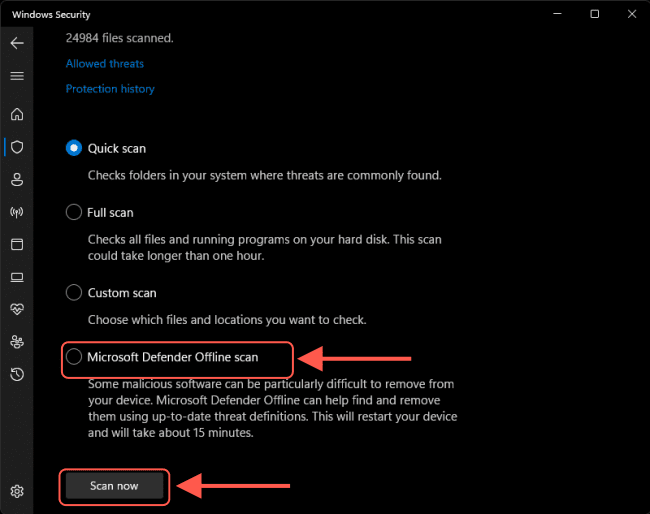
image5

When you click “Scan” on the prompt, your Windows 11 PC will restart and begin the scan.

Here is an exciting guide on Smart App Control and how to enable Phishing Protection: Windows 11 New Security Features, New Windows 11 encryption features and security enhancements will help protect hybrid work.

Use Windows Security to manage Antivirus

Press the Windows key to open Start menu, then type Windows Security and select the result that best match your search.

img1

Select Virus & threat protection to open the Virus & threat protection settings. Under the “Current threats” section, click the Scan options setting.
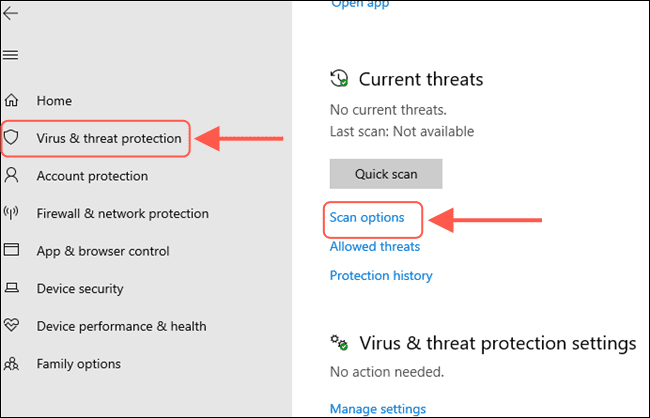
image6

Select the Microsoft Defender Offline scan option. Then click the Scan now button.
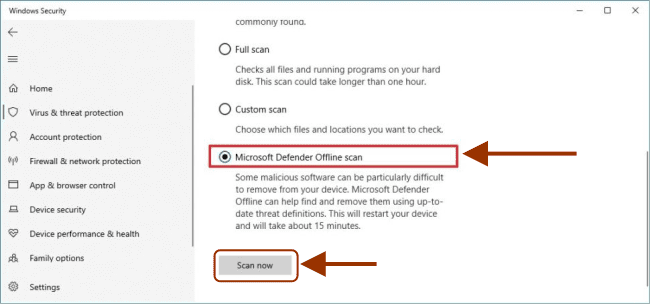
image7

When you click “Scan” on the prompt, your Windows 10 PC will restart and begin the scan. When you complete the steps, your computer will reboot into Windows Recovery Environment (WinRE), where the command-line version of Microsoft Defender Antivirus will run without loading the system.

Without user intervention, the scan will discover and destroy any difficult-to-remove infections it finds. The offline scan will take around 10-15 minutes, after which the machine will automatically restart.

Here are other related guides: How to turn on Windows 10 Tamper Protection for Microsoft Defender, and how to manage Microsoft Defender Antivirus with Group Policy and Microsoft Malware Protection via the Command Line Utility.

View the results of your Malware Scan with Microsoft Defender Offline

To review the scan information, open Windows Security, and click on Virus & threat protection. Under the “Current threats” section, click the Protection history setting.
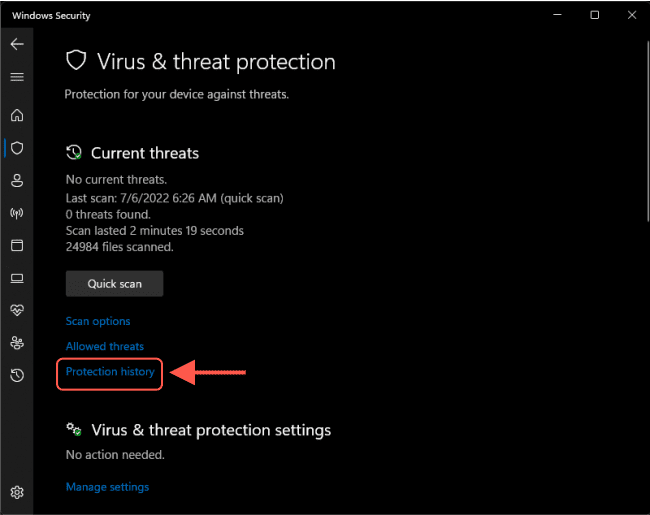
image8

If there is no information in the history, the antivirus was unable to trace anything on the system.

Run Offline Scan from PowerShell

To Run a Microsoft Defender Offline Scan from PowerShell, please see the more usage options for the Start-MpWDOScan command, see: Start-MpWDOScan

1 Open an elevated PowerShell.
2 Copy and paste the Start-MpWDOScan command into the elevated PowerShell, and press Enter.
image-2

Note: You can specify a switch as shown above. The -ScanType parameter allows the user to specify the type of scan to be performed: the acceptable values for this parameter are:
– FullScan
– QuickScan
– CustomScan

Run Offline Scan from Command Prompt

To Run a Microsoft Defender Offline Scan from Command Prompt, please see the usage options for the Start-MpWDOScan command.

1: Open an elevated command prompt.
2 Copy and paste the PowerShell Start-MpWDOScan command into the elevated command prompt, and hit Enter.

It’s also a good idea to pay attention to the dates of the items because the list shows all the most recent activities, and you may notice items from earlier scans or real-time detections.

I hope you found this blog post helpful on how to find and remove Malware with Microsoft Defender Offline. Please let me know in the comment session if you have any questions.

5/5 - (1 vote)

Thank you for reading this post. Kindly share it with others.

  • Share on X (Opens in new window) X
  • Share on Reddit (Opens in new window) Reddit
  • Share on LinkedIn (Opens in new window) LinkedIn
  • Share on Facebook (Opens in new window) Facebook
  • Share on Pinterest (Opens in new window) Pinterest
  • Share on Tumblr (Opens in new window) Tumblr
  • Share on Telegram (Opens in new window) Telegram
  • Share on WhatsApp (Opens in new window) WhatsApp
  • Share on Mastodon (Opens in new window) Mastodon
  • Share on Bluesky (Opens in new window) Bluesky
  • Share on Threads (Opens in new window) Threads
  • Share on Nextdoor (Opens in new window) Nextdoor
Anti-Virus Solution, Security | Vulnerability Scans and Assessment Tags:AntiMalware, AntiVirus, malware, Microsoft Defender Antivirus, Microsoft Windows, scan, Windows 10, Windows 11, Windows Defender, Windows Defender Antivirus

Post navigation

Previous Post: Hide or Remove Search Button from Windows 10 Taskbar
Next Post: How to download a shared ZOOM recording

Related Posts

  • Featured image Periodic scanning
    How to enable or disable Windows Defender Antivirus Scanning periodically on Windows via Windows Settings Security | Vulnerability Scans and Assessment
  • Enable a Pre Boot BitLocker PIN on Windows
    How to Enable a Pre-Boot BitLocker PIN on Windows Security | Vulnerability Scans and Assessment
  • WPScan Banner
    How to scan WordPress Websites With WPScan For Security Vulnerabilities Security | Vulnerability Scans and Assessment
  • update powershell
    Fix WDAC vulnerabilities by updating PowerShell Security | Vulnerability Scans and Assessment
  • HiveNightmare
    Workaround for “SeriousSAM or HiveNightmare” registry vulnerability for Windows 10 and 11 Security | Vulnerability Scans and Assessment
  • Norton AV
    Enable or disable Norton silent mode on Mac Anti-Virus Solution

More Related Articles

Featured image Periodic scanning How to enable or disable Windows Defender Antivirus Scanning periodically on Windows via Windows Settings Security | Vulnerability Scans and Assessment
Enable a Pre Boot BitLocker PIN on Windows How to Enable a Pre-Boot BitLocker PIN on Windows Security | Vulnerability Scans and Assessment
WPScan Banner How to scan WordPress Websites With WPScan For Security Vulnerabilities Security | Vulnerability Scans and Assessment
update powershell Fix WDAC vulnerabilities by updating PowerShell Security | Vulnerability Scans and Assessment
HiveNightmare Workaround for “SeriousSAM or HiveNightmare” registry vulnerability for Windows 10 and 11 Security | Vulnerability Scans and Assessment
Norton AV Enable or disable Norton silent mode on Mac Anti-Virus Solution

Leave a Reply Cancel reply

You must be logged in to post a comment.

Microsoft MVP

VEEAMLEGEND

vexpert-badge-stars-5

Virtual Background

GoogleNews

Categories

veeaam100

Veeam Vanguard

  • firewall windows 1
    Periodic Scanning: How to schedule Windows Defender Antivirus to scan on Windows Windows
  • image 28
    How to monitor your website uptime and status using Uptime Configuration Management Tool
  • windows update 03
    How to target WSUS clients with the registry keys Windows Server
  • FileNotFoundError Errno 2 No such file or directory
    Fix FileNotFoundError: [Errno 2] No such file or directory Scripts
  • template 1
    Install Group Policy Templates for Microsoft Edge and Google Chrome browsers on Windows Windows
  • dasfdg
    Unable to execute: The application GUID not found in the application list Windows Server
  • How to upgrade to SQL Server 2025
    SQL Server 2025 Upgrade Requirements and Compatibility Oracle/MSSQL/MySQL
  • Featured Image new
    Add Registry Keys via DISM in Windows Windows

Subscribe to Blog via Email

Enter your email address to subscribe to this blog and receive notifications of new posts by email.

Join 1,813 other subscribers
  • RSS - Posts
  • RSS - Comments
  • About
  • Authors
  • Write for us
  • Advertise with us
  • General Terms and Conditions
  • Privacy policy
  • Feedly
  • Telegram
  • Youtube
  • Facebook
  • Instagram
  • LinkedIn
  • Tumblr
  • Pinterest
  • Twitter
  • mastodon

Tags

Active Directory Azure Bitlocker Microsoft Windows PowerShell WDS Windows 10 Windows 11 Windows Deployment Services Windows Server 2016

Copyright © 2025 TechDirectArchive


Loading Comments...
 

You must be logged in to post a comment.