Skip to content

TechDirectArchive

Hands-on IT, Cloud, Security & DevOps Insights

  • Home
  • About
  • Advertise With US
  • Contact
  • Reviews
  • Toggle search form
Home » Windows » How to forcefully remove Language Pack on Windows 10 and 11
  • fallocate
    What the Fallocate command does Linux
  • Convert OST to PST
    How to install and work with Stellar Converter for OST Reviews
  • Screenshot 2021 02 05 at 22.40.51
    Disable automatic screen lock on Ubuntu Desktop Linux
  • Copy files between host and workstation
    Various ways to copy files from host to VMware Workstation VM Virtualization
  • nextcloudfeature 1
    How To Install Nextcloud on a Linux system Backup
  • FEATUREDC
    How to create Confidential VMs in Azure AWS/Azure/OpenShift
  • dfeef
    How to automatically resolve errors associated with failed dependencies Linux
  • Screenshot 2020 08 14 at 23.03.54
    How to disable Taskbar Web Search in Windows 10 via GPO and Windows Registry Windows

How to forcefully remove Language Pack on Windows 10 and 11

Posted on 14/07/202211/12/2023 Imoh Etuk By Imoh Etuk No Comments on How to forcefully remove Language Pack on Windows 10 and 11
How-to-Remove-Language-Pack

In this article, we will discuss how to forcefully remove Language Pack on Windows 10 and 11. Windows 10 and 11 are available in various languages, and you can even install language packs for each language you speak. This feature allows you to use a specific language for display (Settings and File Explorer) while still using a different language for the keyboard, apps, and websites. See the following related articles: how to add languages to your Personal PC, how to change or add another keyboard language in Windows Server, Local Experience Packs: How to add languages to Windows images using DISM and PowerShell.

With millions of worldwide users, Windows OS is one of the most popular desktop and laptop operating systems. Currently, it’s installed on over 900 million devices.

As a result of its large user base, it supports the majority of languages. While most users won’t change default display languages, they can install new language packs in Windows (10 & 11). If using multiple languages and facing settings issues, the option to remove a secondary pack might be unavailable. For instance, the upgrade process may unintentionally install a package with the same base language as the display language, resulting in an inability to remove either language.

You need to remove a language but the option is greyed out. Don’t worry; you can use a workaround to swiftly eliminate the unwanted pack using a few PowerShell commands. Let me demonstrate this in the guide. Here, I’m going to show you this in Windows 11. The steps in Windows 10 are the same thing. So feel free to apply the same steps if you’re using Windows 10.

How to remove language packs using PowerShell

Most times, the option to remove the language pack gets greyed out. In such cases, the best bet is to use PowerShell to remove it. The following are the steps to take:

Step 1 – Right-click and run PowerShell as an admin by searching for it in the Windows search bar.

Language Bundle
Opening PowerShell

When the PowerShell console opens up, type the following Cmdlet to display the list of languages currently installed on your PC:

Get-WinUserLanguageList
Screenshot
List of Currently Installed Language Packs

From the screenshot above, I have 3 language packs and I have highlighted the one I want to remove. You should also make a note of the language you wish to remove.

Step 2 – Type the following commands (one at a time) to remove the language that you don’t need and press enter.

1. $LangList = Get-WinUserLanguageList
2. $MarkedLang = $LangList | where LanguageTag -eq "LANGUAGETAG"
3. $LangList.Remove($MarkedLang)
4. Set-WinUserLanguageList $LangList -Force
Localization Pack
Removing Language Pack
Note: in the second Cmdlet command, ensure to replace "LANGUAGETAG" with the code of the language you want to remove. For example, en-DE, if your primary language is not the German English, and it's the pack you want to delete.

Simply rerun the Cmdlet command to verify the removal of the language.

Get-WinUserLanguageList
Multilingual Module
Language Pack Removed

After you’ve finished the steps, open the Settings app by pressing the Windows key + I and navigate to the "Region & language” page, where the language you couldn’t remove before should now be gone. (If you wish to remove another language if necessary, repeat the steps)

Language Bundle
Screenshot before Removing the Language

If you want to remove a primary language, keep in mind that you must first set a new language as the new default before the Remove button appears.
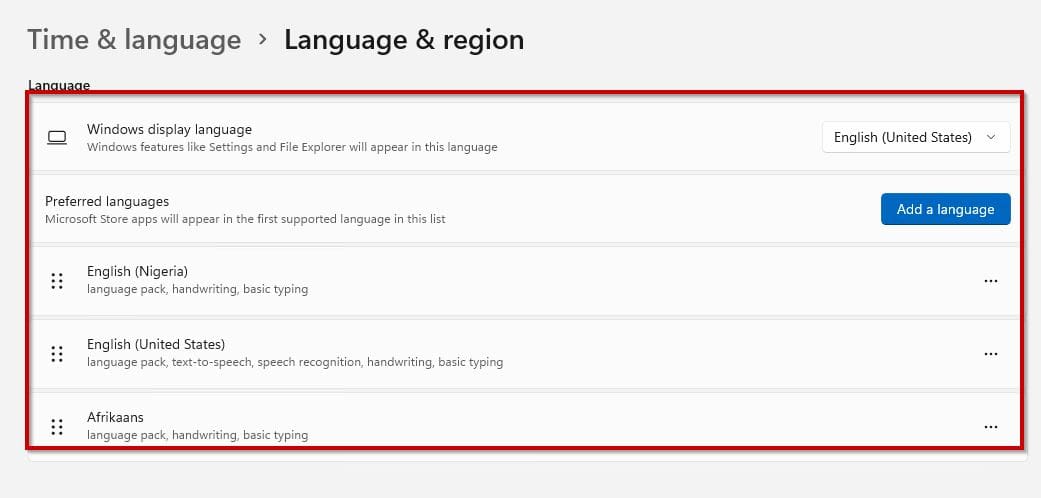
Screenshot
Screenshot After Removing the Language

Explore these captivating guides that may pique your interest: How to install Zoom video conference software in Linux System,  how to manage your Cloud Assets in AWS with CloudQuery, and Charmed Kubernetes: How to install CNF certified Kubernetes in AWS.

I hope you found this blog post on how to forcefully remove Language Pack on Windows 10 and 11 helpful. If you have any questions, please let me know in the comment session.

Rate this post

Thank you for reading this post. Kindly share it with others.

  • Click to share on X (Opens in new window) X
  • Click to share on Reddit (Opens in new window) Reddit
  • Click to share on LinkedIn (Opens in new window) LinkedIn
  • Click to share on Facebook (Opens in new window) Facebook
  • Click to share on Pinterest (Opens in new window) Pinterest
  • Click to share on Tumblr (Opens in new window) Tumblr
  • Click to share on Telegram (Opens in new window) Telegram
  • Click to share on WhatsApp (Opens in new window) WhatsApp
  • Click to share on Pocket (Opens in new window) Pocket
  • Click to share on Mastodon (Opens in new window) Mastodon
  • Click to share on Bluesky (Opens in new window) Bluesky
  • Click to share on Threads (Opens in new window) Threads
  • Click to share on Nextdoor (Opens in new window) Nextdoor
Windows Tags:PowerShell, PowerShell Cmdlet, Windows 10, Windows 11

Post navigation

Previous Post: How to install Zoom video conference software on Linux System
Next Post: How to Exit Linux Vim or Vi Editor

Related Posts

  • shortcut
    How to make a desktop shortcut available for all users in Windows 7 and 10 Windows
  • Slide1 1
    How to manage Microsoft Defender Antivirus using Group Policy and Command Line Utility Anti-Virus Solution
  • Windows Productivity Tips
    Windows Productivity Tips To Get The Most Out Of Your PC Windows
  • image 79
    How to import SSL Certificate to Windows Server using DigiCert Utility Windows
  • Screenshot 2022 04 28 at 22.35.11
    Fix “There was a problem starting logilda.dll” in Windows Windows
  • Fix this PC cannot run Windows 11
    Bypass unsupported CPU and Processor by upgrading to Windows 11 via Windows Update Virtualization

More Related Articles

shortcut How to make a desktop shortcut available for all users in Windows 7 and 10 Windows
Slide1 1 How to manage Microsoft Defender Antivirus using Group Policy and Command Line Utility Anti-Virus Solution
Windows Productivity Tips Windows Productivity Tips To Get The Most Out Of Your PC Windows
image 79 How to import SSL Certificate to Windows Server using DigiCert Utility Windows
Screenshot 2022 04 28 at 22.35.11 Fix “There was a problem starting logilda.dll” in Windows Windows
Fix this PC cannot run Windows 11 Bypass unsupported CPU and Processor by upgrading to Windows 11 via Windows Update Virtualization

Leave a Reply Cancel reply

You must be logged in to post a comment.

Microsoft MVP

VEEAMLEGEND

vexpert-badge-stars-5

Virtual Background

GoogleNews

Categories

veeaam100

sysadmin top30a

  • fallocate
    What the Fallocate command does Linux
  • Convert OST to PST
    How to install and work with Stellar Converter for OST Reviews
  • Screenshot 2021 02 05 at 22.40.51
    Disable automatic screen lock on Ubuntu Desktop Linux
  • Copy files between host and workstation
    Various ways to copy files from host to VMware Workstation VM Virtualization
  • nextcloudfeature 1
    How To Install Nextcloud on a Linux system Backup
  • FEATUREDC
    How to create Confidential VMs in Azure AWS/Azure/OpenShift
  • dfeef
    How to automatically resolve errors associated with failed dependencies Linux
  • Screenshot 2020 08 14 at 23.03.54
    How to disable Taskbar Web Search in Windows 10 via GPO and Windows Registry Windows

Subscribe to Blog via Email

Enter your email address to subscribe to this blog and receive notifications of new posts by email.

Join 1,841 other subscribers
  • RSS - Posts
  • RSS - Comments
  • About
  • Authors
  • Write for us
  • Advertise with us
  • General Terms and Conditions
  • Privacy policy
  • Feedly
  • Telegram
  • Youtube
  • Facebook
  • Instagram
  • LinkedIn
  • Tumblr
  • Pinterest
  • Twitter
  • mastodon

Tags

AWS Azure Bitlocker Microsoft Windows PowerShell WDS Windows 10 Windows 11 Windows Deployment Services Windows Server 2016

Copyright © 2025 TechDirectArchive


Loading Comments...
 

You must be logged in to post a comment.