Skip to content

TechDirectArchive

Hands-on IT, Cloud, Security & DevOps Insights

  • Home
  • About
  • Advertise With US
  • Reviews
  • Contact
  • Toggle search form
Home » Linux » How to encrypt a partition with Cryptsetup

How to encrypt a partition with Cryptsetup

Posted on 16/09/202022/09/2023 Christian By Christian No Comments on How to encrypt a partition with Cryptsetup

Cryptsetup is a utility used to conveniently set up disk encryption based on the DMCrypt kernel module. These include plain dm-crypt volumes, LUKS volumes, loop-AES, TrueCrypt (including VeraCrypt extension), and BitLocker formats. LUKS is the standard for Linux hard disk encryption. By providing a standard on-disk-format, it does not only facilitate compatibility among distributions but also provides secure management of multiple user passwords. LUKS stores all necessary setup information in the partition header, enabling to transport or migrate data seamlessly. Here are some interesting articles: How to add a new partition to an existing Linux server, ESXI 6.7 ALARM: Seat disk exhaustion on 10, and how to setup up WatchGuard Log and Report Server in a VM.

Cryptsetup utility aids in configuring encrypted filesystems. To begin, you must have the cryptsetup-luks package installed. You can use the fdisk –l or blkid command to get a list of available partitions.  For the purpose of this tutorial, I created a new partition called loop2. I will now encrypt our loop2 partition with Cryptsetup.
get the list of the available partitions

Before we encrypt a partition with Cryptsetup, ensure you have backed up essential data on that partition. Furthermore, encryption will overwrite any existing data on the partition.

cryptsetup --verbose --verify-passphrase luksFormat /dev/partition-name

To proceed, type YES in block letters. (Pay attention to the warning.) Afterward, you will need to input a password.
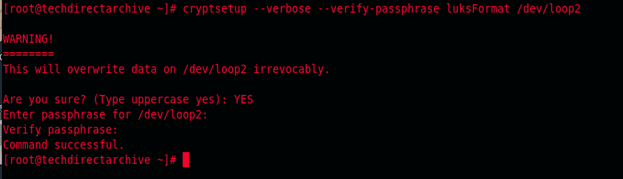
type in YES
cryptsetup luksOpen /dev/partition-name partition-name

This command will prompt you for the password you used for the encryption

Eneter your encryption passphrase

Once it is opened, the already encrypted partition is automatically mapped out to dev/mapper/partition-name and a quick delve into the fdisk –l command will confirm just that.

Encrypted partition has been mapped out

To start using this partition, you will need to format the partition with a filesystem of your choice and then mount it. I used the mkfs command in my own case

mkfs.ext4 /dev/mapper/partition-name
Format the partition filesystem and then mount it

Thats how to encrypt a partition with Cryptsetup. I hope you found this blog post helpful. So, if you have any questions, please let me know in the comment session.

Rate this post

Thank you for reading this post. Kindly share it with others.

  • Share on X (Opens in new window) X
  • Share on Reddit (Opens in new window) Reddit
  • Share on LinkedIn (Opens in new window) LinkedIn
  • Share on Facebook (Opens in new window) Facebook
  • Share on Pinterest (Opens in new window) Pinterest
  • Share on Tumblr (Opens in new window) Tumblr
  • Share on Telegram (Opens in new window) Telegram
  • Share on WhatsApp (Opens in new window) WhatsApp
  • Share on Mastodon (Opens in new window) Mastodon
  • Share on Bluesky (Opens in new window) Bluesky
  • Share on Threads (Opens in new window) Threads
  • Share on Nextdoor (Opens in new window) Nextdoor
Linux Tags:disk, encrytp

Post navigation

Previous Post: Error 0x80070002: When trying to mount an image file
Next Post: How to stop Microsoft Edge from remembering your email ID

Related Posts

  • S3 Bucket 1
    How to delete AWS S3 Bucket and Objects via  AWS CLI from Linux AWS/Azure/OpenShift
  • greywireshark
    How to install WireShark on a Linux Ubuntu System Linux
  • Webp.net resizeimage 1
    Automate Infrastructure Deployments in the Cloud with Ansible and Azure Pipelines AWS/Azure/OpenShift
  • integrate VHR with VBR
    How to deploy and integrate VHR with VBR Backup
  • redisf
    How to install Redis on Linux System Linux
  • ysvxdf
    Install and configure BigBlueButton on Ubuntu Linux Linux

More Related Articles

S3 Bucket 1 How to delete AWS S3 Bucket and Objects via  AWS CLI from Linux AWS/Azure/OpenShift
greywireshark How to install WireShark on a Linux Ubuntu System Linux
Webp.net resizeimage 1 Automate Infrastructure Deployments in the Cloud with Ansible and Azure Pipelines AWS/Azure/OpenShift
integrate VHR with VBR How to deploy and integrate VHR with VBR Backup
redisf How to install Redis on Linux System Linux
ysvxdf Install and configure BigBlueButton on Ubuntu Linux Linux

Leave a Reply Cancel reply

You must be logged in to post a comment.

Microsoft MVP

VEEAMLEGEND

vexpert-badge-stars-5

Virtual Background

GoogleNews

Categories

veeaam100

Veeam Vanguard

  • AzureAD
    Azure Active Directory integration with on-premise AD using PTA AWS/Azure/OpenShift
  • ad
    Service and Network Port requirements for Active Directory Windows
  • Synology Cloud Sync
    How to Sync Data in Cloud Drives to Synology NAS Backup
  • Screenshot
    An error occurred while attempting to start the selected VM Virtualization
  • Turn On Or Off Auto Unlock For BitLocker Drive
    How To Turn On Or Off Auto-Unlock For BitLocker Drive In Windows 10/11 Security | Vulnerability Scans and Assessment
  • How to Force Stop a Grayed Out Windows Service
    How To Force Stop A Windows Service When Stop Option Is Grayed Out Windows
  • Screenshot 2020 05 14 at 19.09.08
    How to backup a Cisco IOS Network | Monitoring
  • Norton backup
    How to set up Norton Cloud Backup on Windows Anti-Virus Solution

Subscribe to Blog via Email

Enter your email address to subscribe to this blog and receive notifications of new posts by email.

Join 1,808 other subscribers
  • RSS - Posts
  • RSS - Comments
  • About
  • Authors
  • Write for us
  • Advertise with us
  • General Terms and Conditions
  • Privacy policy
  • Feedly
  • Telegram
  • Youtube
  • Facebook
  • Instagram
  • LinkedIn
  • Tumblr
  • Pinterest
  • Twitter
  • mastodon

Tags

AWS Azure Bitlocker Microsoft Windows PowerShell WDS Windows 10 Windows 11 Windows Deployment Services Windows Server 2016

Copyright © 2025 TechDirectArchive

Loading Comments...

You must be logged in to post a comment.