Skip to content

TechDirectArchive

Hands-on IT, Cloud, Security & DevOps Insights

  • Home
  • About
  • Advertise With US
  • Contact
  • Reviews
  • Toggle search form
Home » AWS/Azure/OpenShift » Set up and configure Route 53 for your Domain in AWS

Set up and configure Route 53 for your Domain in AWS

Posted on 12/03/202229/12/2023 Dickson Victor By Dickson Victor No Comments on Set up and configure Route 53 for your Domain in AWS
Route53AWS

In this tutorial, I will show you how to set up and configure Route 53 for your Domain in AWS. Route 53 is a highly available and scalable DNS service from AWS. It is designed to give the developers full control over their DNS entries and provide a cost-effective way to route end-users to the correct resources. Apart from being a popular DNS service Route53 is also a domain registrar. As you will see in the tutorial next, you can buy new domain names on Route53. Kindly refer to these related guides: Creating IAM Users, Adding MFA and Policies on AWS, how to setup SPF and TXT Records in AWS, and Domain Name System: How to create a DNS record.

Route53 integrates seamlessly with AWS Services like S3, Elastic Load Balancers etc, which makes route53 a popular choice as a DNS server for AWS applications.

It makes it easier for the end-users to manage their global traffic through a variety of routing types – Weighted routing, Latency Based Routing, GeoProximity Routing and more.

Set up and configure Route 53for your Domain in AWS accounts

Sign in to the AWS Management Console, and navigate to Route 53 dashboard.

In the Route53 Dashboard find the “Registered Domains” option, under Domains in the dashboard on the left.

1-final
Route 53 Console

Domain Registration

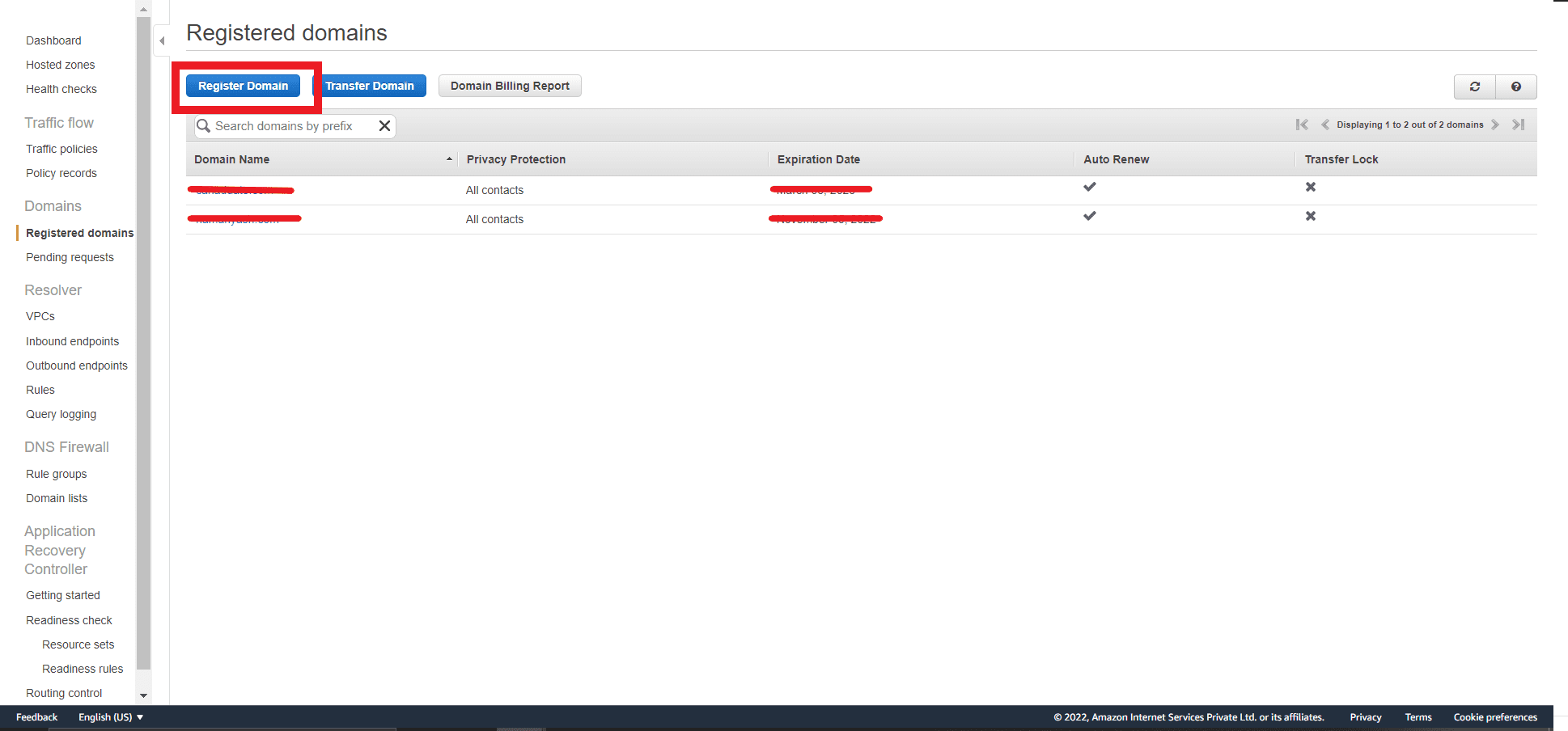
Now that you are on the Registered Domain Page you will see that there are two ways to set up a domain in Route53 – register a new domain and transfer a new domain.

This is the page where you see the list of all your registered domains like in the image below.

Let us go ahead and register a new domain by clicking the “Register Domain” button here.
2-final
Registered Domains Page

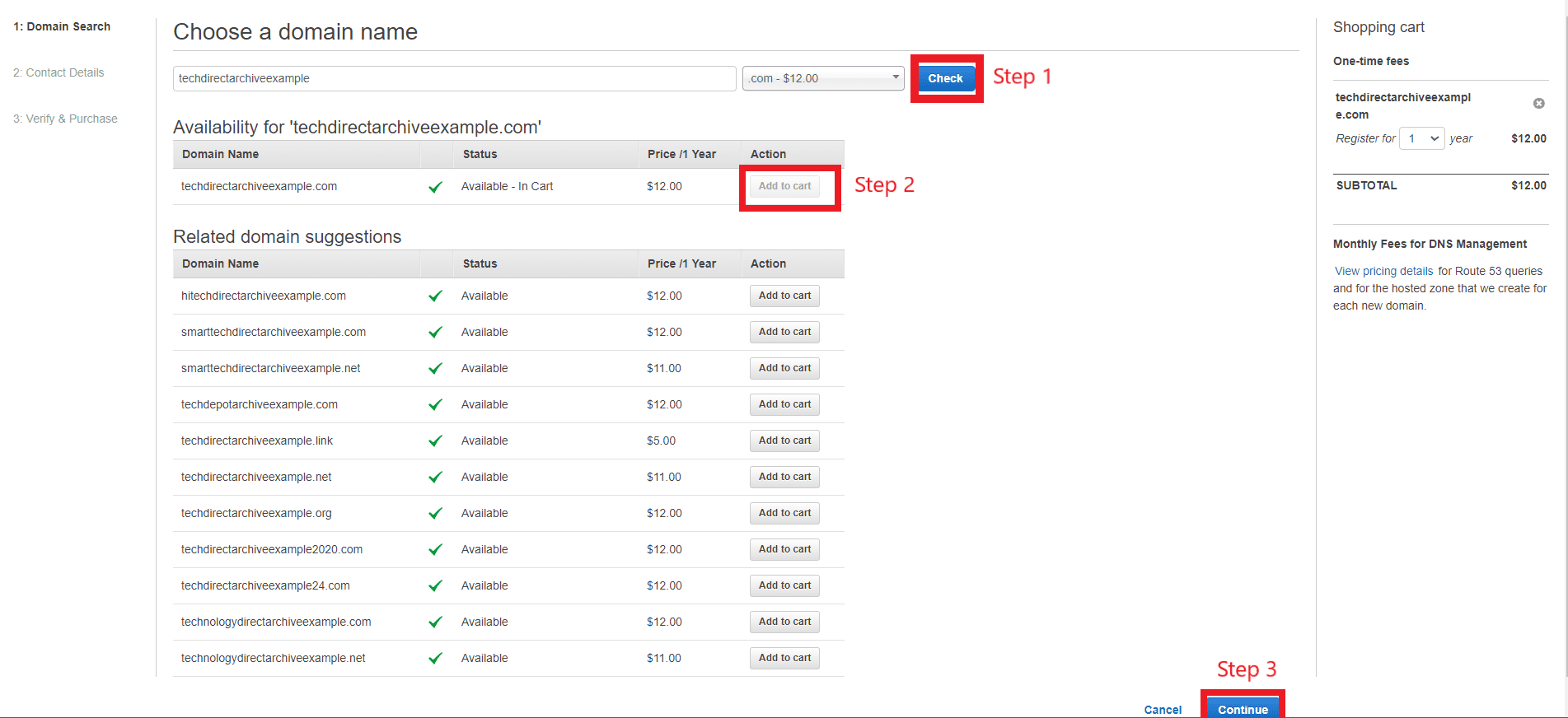
Enter your domain name and click on check. If the domain name is available you will see an output similar to the following image. Choose the domain name you want to register and click “Add to cart”.
4-final
Domain Search

If you agree to the pricing, click Continue.

Please see A-Z of Domain Name System: All you need to know about DNS, how to manage cost with AWS Budgets, and how to Deploy Dynamic Website to AWS EC2.

Register your Organisation’s Contact Details

On the next page, you can add your Registrant Contact, Admin Contact, and the “Tech Contact” details for your domain. Fill in the details and click Continue at the bottom of the page.

5-1
Contact Details Page

On the Verify & Purchase, you can verify your contact information. If you want Route53 to automatically renew your domain name after a year select the Enable option as shown below.

Finally agree to the Terms and Conditions as shown below and click “Complete Order”.

5-2-final

If you go to the pending requests options as shown below. You will see that your domain registration request is in progress.

You can now head to the Orders and invoices page and complete the payment for your domain registration.

If you do not see any new orders yet, please wait, it may take some time for AWS to process the request. After the status of your request changes, you can also head to the billing dashboard by clicking the button as shown below.

6-final

After your payment is done, you will see your domain name on the “Registered domains” page.

7-final

Head over to the Hosted zones option. You will see that Route53 has already created a Hosted Zone for your domain.

Click on your domain name to get started with Route53 and create records for your domain.

8-final
You have now successfully set up Route53 for your new domain name. 

I hope you found this blog post helpful on how to Set up and configure Route 53 for your Domain in AWS. If you have any questions, please let me know in the comment session.

Rate this post

Thank you for reading this post. Kindly share it with others.

  • Share on X (Opens in new window) X
  • Share on Reddit (Opens in new window) Reddit
  • Share on LinkedIn (Opens in new window) LinkedIn
  • Share on Facebook (Opens in new window) Facebook
  • Share on Pinterest (Opens in new window) Pinterest
  • Share on Tumblr (Opens in new window) Tumblr
  • Share on Telegram (Opens in new window) Telegram
  • Share on WhatsApp (Opens in new window) WhatsApp
  • Share on Mastodon (Opens in new window) Mastodon
  • Share on Bluesky (Opens in new window) Bluesky
  • Share on Threads (Opens in new window) Threads
  • Share on Nextdoor (Opens in new window) Nextdoor
AWS/Azure/OpenShift Tags:AWS

Post navigation

Previous Post: How to use Command-Line on Git Bash and GitHub Desktop to PUSH local code to GitHub
Next Post: How to deploy a React Application to AWS S3

Related Posts

  • How to configure Azure container register with secured connection with container apps
    Configure Azure Container Registry for a secure connection with Azure Container Apps AWS/Azure/OpenShift
  • sonarcloud
    How to Integrate SonarCloud with Azure DevOps Pipeline AWS/Azure/OpenShift
  • AWS Principals
    MFA on Root Account: Create a User on AWS and Register MFA AWS/Azure/OpenShift
  • DevOps GIT Docker Kubernetes
    Azure DevOps: Docker and Kubernetes Deployment with GitHub AWS/Azure/OpenShift
  • azure
    Enter connection information for your on-premise directory or forests: Azure AD connect unable to connect directory, forest not available AWS/Azure/OpenShift
  • FEATUREDC
    How to create Confidential VMs in Azure AWS/Azure/OpenShift

More Related Articles

How to configure Azure container register with secured connection with container apps Configure Azure Container Registry for a secure connection with Azure Container Apps AWS/Azure/OpenShift
sonarcloud How to Integrate SonarCloud with Azure DevOps Pipeline AWS/Azure/OpenShift
AWS Principals MFA on Root Account: Create a User on AWS and Register MFA AWS/Azure/OpenShift
DevOps GIT Docker Kubernetes Azure DevOps: Docker and Kubernetes Deployment with GitHub AWS/Azure/OpenShift
azure Enter connection information for your on-premise directory or forests: Azure AD connect unable to connect directory, forest not available AWS/Azure/OpenShift
FEATUREDC How to create Confidential VMs in Azure AWS/Azure/OpenShift

Leave a Reply Cancel reply

You must be logged in to post a comment.

Microsoft MVP

VEEAMLEGEND

vexpert-badge-stars-5

Virtual Background

GoogleNews

Categories

veeaam100

Veeam Vanguard

  • SQL Loves Linux 2 Twitter 002 640x358 1
    Install Microsoft SQL Server 2019 and MSSQL Command line tools on Ubuntu Linux Oracle/MSSQL/MySQL
  • How To Stop Mac From Sleeping Automatically
    How to prevent macOS from going to sleep Mac
  • EFK Stack
    EFK Stack Installation on Docker Virtualization
  • vcenter sign on
    CVE-2021-22048: VMware vCenter Server updates address a privilege escalation vulnerability Security | Vulnerability Scans and Assessment
  • PersonalHow to Create Symbolic Links in Linux
    All You Need to Know About Symbolic Links in Linux Linux
  • Featured image MsTeams.
    How to share an app window on Microsoft Teams Windows
  • s3versioning
    Hosting Static Website and Versioning on AWS S3 AWS/Azure/OpenShift
  • Screenshot 2021 04 03 at 18.30.29
    Setup Windows server backup and create backup jobs with Bare metal backup Backup

Subscribe to Blog via Email

Enter your email address to subscribe to this blog and receive notifications of new posts by email.

Join 1,814 other subscribers
  • RSS - Posts
  • RSS - Comments
  • About
  • Authors
  • Write for us
  • Advertise with us
  • General Terms and Conditions
  • Privacy policy
  • Feedly
  • Telegram
  • Youtube
  • Facebook
  • Instagram
  • LinkedIn
  • Tumblr
  • Pinterest
  • Twitter
  • mastodon

Tags

Active Directory Azure Bitlocker Microsoft Windows PowerShell WDS Windows 10 Windows 11 Windows Deployment Services Windows Server 2016

Copyright © 2025 TechDirectArchive


Loading Comments...
 

You must be logged in to post a comment.