Skip to content

TechDirectArchive

Hands-on IT, Cloud, Security, Veeam & DevOps

  • Home
  • About
  • Advertise With US
  • Reviews
  • Contact
  • Toggle search form

How to enable or disable a Remote WMI Connection in Windows

Posted on 21/05/202216/08/2026 Matthew By Matthew No Comments on How to enable or disable a Remote WMI Connection in Windows
  1. Home
  2. Windows
  3. How to enable or disable a Remote WMI Connection in Windows
Featured-Image_1

To enable or disable a Remote WMI Connection in Windows, employ Command Prompt. Manage multiple WMI rules swiftly, enhancing system control. Enabling these rules allows WMI to accept remote connections and asynchronous callbacks from Unsecapp.exe. This comprehensive guide outlines the process for managing WMI traffic directly from the command prompt, providing valuable insights into controlling remote access and thereby optimizing system management. Please see this detailed guide on: Windows Management Instrumentation: WMI Commands.

See How to Enable and Disable WMI Traffic through Windows CMD, and Remote WMI Connection: How to enable or disable WMI Traffic Using Firewall UI.

Configuring Network Access via Command Prompt Rule Group

Please see this detailed guide on Windows Management Instrumentation: WMI Commands.

Remote WMI Access

Enable WMI traffic through the firewall:

netsh advfirewall firewall set rule group="windows management instrumentation (wmi)" new enable=yes
WMI Connectivity

The “Remote WMI Connection” command activates 8 vital WMI rules, enhancing remote system management. This results in seamless control and comprehensive monitoring.

The Remote WMI Connection significantly empowers control by streamlining system management by integrating 8 essential Windows Management Instrumentation (WMI) rules.

These rules are essential, providing data collection, remote management, and performance monitoring, thus bolstering system security and stability.

Such automation significantly saves time and ensures the consistent application of essential settings, consequently contributing to a more robust and dependable IT infrastructure.

Here is Windows Management Instrumentation Commands, how to Get a list of installed programs locally or remotely in Windows, and “How to delete an Instance (AssignedAccess) when applied via MDM WMI bridge Provider“.

Steps to Turn Off

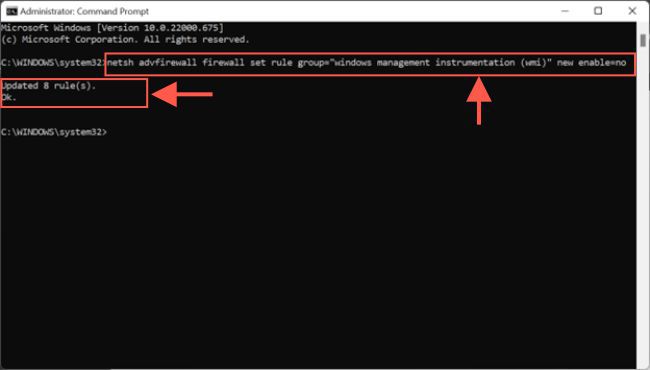
First, run the command prompt as administrator.

netsh advfirewall firewall set rule group="windows management instrumentation (wmi)" new enable=no
Remote System Management

The command removes 8 rules added to the WMI, streamlining the configuration and improving system management.

Please see see how to query a list of installed programs in Windows via Windows Settings, Control Panel, WMIC, PowerShell and Windows Registry, and How to setup and configure Remote Desktop Services via Standard Deployment on Windows Server.

If you’ve found this blog post on how to enable or disable a Remote WMI Connection in Windows helpful, please share your thoughts or questions in the comment section. Additionally, your feedback is greatly appreciated, and I’m here to assist with any inquiries.

Thank you for reading this post. Kindly share it with others.

  • Share on X (Opens in new window) X
  • Share on Reddit (Opens in new window) Reddit
  • Share on LinkedIn (Opens in new window) LinkedIn
  • Share on Facebook (Opens in new window) Facebook
  • Share on Pinterest (Opens in new window) Pinterest
  • Share on Tumblr (Opens in new window) Tumblr
  • Share on Telegram (Opens in new window) Telegram
  • Share on WhatsApp (Opens in new window) WhatsApp
  • Share on Mastodon (Opens in new window) Mastodon
  • Share on Bluesky (Opens in new window) Bluesky
Windows Tags:MDM Bridge WMI Provide, Remote Access, Remote Desktop, Remote Desktop Services, Remote Server Administration Tools, RemoteConnection

Post navigation

Previous Post: How to deactivate and reactivate a Slack user
Next Post: How to remove a user from a Slack Channel

Related Posts

  • banner
    How to Check and Reset Network Data Usage in Windows 11 Network | Monitoring
  • Enable a Pre Boot BitLocker PIN on Windows
    How to Enable a Pre-Boot BitLocker PIN on Windows Security | Vulnerability Scans and Assessment
  • Featured image 2
    How to delete Windows old folder in Windows 11 Windows
  • windows 1
    How to query, stop and delete a service in Windows Windows
  • PowerShell Exec
    Determine the execution policy configured on Windows PC Windows
  • jmeterimage
    Apache JMeter Load Testing: Test Mobile Apps on Windows Configuration Management Tool

More Related Articles

banner How to Check and Reset Network Data Usage in Windows 11 Network | Monitoring
Enable a Pre Boot BitLocker PIN on Windows How to Enable a Pre-Boot BitLocker PIN on Windows Security | Vulnerability Scans and Assessment
Featured image 2 How to delete Windows old folder in Windows 11 Windows
windows 1 How to query, stop and delete a service in Windows Windows
PowerShell Exec Determine the execution policy configured on Windows PC Windows
jmeterimage Apache JMeter Load Testing: Test Mobile Apps on Windows Configuration Management Tool

Leave a Reply Cancel reply

You must be logged in to post a comment.

Microsoft MVP

vexpert-badge-stars-5

Virtual Background

VEEAMLEGEND

Categories

veeaam100

Veeam Vanguard

  • How To Upgrade Windows 11 Pro to Enterprise
    Upgrade Windows 11 Pro to Enterprise and vice Versa Windows
  • 1 WeXxkEX0JG3oB781HD8Hrg 1
    OOBESETTINGSMULTIPLEPAGE error on Windows 10 Windows
  • Disable and Enable USB in Windows
    Disable and Enable USB Usage for Certain Users in Windows Windows
  • Featured image BSOD
    How to troubleshoot and fix Windows 11 blue screen Windows
  • Fix Operating System Loader failed signature verification e1778595875592
    Fix Operating System Loader failed signature verification” on Dell Safe BIOS Systems via PXE [Part 3] Windows
  • FEATURE IMAGE IMAGE
    Install and configure Prometheus for Monitoring on a Linux Linux
  • Leave Slack
    How to remove a user from a Slack Channel JIRA|Confluence|Apps
  • maxresdefault
    How to delete Organizational Unit in Active Directory Windows Server

Subscribe to Blog via Email

Enter your email address to subscribe to this blog and receive notifications of new posts by email.

Join 1,752 other subscribers
  • RSS - Posts
  • RSS - Comments
  • About
  • Authors
  • Write for us
  • Contact
  • Advertise with us
  • General Terms and Conditions
  • Privacy policy
  • Feedly
  • Telegram
  • Youtube
  • Facebook
  • Instagram
  • LinkedIn
  • Tumblr
  • Pinterest
  • Twitter
  • mastodon
  • Bsky

Tags

Active Directory Azure Bitlocker Microsoft Windows PowerShell WDS Windows 10 Windows 11 Windows Deployment Services Windows Server 2016

Copyright © 2026 TechDirectArchive

Loading Comments...

You must be logged in to post a comment.