Skip to content

TechDirectArchive

Hands-on IT, Cloud, Security & DevOps Insights

  • Home
  • About
  • Advertise With US
  • Contact
  • Reviews
  • Toggle search form
Home » Windows » Change Account Lockout Threshold for Local Accounts in Windows: The reference account is locked

Change Account Lockout Threshold for Local Accounts in Windows: The reference account is locked

Posted on 29/11/202210/10/2024 Temitope Odemo By Temitope Odemo No Comments on Change Account Lockout Threshold for Local Accounts in Windows: The reference account is locked
Lockout7

The Account lockout threshold policy setting is one way you can prevent unauthorized access to your computer system. In this article, you will learn how to Change Account Lockout Threshold for Local Accounts in Windows 10 and Windows 11: The reference account is currently locked. An attack like a brute-force attack can be prevented when an automated login system is set up to try several combinations of login credentials. Please see How to manage costs with AWS Budgets, and Microsoft Account Password Reset via Web and Windows

But we also have some bad vectors out there who would like to cause a denial of service on a domain that has an account lockout threshold setup hitting the domain with several combinations of login credentials and making logging into the domain impossible for users.

When the number of attempts set on the policy is exhausted the account will be locked and it’s only an Administrator that can unlock it or you will wait for the specified number of minutes to expire and you can try to log in again.  The amount of value you can set for the sign-in attempts is between 1-999. Kindly take a look at the YouTube video demonstrating these steps.

If you want to read more on Account read these Local Administrators Account lockout is now available, How to Change User Account Type in Windows 10, How to set an account expiration date in Active Directory, Windows sign-in options, and account protection on Windows 11.

Change Account Lockout Threshold for Local Accounts in Windows

Follow the steps below on how to change the account lockout threshold  

1. Run this command secpol.msc to open the Local Security Policy.
2. Navigate to Account Policies > Account Lockout Policy in the left pane of Local Security Policy.

lockout2

Please see How to disable automatic screen lock in Ubuntu Linux. How to deploy MBAM for Bitlocker Administration, and How to create a Windows Server reference image using WDS. See how to fix “An Attempt Was Made to Reference a Token That Does Not Exist” in Windows 10.

Enter the Value for Invalid Logon Attempts

3. In the right pane of Account Lockout Policy, double-click on the Account Lockout threshold policy and type in a number between 0 and 999.

The number entered will be the number of sign-in attempts allowed before the account will be locked out. Click Ok.
lockout3

4. Once you click Ok. You can decide to change the Account lockout duration, Reset the account lockout counter after and Allow Administrator account lockout.

lockout4

5. Now go ahead to try with wrong password three times

lockout5

6. Once the Sign-in attempts are exhausted.

The system will be locked and you will see the below message.
lockout6

7. Using the command to change the Account lockout Threshold open the command prompt as Administrator and run this command.

This will display your current Account Policy settings

net accounts
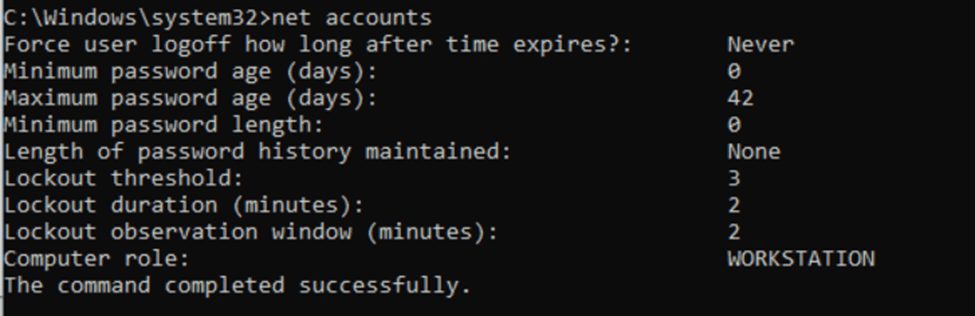
image-61

Enter the below command and input the Number.

image-62
image-63

I hope you found this blog post on how to Change Account Lockout Threshold for Local Accounts in Windows 10 and Windows 11: The reference account is currently locked interesting and helpful. In case you have any questions do not hesitate to ask in the comment section.

5/5 - (1 vote)

Thank you for reading this post. Kindly share it with others.

  • Share on X (Opens in new window) X
  • Share on Reddit (Opens in new window) Reddit
  • Share on LinkedIn (Opens in new window) LinkedIn
  • Share on Facebook (Opens in new window) Facebook
  • Share on Pinterest (Opens in new window) Pinterest
  • Share on Tumblr (Opens in new window) Tumblr
  • Share on Telegram (Opens in new window) Telegram
  • Share on WhatsApp (Opens in new window) WhatsApp
  • Share on Mastodon (Opens in new window) Mastodon
  • Share on Bluesky (Opens in new window) Bluesky
  • Share on Threads (Opens in new window) Threads
  • Share on Nextdoor (Opens in new window) Nextdoor
Windows, Windows Server Tags:Microsoft Windows, Service Logon Account, User Account Control, Windows 10, Windows 11, Windows Server 2016

Post navigation

Previous Post: Set Special File Permissions with SUID or GUID and Sticky Bit
Next Post: CVE-2021-31693: VMware Tools for Windows update addresses a denial-of-service vulnerability

Related Posts

  • How to Upgrade Windows 10 with an Unsupported CPU TPM 1.0 to Windows 11
    Upgrading from Windows 10 with Unsupported CPU and TPM 1.0 Windows
  • 33
    The wim file needs to be remounted: Fix error 0xc1510114 Windows Server
  • Configure NFS on Windows Server
    How to install NFS Server on Windows Server Windows Server
  • TeamPass Password manager
    Install and configure TeamPass Password Manager Password Manager
  • recovery
    Perform System State Restore of Active Directory via Windows Server backup utility Windows Server
  • Screenshot 2021 10 07 at 00.00.32
    How to fix this computer is a domain controller: The snap-in cannot be used on a domain controller Windows Server

More Related Articles

How to Upgrade Windows 10 with an Unsupported CPU TPM 1.0 to Windows 11 Upgrading from Windows 10 with Unsupported CPU and TPM 1.0 Windows
33 The wim file needs to be remounted: Fix error 0xc1510114 Windows Server
Configure NFS on Windows Server How to install NFS Server on Windows Server Windows Server
TeamPass Password manager Install and configure TeamPass Password Manager Password Manager
recovery Perform System State Restore of Active Directory via Windows Server backup utility Windows Server
Screenshot 2021 10 07 at 00.00.32 How to fix this computer is a domain controller: The snap-in cannot be used on a domain controller Windows Server

Leave a Reply Cancel reply

You must be logged in to post a comment.

Microsoft MVP

VEEAMLEGEND

vexpert-badge-stars-5

Virtual Background

GoogleNews

Categories

veeaam100

Veeam Vanguard

  • Featured image 4
    How to enable or fix the missing fast startup option on Windows 11 Windows
  • windows update 03
    How to target WSUS clients with the registry keys Windows Server
  • banner
    How to create a password reset disk: Reset Windows Password Windows
  • Trellix BitLocker and fileVault Recovery
    Selfservice Recovery: Trellix BitLocker and fileVault Recovery Security | Vulnerability Scans and Assessment
  • login keyboard feature
    Sign-In Method Not Allowed: Contact Network Administrator Windows Server
  • vcx
    Fix Error code 0x4 Session disconnected: Your session ended because of an error, if this keeps happening, contact your system administrator Windows
  • 1 kajkbmlyehn0inifwrh 8w
    How to install Kerberos packages via Cygwin in Windows Windows Server
  • banner
    How to hide Folders and Files from Search Results in Windows Windows

Subscribe to Blog via Email

Enter your email address to subscribe to this blog and receive notifications of new posts by email.

Join 1,808 other subscribers
  • RSS - Posts
  • RSS - Comments
  • About
  • Authors
  • Write for us
  • Advertise with us
  • General Terms and Conditions
  • Privacy policy
  • Feedly
  • Telegram
  • Youtube
  • Facebook
  • Instagram
  • LinkedIn
  • Tumblr
  • Pinterest
  • Twitter
  • mastodon

Tags

AWS Azure Bitlocker Microsoft Windows PowerShell WDS Windows 10 Windows 11 Windows Deployment Services Windows Server 2016

Copyright © 2025 TechDirectArchive


Loading Comments...
 

You must be logged in to post a comment.
