Skip to content

TechDirectArchive

Hands-on IT, Cloud, Security & DevOps Insights

  • Home
  • About
  • Advertise With US
  • Reviews
  • Contact
  • Toggle search form
Home » Linux » How to Exit Linux Vim or Vi Editor
  • CAL Removal
    How to Remove and Manage RDS Licenses Web Server
  • vcenter sign on
    CVE-2021-22048: VMware vCenter Server updates address a privilege escalation vulnerability Security | Vulnerability Scans and Assessment
  • Synergy software kvm
    Why Software KVMs such as Synergy is replacing Hardware KVMs Linux
  • Cluster
    Install and configure Hyper-V Cluster On Windows Server Virtualization
  • 1 WeXxkEX0JG3oB781HD8Hrg 1
    Command Prompt in Windows: Creating Volumes Guide Windows
  • screenshot 2020 03 13 at 20.24.17
    How to view installed packages in Cygwin Windows
  • Hyper V VM creation
    How to Create a Windows Server VM on HyperV Windows Server
  • screenshot 2020 03 20 at 00.44.47
    How to check if homebrew is installed on macOS Mac

How to Exit Linux Vim or Vi Editor

Posted on 15/07/202211/12/2023 Raphael Gab-Momoh By Raphael Gab-Momoh No Comments on How to Exit Linux Vim or Vi Editor
feature_photo_quit_vim

This guide shows you how to exit Linux Vim or Vi editor. The screen-based text editor application Vim is open-source and free. Thus, it is a more advanced version of Bill Joy’s vi. Meanwhile, Bill Joy is the creator of Vim. He developed the program from a port of the Stevie editor for the Amiga, and made it available to the public in 1991. By default Vi, comes packaged in every Ubuntu Machine but for Vim you need to install it using the command below. Please see Uninstall Office: How to remove Microsoft Outlook, Teams, Words PowerPoint, and Excel apps from Mac, and Cannot uninstall the OneDrive App: The item “OneDrive” can’t be moved to the Bin because it’s open on Mac.

Like other types of programming, vim script files are kept in plain text and often end in.vim , this doesn’t apply to the .vimrc configuration file for Vim. Note that every command that we run for Vim editor will also work for Vi editor because vim as we mentioned earlier is an improved version of Vi.

Another similar guide can be referenced from this link: How to Save Read-Only Files in VIM Editor in Linux/Unix-like OS. Kindly refer to these interesting guides: Remove Office license file: How do you change the account that Office says it belongs to on a Mac,

Prerequisites to Exit Linux Vim or VI Editor

Below are the prerequisites to exit the editor.

  1. Ubuntu Machine
  2. A user account with Sudo privileges
  3. Terminal

Vim does not come pre-installed, so we need to install it with the command

apt install vim
how to exit Linux vim-apt-install-vim
installed vim

Modes

Below are the various modes available within the Editor.

Normal mode: Vim launches in “normal” mode by default. By hitting Esc key while in another mode, you can return to normal mode. The expected behavior of key presses is not present in Normal mode. In other words, they don’t add text to the page; rather, certain key hits should

Insert Mode: Most individuals will be most familiar with this conduct because it is the second most prevalent mode. I for ’insert’, this immediately switches vim to insert mode by using an insert command from regular mode, you may input it.

Several insert instructions are A for "append,” which advances the cursor after the current character and enters insert mode, and o for "insert,” which inserts a new line below the current line and enters insert mode on the new line.

Exit Vim in Terminal

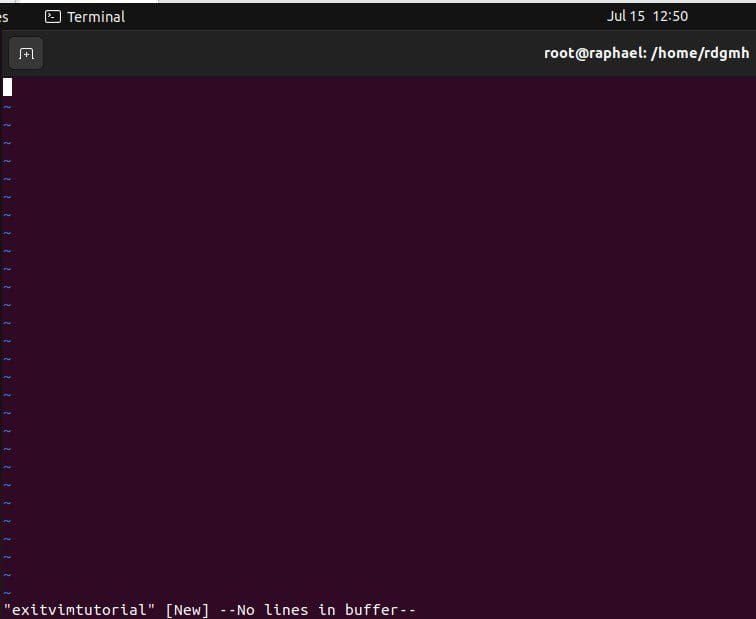
Let’s create a document in Vim and escape. In the demo, we will create a document called exitvimtutorial. We can do this with the command below.

You can choose to call it any name that you want but the most important thing is for the keyword vim to be in front of the name in this format vim <name>

vim exitvimtutorial
vimcreate
created a vim file

To work on the newly created file, we need to hit I for insert mode. And we can type anything to create a file with content in it. As we can see from the screenshot below, we had the steps typed

how to exit Linux vim-Finalexitvim
insert

Steps to exit Linux Vim or Vi editor:

Change to command mode in Vi/Vim to give commands.

  1. Press the Esc key.
  2. Observe the —INSERT— label disappear from the lower-left corner of the screen.
  3. Enter:w followed by Enter to save your changes before exiting. Any modifications made will be saved as a result. In response, Vim will print the filename, whether it is fresh, and the number of characters that were written to the hard disk.
  4. Press Enter after typing:q to leave Vi/Vim.
how to exit Linux vim-EXITVIM

Useful Commands

If you must use Linux via the editor, you will have to familiarize yourself with the following useful commands.

  1. Esc – changes to command mode
  2. :w –list the modifications performed
  3. :q – exit Vim
  4. :q! – exit Vim and discard any changes
  5. :wq – saves the modifications and quits Vim
  6. :x – save the modifications, then quit Vim

Summary

In summary, Vim is a modification of Vi and any command for vim will work for vi. Vi comes installed by default but for vim, you will need to install using the package manager.

We exited vim by following a series of steps as shown above. With the aforementioned steps, you’ll successfully exit Linux Vim and Vi editor.

Rate this post

Thank you for reading this post. Kindly share it with others.

  • Click to share on X (Opens in new window) X
  • Click to share on Reddit (Opens in new window) Reddit
  • Click to share on LinkedIn (Opens in new window) LinkedIn
  • Click to share on Facebook (Opens in new window) Facebook
  • Click to share on Pinterest (Opens in new window) Pinterest
  • Click to share on Tumblr (Opens in new window) Tumblr
  • Click to share on Telegram (Opens in new window) Telegram
  • Click to share on WhatsApp (Opens in new window) WhatsApp
  • Click to share on Pocket (Opens in new window) Pocket
  • Click to share on Mastodon (Opens in new window) Mastodon
  • Click to share on Bluesky (Opens in new window) Bluesky
  • Click to share on Threads (Opens in new window) Threads
  • Click to share on Nextdoor (Opens in new window) Nextdoor
Linux Tags:Linux distro, Ubunt 20.04 LTS, Ubuntu, Ubuntu 20.04 LTS

Post navigation

Previous Post: How to forcefully remove Language Pack on Windows 10 and 11
Next Post: How to fix an attempt was made to reference a Token that does not exist

Related Posts

  • FEATURE IMAGE BASE URL 1
    How to solve cannot find a valid base URL for repo: base/7/x86_64 Linux
  • Groovy
    How to install Groovy on Linux and Windows Configuration Management Tool
  • PersonalHow to Create Symbolic Links in Linux
    All You Need to Know About Symbolic Links in Linux Linux
  • RUST FEATURE
    How to install Rust in a Linux System Linux
  • teams feature
    How to install and configure Microsoft Teams on Ubuntu Linux
  • FEATURE IMAGE
    SSH into a VM created using Azure CLI or GUI Linux

More Related Articles

FEATURE IMAGE BASE URL 1 How to solve cannot find a valid base URL for repo: base/7/x86_64 Linux
Groovy How to install Groovy on Linux and Windows Configuration Management Tool
PersonalHow to Create Symbolic Links in Linux All You Need to Know About Symbolic Links in Linux Linux
RUST FEATURE How to install Rust in a Linux System Linux
teams feature How to install and configure Microsoft Teams on Ubuntu Linux
FEATURE IMAGE SSH into a VM created using Azure CLI or GUI Linux

Leave a Reply Cancel reply

You must be logged in to post a comment.

Microsoft MVP

VEEAMLEGEND

vexpert-badge-stars-5

Virtual Background

GoogleNews

Categories

veeaam100

sysadmin top30a

  • CAL Removal
    How to Remove and Manage RDS Licenses Web Server
  • vcenter sign on
    CVE-2021-22048: VMware vCenter Server updates address a privilege escalation vulnerability Security | Vulnerability Scans and Assessment
  • Synergy software kvm
    Why Software KVMs such as Synergy is replacing Hardware KVMs Linux
  • Cluster
    Install and configure Hyper-V Cluster On Windows Server Virtualization
  • 1 WeXxkEX0JG3oB781HD8Hrg 1
    Command Prompt in Windows: Creating Volumes Guide Windows
  • screenshot 2020 03 13 at 20.24.17
    How to view installed packages in Cygwin Windows
  • Hyper V VM creation
    How to Create a Windows Server VM on HyperV Windows Server
  • screenshot 2020 03 20 at 00.44.47
    How to check if homebrew is installed on macOS Mac

Subscribe to Blog via Email

Enter your email address to subscribe to this blog and receive notifications of new posts by email.

Join 1,841 other subscribers
  • RSS - Posts
  • RSS - Comments
  • About
  • Authors
  • Write for us
  • Advertise with us
  • General Terms and Conditions
  • Privacy policy
  • Feedly
  • Telegram
  • Youtube
  • Facebook
  • Instagram
  • LinkedIn
  • Tumblr
  • Pinterest
  • Twitter
  • mastodon

Tags

AWS Azure Bitlocker Microsoft Windows PowerShell WDS Windows 10 Windows 11 Windows Deployment Services Windows Server 2016

Copyright © 2025 TechDirectArchive


Loading Comments...
 

You must be logged in to post a comment.