
In this article, we shall discuss how to “use iCloud for Windows: How to install and uninstall iCloud for Windows”. iCloud for Windows is a Windows-based application provided by Apple that allows you to access your iCloud content, including photos, videos, documents, and emails, from a Windows PC. Please see How to sync your passwords across iOS and Mac devices, and FoneTool is the best iPhone backup software. Also, see How to upgrade macOS Big Sur to macOS Monterey.
It provides seamless integration between your Windows computer and your Apple devices, such as iPhones, iPads, and Macs. Here is a new blog post showing how to synchronize Apple Calendar on Windows with Outlook [Part 2]
The easiest way to load data from iCloud onto a Windows PC is to use iCloud’s web interface. To do this, navigate to iCloud.com, log in and download images. You only need iCloud for Windows if you want to synchronize data. Please see how to remove Windows PC from your iCloud Account Completely.
Features of iCloud for Windows
That said, iCloud for Windows automatically keeps your photos, files, calendars, contacts, passwords, and other important information in sync between your iPhone and your Windows PC. With iCloud for Windows, you could perform the following
- Keep your photos up to date across all your devices and your PC.
- Create shared albums and invite people to add their own photos, videos, and comments.
- Access, add, or remove photos and videos in your shared iCloud Photo Library.
- View photos directly in the Microsoft Photos app on Windows 11.
- Securely store and open all your files and folders on iCloud Drive.
- Share files with friends, family or colleagues directly from File Explorer.
- View and manage your passwords in the iCloud Passwords app on your Windows PC.
- Secure and sync your passwords across all your devices, including your PC, using the iCloud Passwords extension in Chrome or Edge.
- Create time-based one-time passwords (TOTP) in the iCloud Passwords app.
- Keep contacts and calendars up to date across all your devices and your PC.
- See your iCloud calendar in Outlook.
- Bookmarks in Edge, Firefox and Google Chrome are automatically kept up to date with the latest Safari.
Download iCloud for Windows
Navigate to the following link to download iCloud for Windows. Click on the download link as shown below.

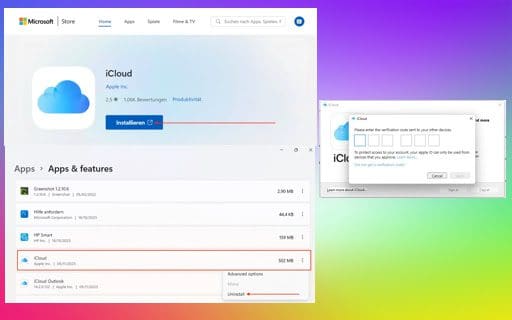
Click on install as shown below.

This will require you to open iCloud from the Microsoft Store.

Now, iCloud as been opened from the Microsoft Store. Click on Download as shown below.

Shortly, iCloud will be downloaded and installed on your PC.

You may also want to see “AD Connect Sync Service not running: Cannot proceed because the sync service is not running, start the ADSync service and restart the AD Connect Wizard to continue“, and how to restore accidentally deleted calendars, bookmarks, files, or contacts from iCloud.
Launch iCloud for Windows
iCloud for Windows has been installed, click open as shown below.

Login to associate the PC with iCloud. Provide your Apple ID and password and click on sign-in

A verification code will be sent to you. Click Allow to enable your Apple ID to sign into a new device.

Do not forget to enter the verification code displayed on your Mobile Device

Next, you would have to select what you would like to synchronize with iCloud. When you are done, click on Apply.

You may want to see PowerShell Script: Uninstalling Applications Made Easy, and how to fix Norton Autofix identified an issue: Fix Norton 360 Installation has encountered an error 8404 on Windows.
Uninstall iCloud for Windows App
If you need to uninstall iCloud for Windows for any reason, you can easily do so using the Windows Settings. It is advisable to back up the local data to iCloud first. While it’s pretty easy to uninstall iCloud with Windows Setting. Sometimes, it does leave behind some residual files. Apple has documentation on these regarding the version of Windows you are using.
You can do a thorough uninstall using the uninstaller program "Revo Uninstaller".
Before signing out of or uninstalling iCloud for Windows, you may want to make a copy of your iCloud data and save it on your PC as mentioned earlier. This is because the information on your PC won’t automatically stay up to date in iCloud and you won’t see updates made on your other devices.
Step 1: Sign out of iCloud on Windows using the signout button below. When prompted to enter the Apple ID and password, ignore this as you wish to remove iCloud for Windows.
Step 2: Choose Start menu > Settings

Click on Apps and then on Apps & features.

Locate iCloud, click the More button, choose Uninstall, and then follow the onscreen instructions.

Confirm iCloud removal

Since I am using Windows 11. This is all that is needed to install and uninstall iCloud for Windows as stated in their documentation.
FAQ relating to the usage of iCloud for Windows
iCloud for Windows is compatible with Windows 7 and later versions, including Windows 10. However, for the best experience and access to all iCloud features, it’s recommended to use it with the latest versions of Windows. Some advanced features may not be available on older Windows versions.
You can access your iCloud Photos on a Windows PC using iCloud for Windows. When you enable the Photos option during the setup, it will automatically download and sync your photos and videos to your PC. You can then access and manage your iCloud Photos using the Windows File Explorer or the iCloud Photos app.
I hope you found this blog post helpful on how to use iCloud for Windows: How to install and uninstall iCloud for Windows. Please let me know in the comment section if you have any questions.


