Skip to content

TechDirectArchive

Hands-on IT, Cloud, Security, Veeam & DevOps

  • Home
  • About
  • Advertise With US
  • Contact
  • Reviews
  • Toggle search form

How to use Microsoft SQL Server Management Studio to Export and Import your MsSQL database from Azure to local computer

Posted on 14/12/202125/08/2023 Temitope Odemo By Temitope Odemo No Comments on How to use Microsoft SQL Server Management Studio to Export and Import your MsSQL database from Azure to local computer
  1. Home
  2. AWS/Azure/OpenShift
  3. How to use Microsoft SQL Server Management Studio to Export and Import your MsSQL database from Azure to local computer
Export

Microsoft SQL Server Management Studio (SSMS) is an integrated environment where you can manage your SQL infrastructure. SSMS can be used to access, configure, manage, administer, and develop all components of SQL Server and Azure SQL Database. Microsoft SQL server management studio is a free software for public use and can be connected to any of your SQL server instances. MsSQL is a collection of tables that stores structured data in the form that contains a collection of rows that is referred to as records and columns that is referred to as attributes.

Here are some similar guides you can read: How to install Microsoft SQL Server Management Studio, How to uninstall Microsoft SQL Server Management Studio, How to download and install Microsoft SQL Server 2019 Express Edition and Microsoft Management Studio on Windows Server, How to uninstall Microsoft SQL Server on Windows 10 and Windows Server

Step-by-Step Guide: Exporting and Importing Azure Database to Local Computer

In this guide I will show you how to quickly export and import your database from Azure account to your local computer.

  • Login to your Azure Portal: https://portal.azure.com
  • Under Azure Services click SQL databases and select the Database you want to access.
Import
Open your MsSQL Database on Azure
  • Click Set server firewall and add your system IP to the firewall rule and Save.
Microsoft SQL Server Management Studio
Setting your Firewall rule on Azure
  • Download SSMS and install on your local system.
  • Copy the Server name and login name from the Azure portal and enter the valid password and connect to your Azure database.
Azure
Microsoft SQL Server Management Studio

Exporting Database

  • After you have connected right-click database. Click Tasks > Export Data-tier Application.
MsSQL database
Exporting Database
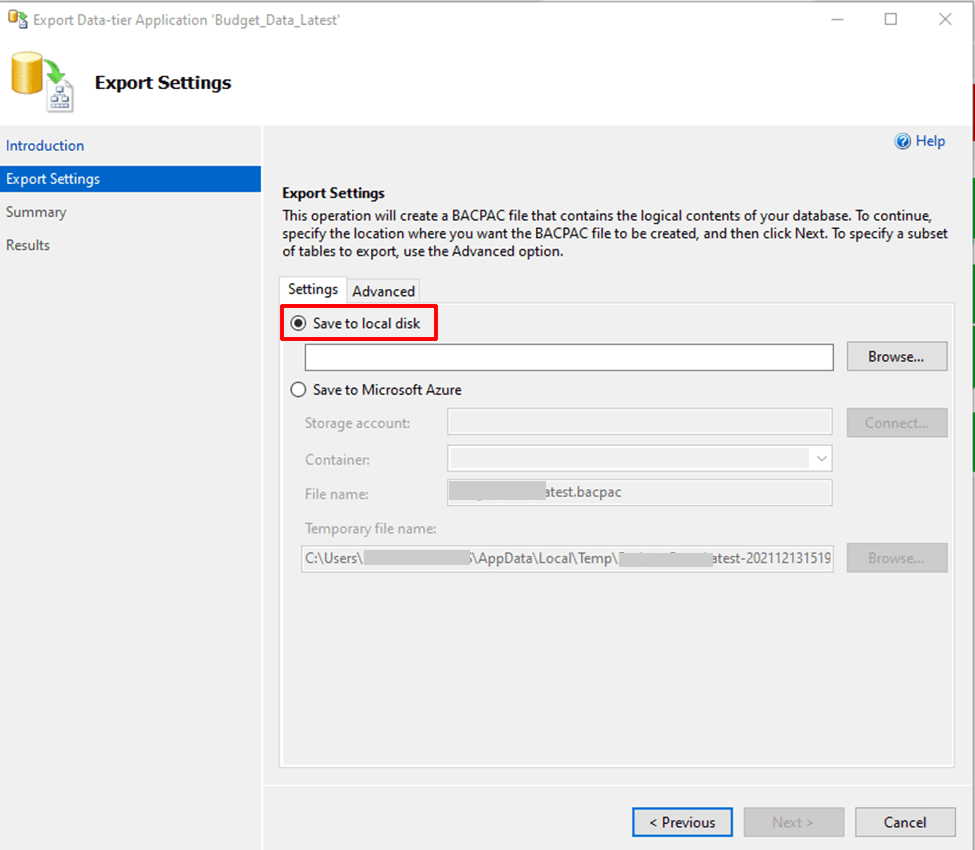
  • Select Save to local disk and browse to the location you want to export the data.
Export
Export Setting
  • Click on Next and you start exporting
image-5
Exporting Database

Importing Database

  • After you have connected right-click database and select Import Data-tier Application.
image-6
Importing Database
  • Select Import from local disk and browse to the location you have the database file you want to import.
image-7
Import Settings
  • Make sure you give the database a name, enter the edition, maximum database size and service objective.
image-8
Database settings
  • Importing of Database starts.
image-9
Importing Database

I hope you found this blog post on How to use Microsoft SQL Server Management Studio to Export and Import your MsSQL database from Azure to local computer very interesting and helpful. In case you have any questions do not hesitate to ask in the comment section.

Rate this post

Thank you for reading this post. Kindly share it with others.

  • Share on X (Opens in new window) X
  • Share on Reddit (Opens in new window) Reddit
  • Share on LinkedIn (Opens in new window) LinkedIn
  • Share on Facebook (Opens in new window) Facebook
  • Share on Pinterest (Opens in new window) Pinterest
  • Share on Tumblr (Opens in new window) Tumblr
  • Share on Telegram (Opens in new window) Telegram
  • Share on WhatsApp (Opens in new window) WhatsApp
  • Share on Mastodon (Opens in new window) Mastodon
  • Share on Bluesky (Opens in new window) Bluesky
  • Share on Threads (Opens in new window) Threads
  • Share on Nextdoor (Opens in new window) Nextdoor
AWS/Azure/OpenShift, Oracle/MSSQL/MySQL, Windows, Windows Server Tags:Database, Microsoft SQL, Microsoft SQL Server 2019 Express Edition, Microsoft SQL Server Management Studio, Microsoft SQL Server Studio

Post navigation

Previous Post: How to Solve “The parameter is incorrect” problem on External Hard Disk in Windows
Next Post: Download your MySQL database from Azure to a local PC with MySQL Workbench

Related Posts

  • enable or disable WinRM
    How to enable or disable WinRM via the command-line Windows
  • microsoft edge
    All available Policies for the latest version of Microsoft Edge Windows
  • EC2 Public IP
    How to Allocate, Associate, Disassociate and Release Elastic IP Address from an EC2 Instance AWS/Azure/OpenShift
  • LDPAs
    Fix LDAP Connection Error 81: Cannot open connection via the ldp.exe tool Windows
  • Missing ADML File
    Fix an appropriate resource file could not be found for LAPS Windows
  • self signed sslcert
    Generate self-signed certificate and export in PFX format via PowerShell [Part 2] Windows

More Related Articles

enable or disable WinRM How to enable or disable WinRM via the command-line Windows
microsoft edge All available Policies for the latest version of Microsoft Edge Windows
EC2 Public IP How to Allocate, Associate, Disassociate and Release Elastic IP Address from an EC2 Instance AWS/Azure/OpenShift
LDPAs Fix LDAP Connection Error 81: Cannot open connection via the ldp.exe tool Windows
Missing ADML File Fix an appropriate resource file could not be found for LAPS Windows
self signed sslcert Generate self-signed certificate and export in PFX format via PowerShell [Part 2] Windows

Leave a Reply Cancel reply

You must be logged in to post a comment.

Microsoft MVP

VEEAMLEGEND

vexpert-badge-stars-5

Virtual Background

GoogleNews

Categories

veeaam100

Veeam Vanguard

  • ios microsoft remote desktop app
    Remote Desktop can not find the computer FQDN and this might mean that FQDN does not belong to the specified network Windows
  • Featured image 1
    How to Share Microsoft Outlook Calendar on Desktop and on Web Microsoft Exchange/Office/365
  • Stop teams from auto start
    Prevent Microsoft Teams from starting automatically on Windows Windows
  • screenshot 2020 04 02 at 23.27.20
    Cloud Protection Manager: N2WS Veeam CPM Guide Backup
  • BitLocker34
    BitLocker Back Door: Stolen laptop to inside the company network Security | Vulnerability Scans and Assessment
  • commit trong git 640
    How to uninstall Git from MacOS Mac
  • Clone a Virtual Machine via Export and Import
    Clone a VM via Export and Import: Copy Virtual Hard Disk on Hyper-V Virtualization
  • images 5
    Perform Pleasant Password Self-Service Reset Enrolment Password Manager

Subscribe to Blog via Email

Enter your email address to subscribe to this blog and receive notifications of new posts by email.

Join 1,784 other subscribers
  • RSS - Posts
  • RSS - Comments
  • About
  • Authors
  • Write for us
  • Advertise with us
  • General Terms and Conditions
  • Privacy policy
  • Feedly
  • Telegram
  • Youtube
  • Facebook
  • Instagram
  • LinkedIn
  • Tumblr
  • Pinterest
  • Twitter
  • mastodon

Tags

Active Directory Azure Bitlocker Microsoft Windows PowerShell WDS Windows 10 Windows 11 Windows Deployment Services Windows Server 2016

Copyright © 2025 TechDirectArchive

Loading Comments...

You must be logged in to post a comment.