Skip to content

TechDirectArchive

Hands-on IT, Cloud, Security & DevOps Insights

  • Home
  • About
  • Advertise With US
  • Reviews
  • Contact
  • Toggle search form
Home » Windows » How to delete Windows old folder in Windows 11

How to delete Windows old folder in Windows 11

Posted on 25/06/202211/12/2023 Matthew By Matthew No Comments on How to delete Windows old folder in Windows 11
Featured-image-2

In this article, we shall discuss how to delete Windows old folder in Windows 11. When upgrading Windows versions, it creates a folder called Windows.old, containing all information from the prior installation. If you don’t like the new version of Windows, you may use it to restore your system to the previous version. Explore the Windows.old folder. Find the exact file you need, in case it wasn’t copied correctly to the new Windows installation. For a similar issue, see how to resolve “Error 740: Elevated permissions are required to run DISM“, and how to create a hidden share (Administrative share) folder on Windows devices.

In essence, the Windows.old folder just holds the previous version of Windows. From your installed applications to the Windows system files to the settings and data for each user account. In case you want to revert to that earlier version of Windows or if you need to search around for a file, the current version of Windows retains it around.

In order to save up space, Windows will automatically remove the Windows.old folder after a month. However, if the folder is still present after a month or you need to delete it immediately, follow the instructions below.

Here are other related guides: Folder Access Denied, you require permission from SYSTEM: Unable to delete old windows folder. File Access Denied, You require permission from trusted installer: How to delete or rename files protected by Trusted Installer.

Let’s now look at how to remove the Windows.old folder will help you free up some system space.

Delete the Windows.old Folder to Free Up Space in Windows 11

The Windows.old folder can take a lot of disk space. Depending on the size of your prior Windows installation, it may easily use up 15 GB or more of disk space.

See the two methods listed below to remove windows.old folder in Windows 11.

Delete Windows.old from the File Explorer.

You can delete the Windows.old folder from File Explorer like you would any other folder. To do this, open the file explorer and navigate to the C: folder. Then right-click and click delete
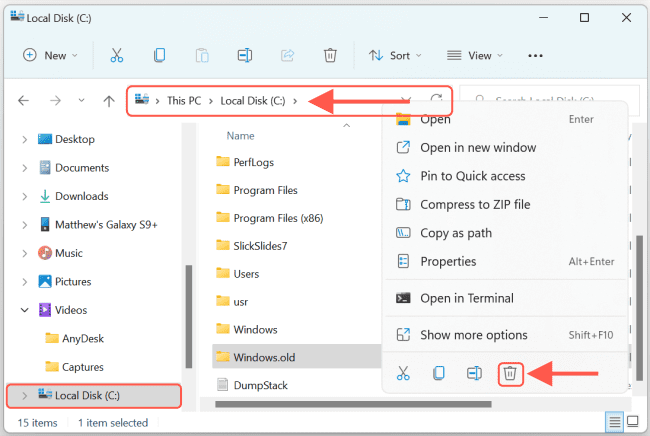
Windows 11

You’ll be prompted to provide administrator permission to delete the folder, click Continue.
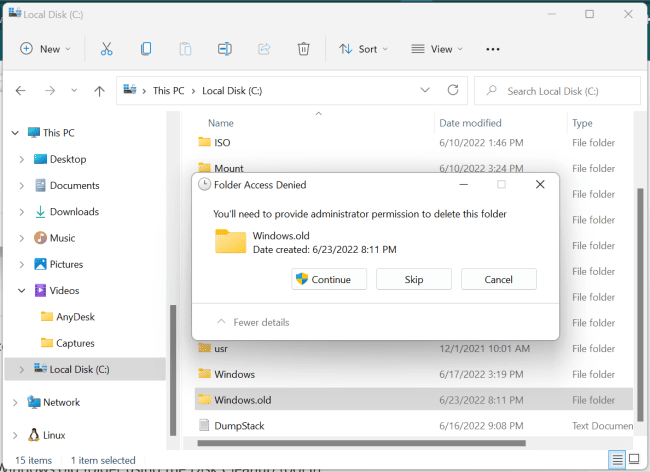
cleanup

Once you provide the administrator permission the folder will be deleted.

Note: If the Windows.old folder is for another user, you will need to take ownership of the folder before it can be deleted. See Folder Access Denied, you require permission from SYSTEM: Unable to delete old windows folder.

Delete the Windows.old folder using Windows Disk Cleanup tool

Another easy way to delete the Windows.old folder in Windows 11 is through the Windows Disk Cleanup tool.

First, click the Windows Start button, then search for Disk Cleanup, under Best match, click Disk Cleanup app as shown below. You can also right-click the C:\ drive in File Explorer, select Properties, and then click the “Disk Clean-up” button on the “General” tab.

disk space

From the Disk Cleanup window, press the “Clean up System Files” button at the bottom.
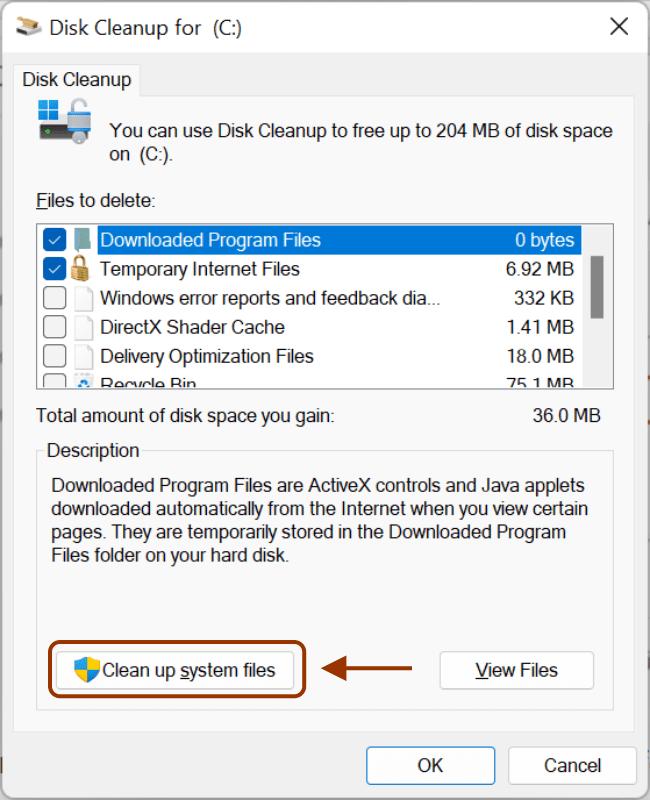
storage management

The Disk Cleanup tool will scan your computer for unused files depending on the speed and size of your hard drive.
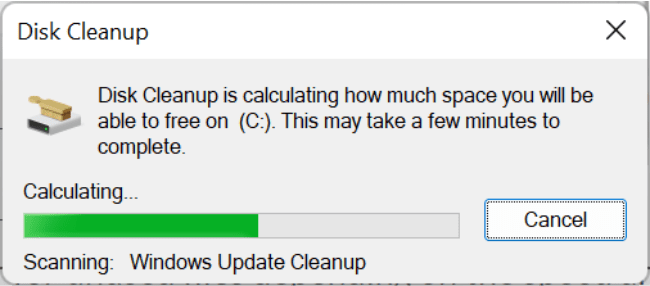
Windows 11

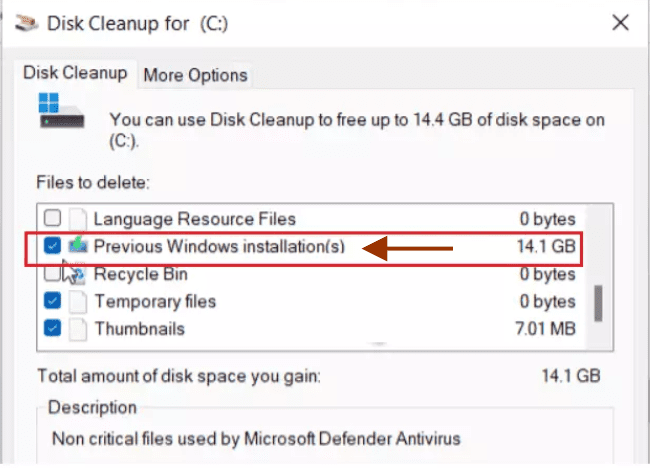
Once the tool finishes scanning your drive, it will show items you can safely delete from your drive to free up space. On the list you should see the Previous Windows installation(s) item which is the Windows.old content.
cleanup

Tick the boxes of the items you want to remove. It safe to check all and click the OK button. You’ll get a prompt to confirm that you want to delete the files.
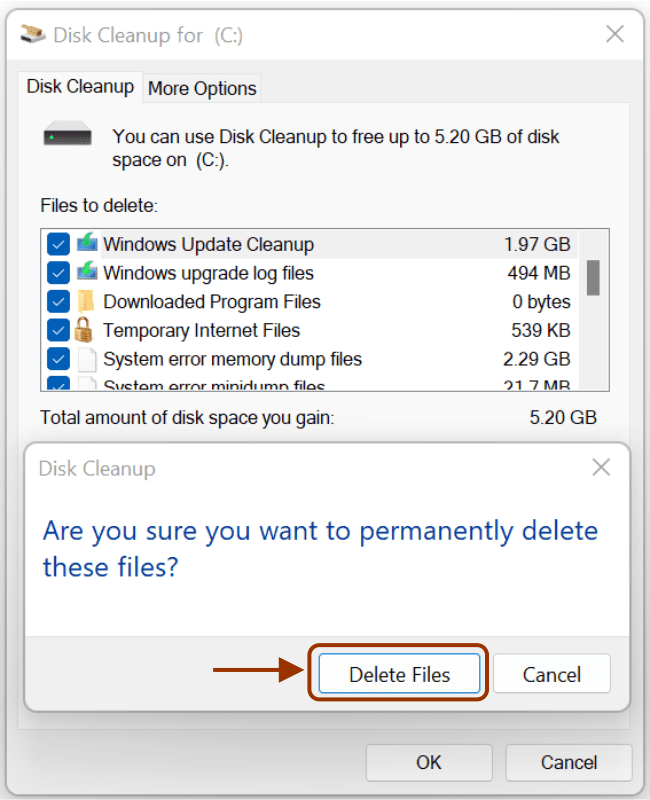
image9

You may also get a second prompt to confirm that you want to delete Windows installations or temporary installations file. Click Yes to confirm and delete.
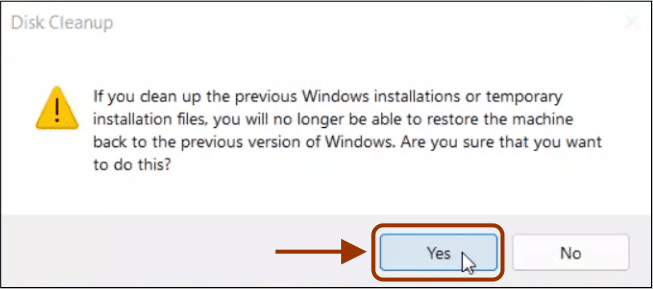
image10

Removing the Windows.old directory has no downsides. You can delete the Windows.old folder as long as you’re satisfied with your current Windows setup, don’t want to downgrade, and you are certain that you have all of your necessary files, and don’t need to take any leftovers from there. 

I hope you found this article useful on how to delete Windows old folder in Windows 11. Please feel free to leave a comment below.

Rate this post

Thank you for reading this post. Kindly share it with others.

  • Share on X (Opens in new window) X
  • Share on Reddit (Opens in new window) Reddit
  • Share on LinkedIn (Opens in new window) LinkedIn
  • Share on Facebook (Opens in new window) Facebook
  • Share on Pinterest (Opens in new window) Pinterest
  • Share on Tumblr (Opens in new window) Tumblr
  • Share on Telegram (Opens in new window) Telegram
  • Share on WhatsApp (Opens in new window) WhatsApp
  • Share on Mastodon (Opens in new window) Mastodon
  • Share on Bluesky (Opens in new window) Bluesky
  • Share on Threads (Opens in new window) Threads
  • Share on Nextdoor (Opens in new window) Nextdoor
Windows Tags:deletion, Folder, Microsoft Windows, Permission, Windows 10, Windows 11

Post navigation

Previous Post: How to Disable Internet Explorer with Group Policy & Registry
Next Post: How to enable or disable color filters in Windows

Related Posts

  • SysInternals
    Use Active Directory Explorer from Sysinternals Windows
  • CAL Removal
    How to Remove and Manage RDS Licenses Web Server
  • wmic4
    How to find User Security Identifier (SID) in Windows [Part 1] Windows
  • Check Hard Drive Health (SMART) in Windows
    How to check Hard Drive Health (SMART) in Windows Windows
  • google chrome web browser download icon png favpng 2fg4fswmttnwqnvax7lrd1hxp
    How to remove Quick Access from Google Drive Online Windows
  • Feature image Install.wim file
    How To Get Install.WIM From Windows 10 Installation File Windows

More Related Articles

SysInternals Use Active Directory Explorer from Sysinternals Windows
CAL Removal How to Remove and Manage RDS Licenses Web Server
wmic4 How to find User Security Identifier (SID) in Windows [Part 1] Windows
Check Hard Drive Health (SMART) in Windows How to check Hard Drive Health (SMART) in Windows Windows
google chrome web browser download icon png favpng 2fg4fswmttnwqnvax7lrd1hxp How to remove Quick Access from Google Drive Online Windows
Feature image Install.wim file How To Get Install.WIM From Windows 10 Installation File Windows

Leave a Reply Cancel reply

You must be logged in to post a comment.

Microsoft MVP

VEEAMLEGEND

vexpert-badge-stars-5

Virtual Background

GoogleNews

Categories

veeaam100

sysadmin top30a

  • uninstalloffice
    Remove All Microsoft Office Apps from Mac Network | Monitoring
  • Active Directory Restore issue
    AD Recovery: Fix device ran into an issue with error 0xc00002e2 Windows Server
  • Add additional Windows drives
    How to Add Another Hard Drive to a Virtual Machine in HyperV  Virtualization
  • Wingettool
    Install and Manage Applications with Winget Windows
  • homebrew social card
    Package Manager for macOS: How to install Homebrew on macOS Mac
  • MicrosoftOneDrive32
    Microsoft OneDrive Setup: Files On-Demand & Key Features Backup
  • ADDS vs AD LDS
    Differences between AD LDS and AD DS Windows
  • veeam
    How to uninstall Veeam Backup and Replication from your server Backup

Subscribe to Blog via Email

Enter your email address to subscribe to this blog and receive notifications of new posts by email.

Join 1,824 other subscribers
  • RSS - Posts
  • RSS - Comments
  • About
  • Authors
  • Write for us
  • Advertise with us
  • General Terms and Conditions
  • Privacy policy
  • Feedly
  • Telegram
  • Youtube
  • Facebook
  • Instagram
  • LinkedIn
  • Tumblr
  • Pinterest
  • Twitter
  • mastodon

Tags

Active Directory AWS Azure Bitlocker Microsoft Windows PowerShell WDS Windows 10 Windows 11 Windows Server 2016

Copyright © 2025 TechDirectArchive


Loading Comments...
 

You must be logged in to post a comment.