

Skip to content

TechDirectArchive

Hands-on IT, Cloud, Security & DevOps Insights

  • Home
  • About
  • Advertise With US
  • Reviews
  • Contact
  • Toggle search form
Home » Windows » How to use Microsoft SQL Server Management Studio to Export and Import your MsSQL database from Azure to local computer
  • TERRAFORM ON LINUX FEATURE IMAGE
    How to Install Terraform on Linux Linux
  • exchange 2016 1
    How to Block Change Password for Specific Exchange Users Network | Monitoring
  • Featured image 3
    How to add a device to your Microsoft Account Microsoft Exchange/Office/365
  • fdsdsd
    Configuring DHCP Scope: Post-deployment of Dynamic Host Configuration Protocol Windows Server
  • savds
    VM is not accessible: Fix Taking ownership of a VM failed Virtualization
  • Domain
    Connectivity to a writable domain controller from a node could not be determined because of an error Virtualization
  • BANNER
    How to Install and Set Lively Wallpaper on Windows 11 Windows
  • Install Microsoft PKI   ADCS
    Set up Microsoft PKI (ADCS) for SystoLOCK via PowerShell Windows Server

How to use Microsoft SQL Server Management Studio to Export and Import your MsSQL database from Azure to local computer

Posted on 14/12/202125/08/2023 Temitope Odemo By Temitope Odemo No Comments on How to use Microsoft SQL Server Management Studio to Export and Import your MsSQL database from Azure to local computer
Export

Microsoft SQL Server Management Studio (SSMS) is an integrated environment where you can manage your SQL infrastructure. SSMS can be used to access, configure, manage, administer, and develop all components of SQL Server and Azure SQL Database. Microsoft SQL server management studio is a free software for public use and can be connected to any of your SQL server instances. MsSQL is a collection of tables that stores structured data in the form that contains a collection of rows that is referred to as records and columns that is referred to as attributes.

Here are some similar guides you can read: How to install Microsoft SQL Server Management Studio, How to uninstall Microsoft SQL Server Management Studio, How to download and install Microsoft SQL Server 2019 Express Edition and Microsoft Management Studio on Windows Server, How to uninstall Microsoft SQL Server on Windows 10 and Windows Server

Step-by-Step Guide: Exporting and Importing Azure Database to Local Computer

In this guide I will show you how to quickly export and import your database from Azure account to your local computer.

  • Login to your Azure Portal: https://portal.azure.com
  • Under Azure Services click SQL databases and select the Database you want to access.
Import
Open your MsSQL Database on Azure
  • Click Set server firewall and add your system IP to the firewall rule and Save.
Microsoft SQL Server Management Studio
Setting your Firewall rule on Azure
  • Download SSMS and install on your local system.
  • Copy the Server name and login name from the Azure portal and enter the valid password and connect to your Azure database.
Azure
Microsoft SQL Server Management Studio

Exporting Database

  • After you have connected right-click database. Click Tasks > Export Data-tier Application.
MsSQL database
Exporting Database
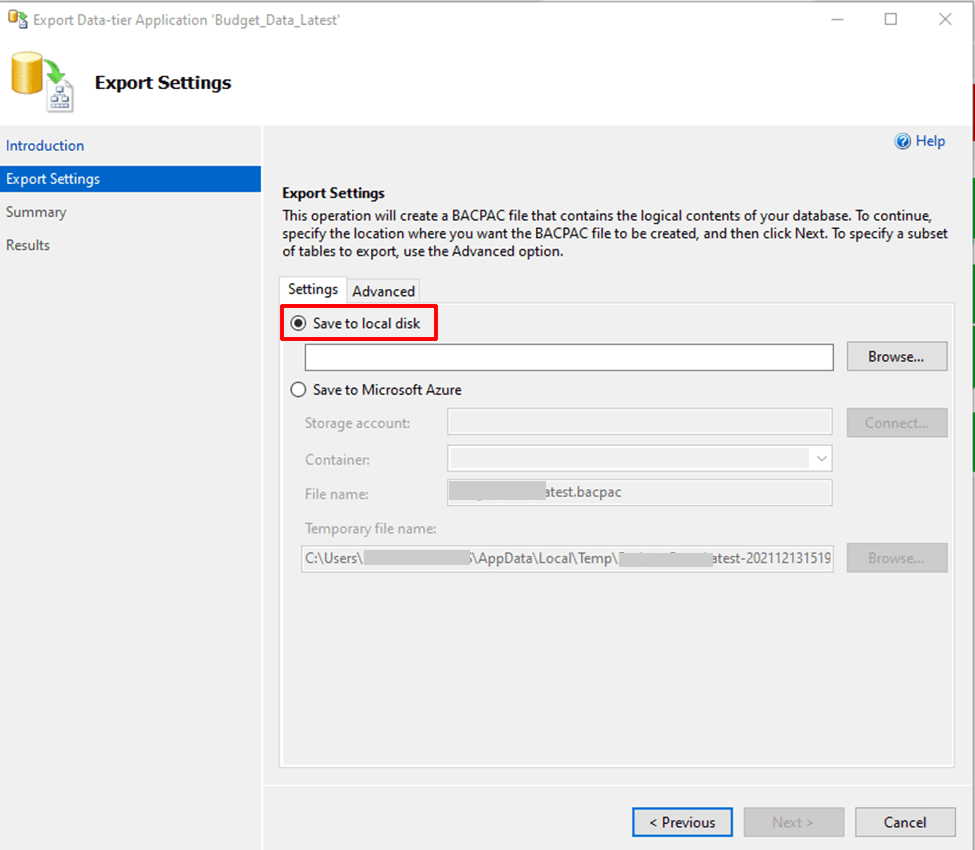
  • Select Save to local disk and browse to the location you want to export the data.
Export
Export Setting
  • Click on Next and you start exporting
image-5
Exporting Database

Importing Database

  • After you have connected right-click database and select Import Data-tier Application.
image-6
Importing Database
  • Select Import from local disk and browse to the location you have the database file you want to import.
image-7
Import Settings
  • Make sure you give the database a name, enter the edition, maximum database size and service objective.
image-8
Database settings
  • Importing of Database starts.
image-9
Importing Database

I hope you found this blog post on How to use Microsoft SQL Server Management Studio to Export and Import your MsSQL database from Azure to local computer very interesting and helpful. In case you have any questions do not hesitate to ask in the comment section.


Rate this post

Thank you for reading this post. Kindly share it with others.

  • Share on X (Opens in new window) X
  • Share on Reddit (Opens in new window) Reddit
  • Share on LinkedIn (Opens in new window) LinkedIn
  • Share on Facebook (Opens in new window) Facebook
  • Share on Pinterest (Opens in new window) Pinterest
  • Share on Tumblr (Opens in new window) Tumblr
  • Share on Telegram (Opens in new window) Telegram
  • Share on WhatsApp (Opens in new window) WhatsApp
  • Share on Pocket (Opens in new window) Pocket
  • Share on Mastodon (Opens in new window) Mastodon
  • Share on Bluesky (Opens in new window) Bluesky
  • Share on Threads (Opens in new window) Threads
  • Share on Nextdoor (Opens in new window) Nextdoor
AWS/Azure/OpenShift, Oracle/MSSQL/MySQL, Windows, Windows Server Tags:Database, Microsoft SQL, Microsoft SQL Server 2019 Express Edition, Microsoft SQL Server Management Studio, Microsoft SQL Server Studio

Post navigation

Previous Post: How to Solve “The parameter is incorrect” problem on External Hard Disk in Windows
Next Post: Download your MySQL database from Azure to a local PC with MySQL Workbench

Related Posts

  • LAPS PAssword Not Showing Up
    LAPS password not showing up in GUI Windows
  • create a two way Active Directory Trust
    How to create a two-way Active Directory Trust Windows Server
  • article 1280x720.192a2586
    Windows Deployment Services: How to setup and install WDS role Windows Server
  • Fix Network related MSSQL instance error
    Fix a network-related or instance-specific error occurred while establishing a connection to SQL Server [Part 2] Oracle/MSSQL/MySQL
  • Encryption
    How to encrypt Microsoft SQL Server Traffic Oracle/MSSQL/MySQL
  • TeamPass Password manager
    Install and configure TeamPass Password Manager Password Manager

More Related Articles

LAPS PAssword Not Showing Up LAPS password not showing up in GUI Windows
create a two way Active Directory Trust How to create a two-way Active Directory Trust Windows Server
article 1280x720.192a2586 Windows Deployment Services: How to setup and install WDS role Windows Server
Fix Network related MSSQL instance error Fix a network-related or instance-specific error occurred while establishing a connection to SQL Server [Part 2] Oracle/MSSQL/MySQL
Encryption How to encrypt Microsoft SQL Server Traffic Oracle/MSSQL/MySQL
TeamPass Password manager Install and configure TeamPass Password Manager Password Manager

Leave a Reply Cancel reply

You must be logged in to post a comment.

Microsoft MVP

VEEAMLEGEND

vexpert-badge-stars-5

Virtual Background

GoogleNews

Categories

veeaam100

sysadmin top30a

  • TERRAFORM ON LINUX FEATURE IMAGE
    How to Install Terraform on Linux Linux
  • exchange 2016 1
    How to Block Change Password for Specific Exchange Users Network | Monitoring
  • Featured image 3
    How to add a device to your Microsoft Account Microsoft Exchange/Office/365
  • fdsdsd
    Configuring DHCP Scope: Post-deployment of Dynamic Host Configuration Protocol Windows Server
  • savds
    VM is not accessible: Fix Taking ownership of a VM failed Virtualization
  • Domain
    Connectivity to a writable domain controller from a node could not be determined because of an error Virtualization
  • BANNER
    How to Install and Set Lively Wallpaper on Windows 11 Windows
  • Install Microsoft PKI   ADCS
    Set up Microsoft PKI (ADCS) for SystoLOCK via PowerShell Windows Server

Subscribe to Blog via Email

Enter your email address to subscribe to this blog and receive notifications of new posts by email.

Join 1,832 other subscribers
  • RSS - Posts
  • RSS - Comments
  • About
  • Authors
  • Write for us
  • Advertise with us
  • General Terms and Conditions
  • Privacy policy
  • Feedly
  • Telegram
  • Youtube
  • Facebook
  • Instagram
  • LinkedIn
  • Tumblr
  • Pinterest
  • Twitter
  • mastodon

Tags

AWS Azure Bitlocker Microsoft Windows PowerShell WDS Windows 10 Windows 11 Windows Deployment Services Windows Server 2016

Copyright © 2025 TechDirectArchive


Loading Comments...
 

You must be logged in to post a comment.