Skip to content

TechDirectArchive

Hands-on IT, Cloud, Security, Veeam & DevOps

  • Home
  • About
  • Advertise With US
  • Reviews
  • Contact
  • Toggle search form
  1. Home
  2. Breadcrumb-Yoast

[wpseo_breadcrumb]

How to find User Security Identifier (SID) in Windows [Part 1]

Posted on 27/12/202221/01/2026 Temitope Odemo By Temitope Odemo No Comments on How to find User Security Identifier (SID) in Windows [Part 1]
  1. Home
  2. Windows
  3. How to find User Security Identifier (SID) in Windows [Part 1]
wmic4

You may have the SID and do not know the user it belongs to. Or the use is known, but do not know the SID. So there will be a need to use a windows command. Matching the SIDs to accounts is very easy using the necessary commands. In this article, we shall discuss “How to find User Security Identifier (SID) in Windows [Part 1]”. Please, see a similar guide, and “Clone a Virtual Machine via Export and Import: How to copy Virtual Hard Disk on Hyper-V“.

If you follow the steps below you will be able to do the matching very easily. In this article, you will learn about Security Identifier: Find User SID in Windows.

If you want to read more on Windows security you can read these: New Windows 11 encryption features and security enhancements will help protect hybrid work, How to use the Windows Sandbox as a security feature in Windows 10 and 11, How to enable Secure Boot on PC to install Windows 11.

Find User SID via the WMIC Command

Open the command prompt terminal and type this command and hit the enter key:

image-106

You will get the SIDs displayed

image-107

If you know the particular account username and only need that account SID then you will have to replace the name with the user.

image-108

I will be typing temitope as the USER

image-109

How to find the Users using the SID

This time around you may have the SID and you need to know the USER, then you will need to reverse the command like this:

image-110

Once you click enter you will see the name of the SID.         

image-111

Please, see Windows Local Account Authorization and Access Control, Migrating SAP HANA Plugin to Veeam, and Open the location of a Program: How to search in Windows 10 to find a file, folder, or program in File Explorer.

Via the Windows Registry

Another way we can find a user SID is through the Registry. Follow this path below. The SID can be confirmed by looking through the ProfileImagePath.

HKEY_LOCAL_MACHINE\SOFTWARE\Microsoft\Windows NT\CurrentVersion\ProfileList. 

On the ProfileList you will notice some numbers that are security identifiers and when I select the SID S-1-5-21-522739724-11777 you will see the corresponding account C:\Users\temitope and I can confirm that the SID belongs to the user account temitope.
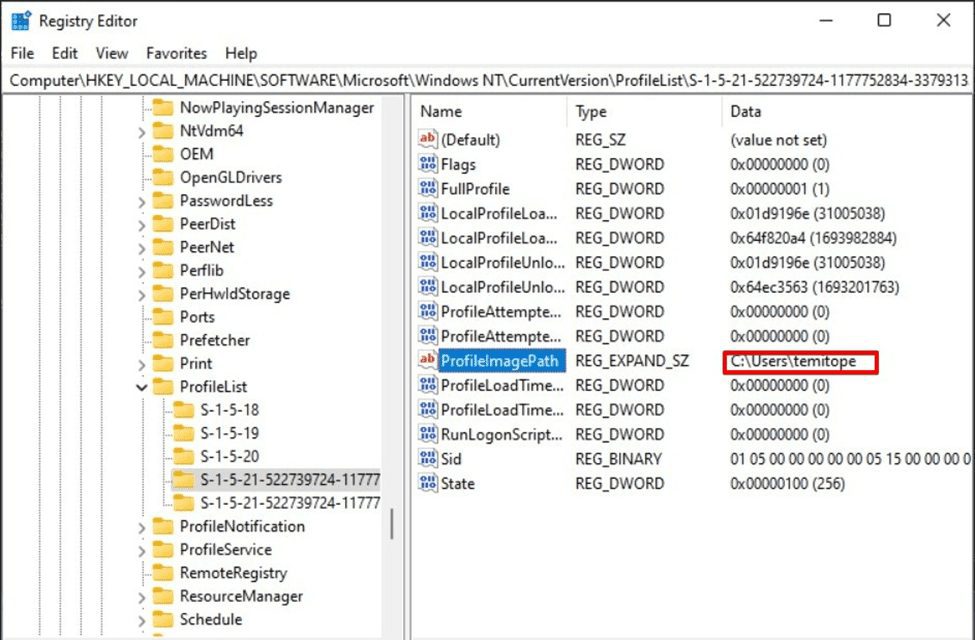
image-112

I hope you found this blog post on how to find User Security Identifier (SID) in Windows [Part 1] very interesting and helpful. In case you have any questions do not hesitate to ask in the comment section.

5/5 - (1 vote)

Thank you for reading this post. Kindly share it with others.

  • Share on X (Opens in new window) X
  • Share on Reddit (Opens in new window) Reddit
  • Share on LinkedIn (Opens in new window) LinkedIn
  • Share on Facebook (Opens in new window) Facebook
  • Share on Pinterest (Opens in new window) Pinterest
  • Share on Tumblr (Opens in new window) Tumblr
  • Share on Telegram (Opens in new window) Telegram
  • Share on WhatsApp (Opens in new window) WhatsApp
  • Share on Mastodon (Opens in new window) Mastodon
  • Share on Bluesky (Opens in new window) Bluesky
  • Share on Threads (Opens in new window) Threads
  • Share on Nextdoor (Opens in new window) Nextdoor
Windows, Windows Server Tags:Microsoft Windows, security, Windows 10, Windows 11, Windows Security, Windows Server 2016

Post navigation

Previous Post: How to Find Security Identifier on Windows [Part 2]
Next Post: How to troubleshoot and fix Windows 11 blue screen

Related Posts

  • dd featured 1
    How to delete obsolete drivers from the Driver Store in Windows Windows
  • TPM 1
    How to fix unable to find compatible TPM Windows
  • User profile in Windows
    How to delete User Profile in Windows Windows
  • Featured image Chrome notification
    How to Disable Chrome Browser Notifications on Windows Windows
  • Screenshot 2020 05 26 at 18.57.25
    WDS and DHCP Deployment Scenarios: Configure DHCP Options 60, 66, and 67 Windows Server
  • BitLocker
    Hide Default BitLocker Drive Encryption item in Windows Windows Server

More Related Articles

dd featured 1 How to delete obsolete drivers from the Driver Store in Windows Windows
TPM 1 How to fix unable to find compatible TPM Windows
User profile in Windows How to delete User Profile in Windows Windows
Featured image Chrome notification How to Disable Chrome Browser Notifications on Windows Windows
Screenshot 2020 05 26 at 18.57.25 WDS and DHCP Deployment Scenarios: Configure DHCP Options 60, 66, and 67 Windows Server
BitLocker Hide Default BitLocker Drive Encryption item in Windows Windows Server

Leave a Reply Cancel reply

You must be logged in to post a comment.

Microsoft MVP

VEEAMLEGEND

vexpert-badge-stars-5

Virtual Background

GoogleNews

Categories

veeaam100

Veeam Vanguard

  • WindowsWebClientcoverPH67
    ​​​​​Install HTML Web Client for Microsoft RDS Windows
  • ePO installation on Windows Server
    Trellix ePolicy Orchestrator Installation on Windows Server Security | Vulnerability Scans and Assessment
  • How to Disable the Command Prompt on Windows 11
    How to Disable the Command Prompt on Windows 11 Windows
  • Tape Logo
    Tape Backup Troubleshooting in Veeam: Real Cases Backup
  • Screenshot 2022 03 21 at 18.06.30
    How to Configure Virtual Host for Apache HTTP Web Server to Host Several Domains on Ubuntu 20.04 LTS Linux
  • Diskspd
    Veeam Backup and Replication Disk I/O with diskspd Backup
  • SQL server authentication mode
    Change from SQL Server and Windows Authentication Mode to Windows authentication Mode Oracle/MSSQL/MySQL
  • sd 1
    How to link your Android or iPhone to your Windows PC Windows

Subscribe to Blog via Email

Enter your email address to subscribe to this blog and receive notifications of new posts by email.

Join 1,803 other subscribers
  • RSS - Posts
  • RSS - Comments
  • About
  • Authors
  • Write for us
  • Advertise with us
  • General Terms and Conditions
  • Privacy policy
  • Feedly
  • Telegram
  • Youtube
  • Facebook
  • Instagram
  • LinkedIn
  • Tumblr
  • Pinterest
  • Twitter
  • mastodon

Tags

AWS Azure Bitlocker Microsoft Windows PowerShell WDS Windows 10 Windows 11 Windows Deployment Services Windows Server 2016

Copyright © 2025 TechDirectArchive

Loading Comments...

You must be logged in to post a comment.