Skip to content

TechDirectArchive

Hands-on IT, Cloud, Security & DevOps Insights

  • Home
  • About
  • Advertise With US
  • Reviews
  • Contact
  • Toggle search form
Home » Windows » How to Install a Windows Server Container Host

How to Install a Windows Server Container Host

Posted on 29/12/202125/03/2024 Christian By Christian No Comments on How to Install a Windows Server Container Host
Windows Container

In this article, I’ll be showing you how to install a Windows server container host. Containers are a game-changing technology, especially for teams that have developers who need dynamic environments to work from. Please see how to configure SSL between WSUS upstream and downstream servers, how to setup and configure Windows server update services (WSUS) and how to perform redirection from HTTP to HTTPS.

A developer can launch a container that supports the needs of her application within minutes, and many of the container images are purpose build with the various programming frameworks called out in the title of the container image.

Kindly refer to the following related contents: Event ID 5059: Application pool has been disabled or Changing identity user for IIS Application Pool, and how to install Pleasant Password Server.

Install a windows server container host

Installing Windows containers is simple. After launching your window server, and from the Server Manager, choose Manage → Add Roles and Features.

Capture-92

On the Before You Begin screen, click Next.

Capture-93

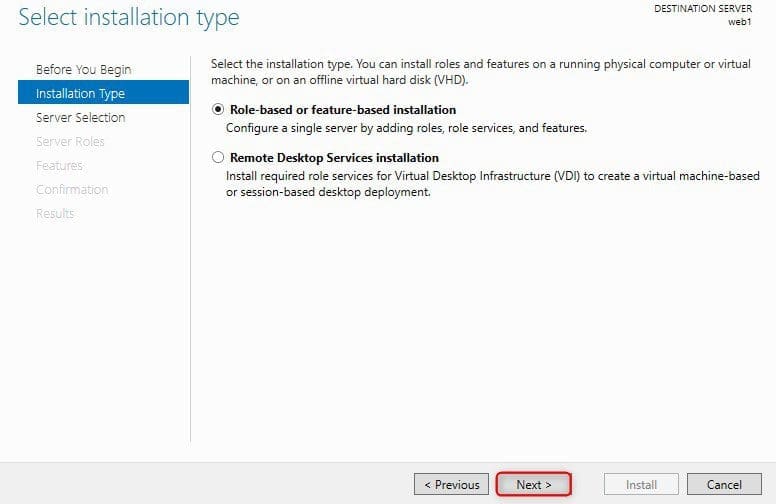
On the Select Installation Type screen, click Next.
Capture-94

In the Select Destination Server screen, click Next.

Capture-95

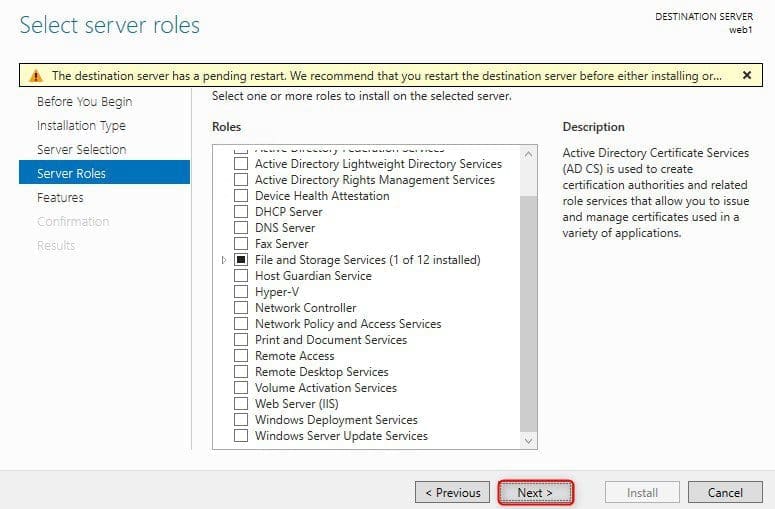
In the Select Server Roles screen, click Next.
Capture-96

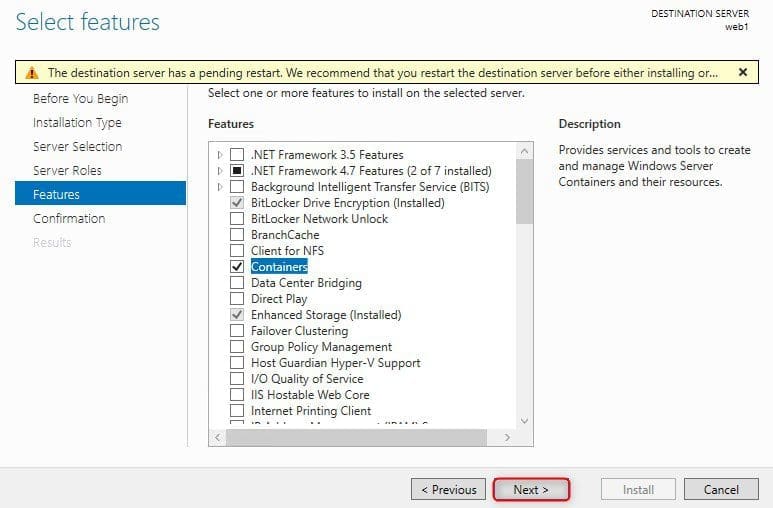
From this window, choose Features screen and click on Containers (shown in the following figure below), and then click Next.
Capture-97

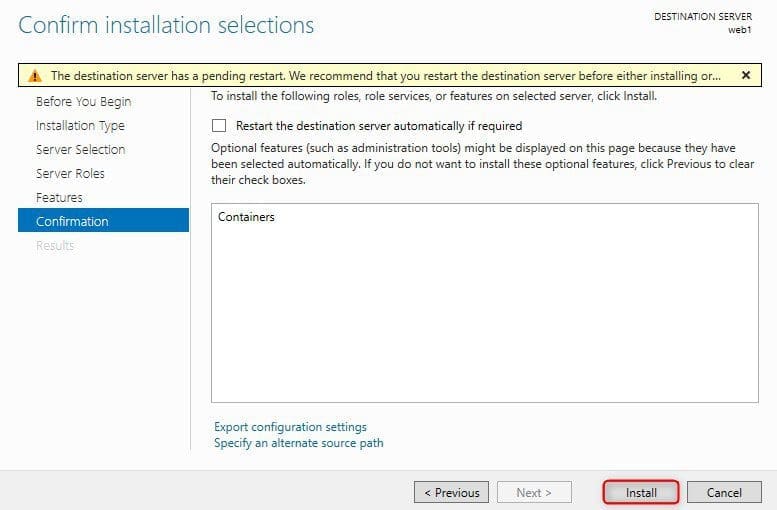
From this page “Confirm Installation Selections” screen, click on Install.
Capture-98

Click Close and restart the server.

Capture-100

To use Windows Containers, you only need to install the Containers feature and then install Docker.

How to install Docker

At this point, you’ve at least got the containers to feature installed. Now you need to install the Docker Engine. This is the piece that really ties all the other pieces together.

You’ll need to open PowerShell to run these commands, as well as the commands that follow under “Test Your Container Installation.” To open PowerShell, right-click on Start and select Windows PowerShell (Admin).

After you’ve opened PowerShell, your first step is to install the Microsoft Package Provider for Docker. This is done with the following command:

Install-Module -Name DockerMsftProvider -Repository PSGallery -Force
Capture-103

Now you can install the latest version of Docker with the following command:

Install-Package -Name docker -ProviderName DockerMsftProvider
Capture-104

After Docker is installed, you need one more restart. You can do this through the graphical user interface (GUI), or you can just type the following into PowerShell:

Restart-Computer -Force
Capture-105

Please see Pull and Deploy Nginx Container Images from Docker Hub, How to stop Docker from automatically starting on Mac, and “Failed to remove network for build: Error during connect in the default daemon configuration on Windows, the Docker client must be run with elevated privileges“.

Test your container installation

After your server is configured and Docker is installed, you’ll want to test to ensure that your container installation is working properly.

There is a simple way to test that your Windows container installation is installed properly: Download and run a container image. One of my favourites is a sample image because it prints out a “Hello world”–style message and then exits.

To run this test, you use the docker run command. Because the container image is not downloaded yet, it will download the container image first, and then run it.

If you want to stage the image so you can play with it later, you can use the docker pull command instead of docker run, and it will only download the container image. Here is the command to see the downloaded image container:

docker images
Capture-106

I hope you found this blog post helpful on how to install a Windows Server Container Host. Please let me know in the comment session if you have any questions.

Rate this post

Thank you for reading this post. Kindly share it with others.

  • Share on X (Opens in new window) X
  • Share on Reddit (Opens in new window) Reddit
  • Share on LinkedIn (Opens in new window) LinkedIn
  • Share on Facebook (Opens in new window) Facebook
  • Share on Pinterest (Opens in new window) Pinterest
  • Share on Tumblr (Opens in new window) Tumblr
  • Share on Telegram (Opens in new window) Telegram
  • Share on WhatsApp (Opens in new window) WhatsApp
  • Share on Mastodon (Opens in new window) Mastodon
  • Share on Bluesky (Opens in new window) Bluesky
  • Share on Threads (Opens in new window) Threads
  • Share on Nextdoor (Opens in new window) Nextdoor
Containers, Windows Tags:container

Post navigation

Previous Post: How to Install Terraform on Linux
Next Post: Bang and Olufsen Bluetooth connection: How to connect and remove Beoplay E8 3rd Generation to Mac

Related Posts

  • MBAM
    The web application “Administration Portal” cannot be enabled because one or more software dependencies are not met Windows
  • media8
    How to create a Windows 11 Bootable USB drive Windows
  • jhgfx
    How to make Cortana use your default web browser such as Google Chrome Windows
  • article 1280x720.13392821
    How to use command prompt to shutdown and restart your computer Windows
  • Slide1 1
    How to manage Microsoft Defender Antivirus using Group Policy and Command Line Utility Anti-Virus Solution
  • fba7f screenshot 2019 04 15 at 18.33.30
    File System Overview: How to decide on the right File System to use for your USB Linux

More Related Articles

MBAM The web application “Administration Portal” cannot be enabled because one or more software dependencies are not met Windows
media8 How to create a Windows 11 Bootable USB drive Windows
jhgfx How to make Cortana use your default web browser such as Google Chrome Windows
article 1280x720.13392821 How to use command prompt to shutdown and restart your computer Windows
Slide1 1 How to manage Microsoft Defender Antivirus using Group Policy and Command Line Utility Anti-Virus Solution
fba7f screenshot 2019 04 15 at 18.33.30 File System Overview: How to decide on the right File System to use for your USB Linux

Leave a Reply Cancel reply

You must be logged in to post a comment.

Microsoft MVP

VEEAMLEGEND

vexpert-badge-stars-5

Virtual Background

GoogleNews

Categories

veeaam100

Veeam Vanguard

  • Building VPC
    Build a Scalable VPC for Your AWS Environment [Part 1] AWS/Azure/OpenShift
  • screenshot 2020 04 18 at 00.01.07
    Different ways to check for Ansible syntax errors Configuration Management Tool
  • removeguesttrello
    Remove a member from Trello Workspace: How to add or remove a Board Guest to a Trello Board JIRA|Confluence|Apps
  • GPO Blocked Downloads 3
    How to Block downloads on Microsoft Edge using GPO on Windows Server 2019 and 2022 Windows
  • maxresdefault
    How to join a computer to the Domain Windows Server
  • BitLocker
    BitLocker Drive Encryption architecture and implementation types on Windows Windows Server
  • Fix invalid backup repostory and delete not needed repo via Veeam Backup Repository
    Fix missing path and delete a Veeam Backup Repository Backup
  • FEATURE IMAGE BASE URL 1
    How to solve cannot find a valid base URL for repo: base/7/x86_64 Linux

Subscribe to Blog via Email

Enter your email address to subscribe to this blog and receive notifications of new posts by email.

Join 1,823 other subscribers
  • RSS - Posts
  • RSS - Comments
  • About
  • Authors
  • Write for us
  • Advertise with us
  • General Terms and Conditions
  • Privacy policy
  • Feedly
  • Telegram
  • Youtube
  • Facebook
  • Instagram
  • LinkedIn
  • Tumblr
  • Pinterest
  • Twitter
  • mastodon

Tags

Active Directory Azure Bitlocker Microsoft Windows PowerShell WDS Windows 10 Windows 11 Windows Deployment Services Windows Server 2016

Copyright © 2025 TechDirectArchive


Loading Comments...
 

You must be logged in to post a comment.