Skip to content

TechDirectArchive

Hands-on IT, Cloud, Security, Veeam & DevOps

  • Home
  • About
  • Advertise With US
  • Reviews
  • Tech News
  • Contact
  • Toggle search form

Remote Desktop Services Setup on Windows Server

Posted on 24/05/201817/08/2026 IT Expert By IT Expert No Comments on Remote Desktop Services Setup on Windows Server
  1. Home
  2. Windows Server
  3. Remote Desktop Services Setup on Windows Server
Remote Desktop

Remote Desktop Services, known as Terminal Services in Windows Server 2008 and earlier, is one of the components of Microsoft Windows that allow a user to take control of a remote computer or virtual machine over a network connection. Here are the step-by-step guide for installing Remote Desktop Services Setup on Windows Server. Kindly refer to these related guides: Changed expired RDP password: How to change a password on a Remote Desktop session, how to fix “the logon attempt failed for the remote desktop connection“, and how to Resolve Microsoft RDP Connection Black Screen.

Step 1: Prerequisite Remote Desktop Services Setup on Windows Server

  • Users need to be created in AD
  • You need a User Access group and
  • Computer groups are all created in AD to access this Terminal server.

Kindly stay put! I will be creating two new guides on how to deploy RDS using Quick Start and Standard deployment using Windows Server 2019. Please see this guide on Publish Remote Desktop Web Client: How to install HTML 5 Web Client for Microsoft RDS Server. Below is the core architecture of RDS.

RDS configuration

We have to add the Server we wish to configure RDS as shown below. Select the DNS name and search using the FQDN of the VM. Here is a comprehensive guide on “how to install RDS via Quick Start Deployment: Install, Publish, Update and Uninstall Remote Desktop Web Client“

Windows Server remote access

Click on the arrow and click on OK. Now on the Server Manager, navigate to the All Servers tab and click on it. Then it would display the two added servers.

Note: This server must be added with the domain administrator’s right if joined to the domain where special permissions are assigned and not the local administrator’s password.

Since we have all servers necessary for configuring the RDS, now let’s add the Remote Desktop Services role and features to the Terminal server itself.

You may be interested in these guides: How to change a password on a Remote Desktop session, How to Activate and Press Ctrl+Alt+Del in Anydesk for Remote Access Connection to Windows system, and how to Deploy MVC Application to AWS EC2 Using RDP Connection and Web Deploy.

Step 2: Installing the Remote Desktop Services Roles on the Test-RDPServer

Click on Manage,
Select add Roles and Features wizard,
The installation type is Remote Desktop Services Installation.

Remote Desktop setup

The deployment type chosen is a standard deployment

Screenshot displaying options for selecting deployment type in a Remote Desktop Services setup, featuring 'Standard deployment' and 'Quick Start' with descriptions for each.

Deployment Scenario is a Session-based desktop deployment 

Remote Desktop

Below are the roles services tat will be installed

RDS configuration

The RD connection Broker, select the Test-RDP Server VM and click on next

Windows Server remote access

For RD Web Access select the added server in step 1 which is the test-VM from the server pool.

Note:  By selecting this option, the web access role services are being installed to the test-VM server (which will act as our RD gateway)

Remote Desktop setup

For the RD Session Host, select the RDP from the Pool of servers

Remote Desktop

In the confirmation option, select restart the destination server automatically if required, or else you can’t proceed.

RDS configuration

Note: The server restarts afterward and continues with the installation and if completed successfully it displays success.

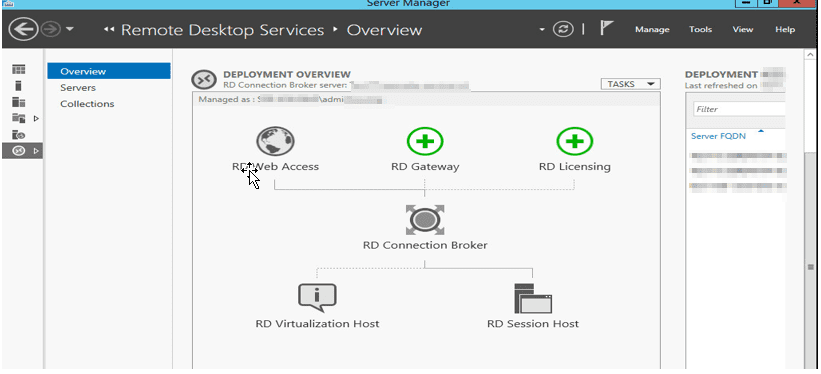
From the Server Manager, open Remote Desktop Services, and Test-RDP VM
Windows Server remote access

Part 3: Here we currently have the RD Licensing option missing  

Add the licensing Server as the Terminal Server itself.

Remote Desktop setup

Click on next and select add and after it succeeds, click on close.

Remote Desktop

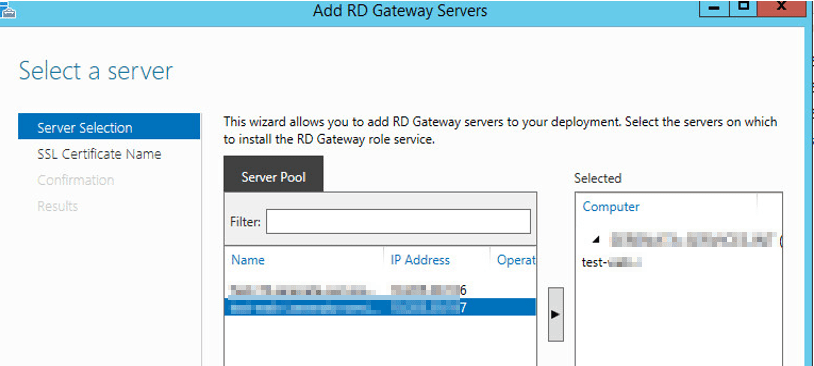
Now install RD Gateway server, this would be added server in step 1.  This is the test-VM
RDS configuration

Click on next and then Install the SSL certificates. This is needed to encrypt the communication between the RD Gateway server and remote desktop services clients.

Windows Server remote access

The entered URL will be used by the clients to access the remote gateway server.  Ensure you have an A record created for this in your DNS server.

Screen displaying the confirmation selections for adding RD Gateway servers, including server details and SSL certificate information.

And click on Add

Progress screen showing the installation of Remote Desktop Gateway role service on a server, indicating the installation status as 'In Progress.'

After this step, still on the Terminal Server (locate). Open the Remote Desktop Services
Navigate to the deployment overview and select Edit deployment Properties
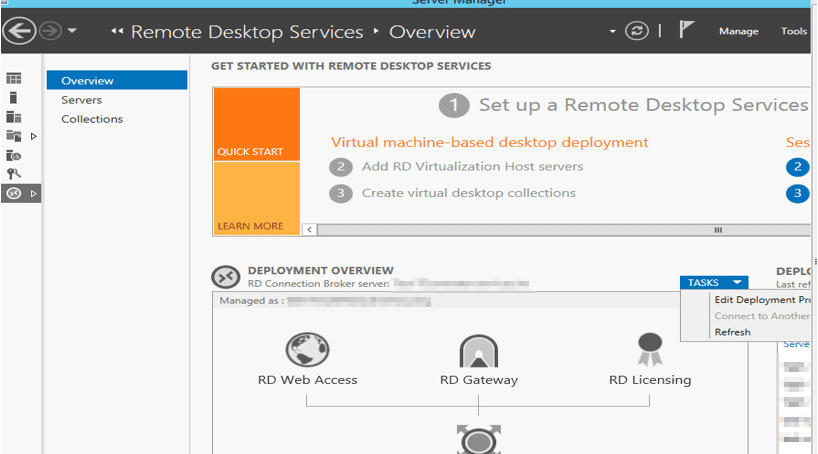
Screenshot of the Remote Desktop Services Overview interface, displaying options for virtual machine-based desktop deployment and details on RD Web Access, RD Gateway, and RD Licensing.

And Modify the deployment of these configurations
– Remote Desktop Gateway
– RD Licensing,
– RD Web Access:
– Certificates

Now type https://xxxxxxxxxx.com/rdweb to any web browser and access.
RDweb

For the certificates, we can see they are not configured
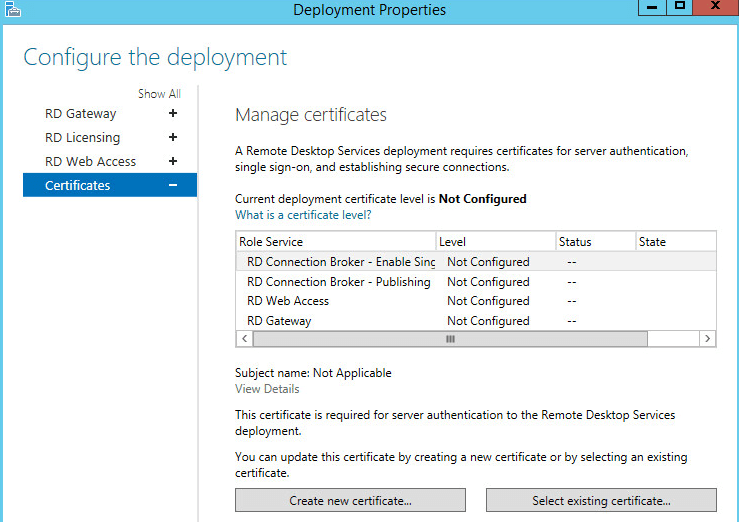
Screenshot of Remote Desktop Services deployment properties showing the certificate management section. The current deployment certificate level is 'Not Configured' for various role services, including Connection Broker and Gateway, with options to create or select existing certificates.

Click on select existing certificates and enter the password for all the role services not configured.

Create Collections

This is necessary to have users that are allowed to access the Remote Desktop Services and to let the RDS Know what to publish.

Open Server Manager,
- Click on Remote Desktop Services,
- Click on Session Collections,
- Click Tasks and
- Click Create Session Collection.
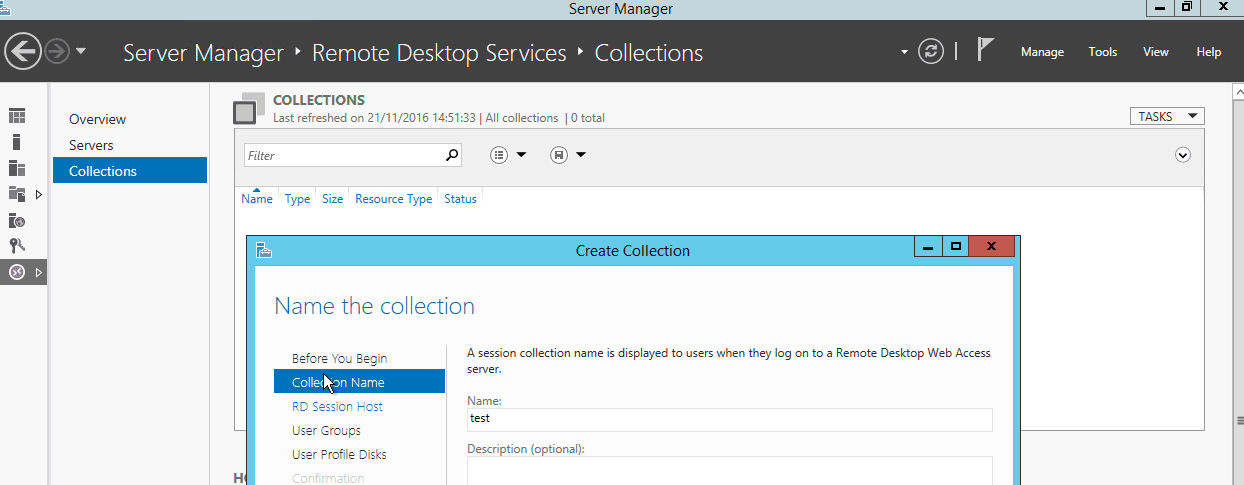
Screenshot of the Server Manager interface displaying the Remote Desktop Services collections section, with a focus on creating a new collection and naming it.

Specify the Collection name e.g. Test representing the Customer or user, and select the RD Session Host servers by click the add (arrow) button to add the users
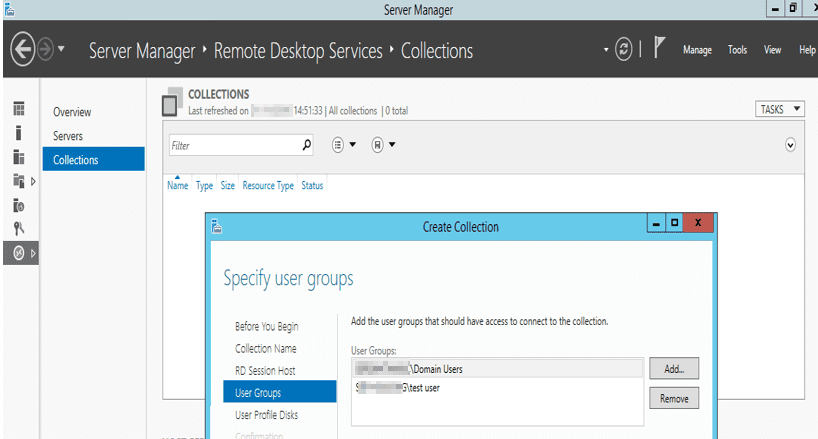
Screenshot of Windows Server Manager showing the Remote Desktop Services Collections section. The interface displays a 'Create Collection' dialog with options to specify user groups for connection.

Add the user group created to access the RDS Server to restrict access to the specified groups only.
And deselect User Profile Disks.

Screenshot of Windows Server Manager displaying Remote Desktop Services Collections settings, with a focus on user profile disk configuration.

Verify that all entered information is valid and click on create a collection as shown below.

Screenshot of the Server Manager interface, displaying the 'Confirm selections' section for creating a Remote Desktop Services collection. It includes fields for the collection name, user groups, and additional settings.

And finally if succeeded, you will be prompted with the screen below
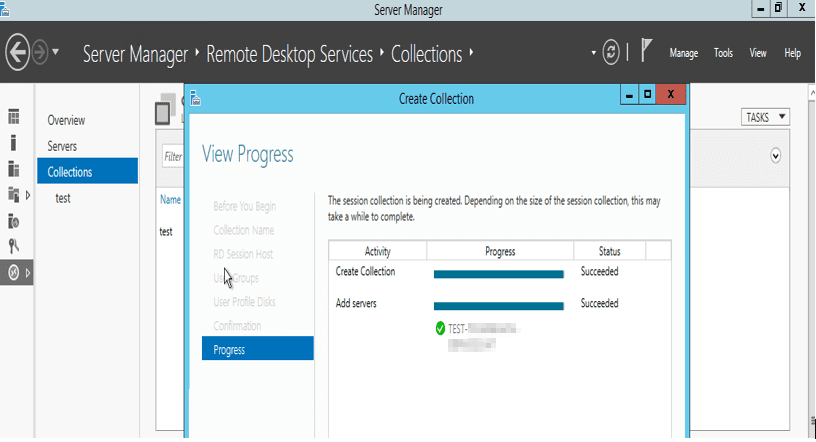
Server Manager interface showing the progress of creating a Remote Desktop Services collection.

After completion, you should have your collection displayed as below.

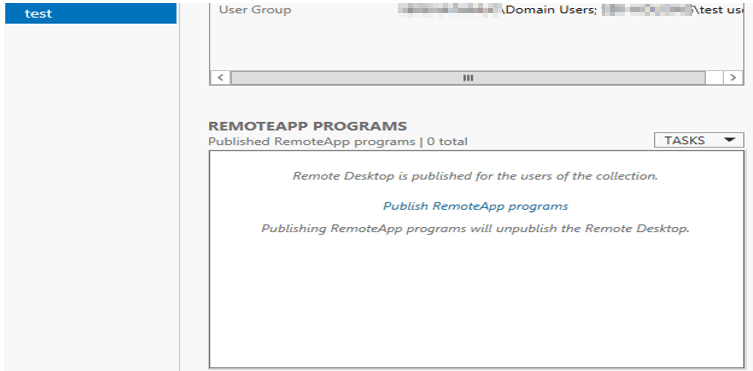
Screenshot of Server Manager showing Remote Desktop Services collection properties and connections for the 'test' collection.

Now to publish Remote app programs

Screenshot of a software interface showing 'RemoteApp Programs' with options to publish Remote Desktop programs.

Select the created Collection
Navigate to remote App Programs
Select Tasks,
Click on publish Remote App as shown below
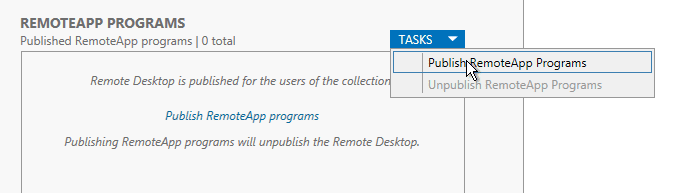
Screenshot of a user interface titled 'RemoteApp Programs', showing a task dropdown with options to 'Publish RemoteApp Programs' and 'Upload RemoteApp Programs'.

Select the Programs you wish to publish or add additional programs you wish to publish.
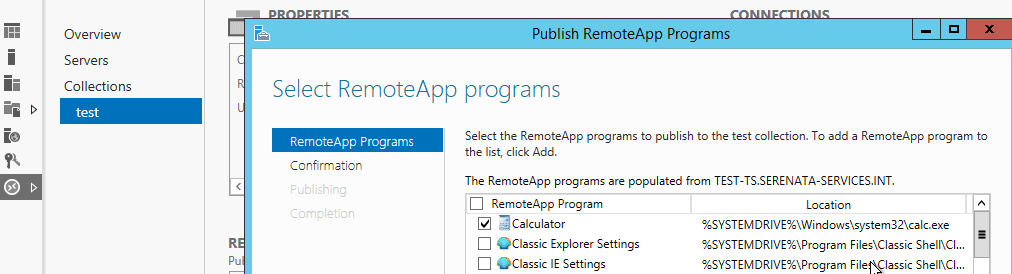
Screenshot of a software interface showing the 'Select RemoteApp programs' window with options for publishing applications including 'Calculator' and 'Remote Desktop Settings'.

Here we have the Calculator and WordPad selected as shown below

Screenshot of a software interface showing the 'Confirmation' step for publishing Remotely Accessed Programs, including a list of programs and their locations.

And click on publish and when completed it shows
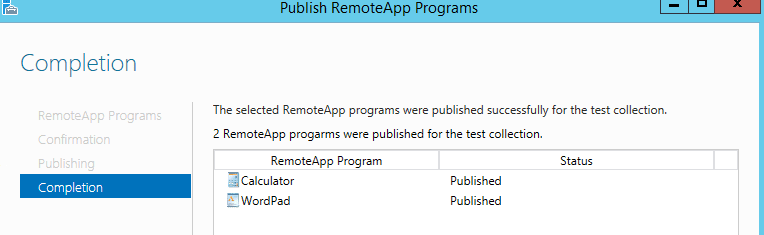
Completion screen showing successful publication of RemoteApp programs, including Calculator and WordPad, with their status listed as 'Published'.

Now you have the programs published under RemoteApp Programs

Part 4: On the test Web Server, (Acting as the RD Gateway)

Add both Servers to the Sever pool, which are test-TS and Test VM as well.
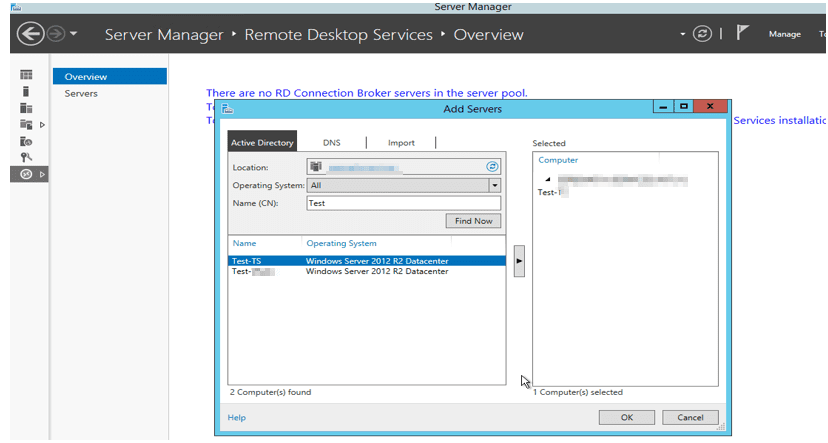
Screenshot of the Server Manager interface showing the Remote Desktop Services Overview, with options to add servers and details about server configuration.

Remote Desktop Services: Access the RD Gateway manager

Now access the RD Gateway manager to assign the user and computer group that can access the Terminal Server.
– Connect to the Test-Web-I server
– Open Remote Desktop Services,
– Click on Servers as shown below
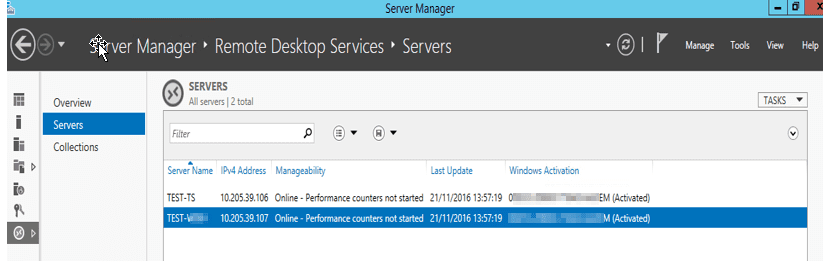
Screenshot of Windows Server Manager showing Remote Desktop Services with a list of server details including names, status, and last updates.

Select from the Server pool the Test VM and right-click on it
Select RD Gateway Manager
Expand the Test VM
Expand the Policies node and Select the  Connection Authorisation Policies as shown below. It allows you to specify users who can access the Server.
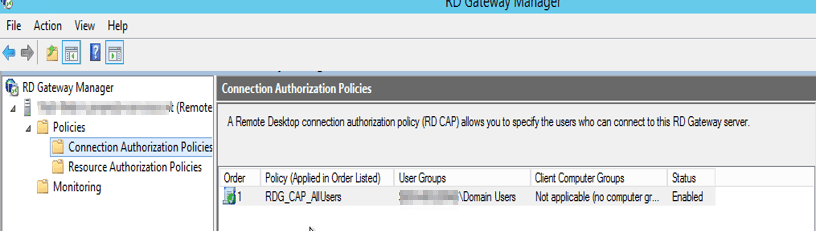
Screen capture of Remote Desktop Connection Authorization Policies in Windows Server, displaying configuration options and user groups.

On the connection Authorization Tab, double click on the Policy or right-click and select properties

Note: You can create new policies and disable the existing ones or modify the existing one. Here we are modifying it.
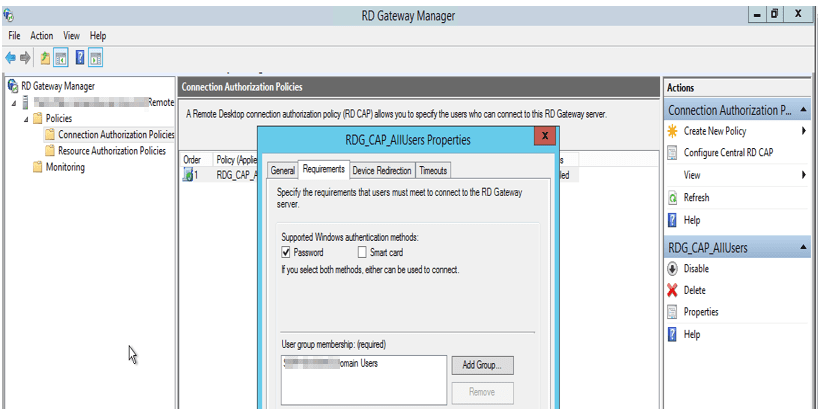
Screenshot of the RDS Gateway Manager interface, displaying the properties settings for the RDS CAP (Connection Authorization Policy) with options including device authentication methods.

Here navigate through the various properties TAB
Under General: You can give the policy whatever name you want
Requirements: Add the user group from the Active Directory. Here we have the test-User-Access group created (populated with the users) that can access this Terminal Server.
Navigate through the Device Redirection and Timeout to define the required idle timeout.  Click on apply and close.

Now select the second Resource Authorization Policies.
Here you also have to add the Remote User group,
And under Network resource, select the test-RDGW-Acc_Computer group created.  Click on apply and finish.
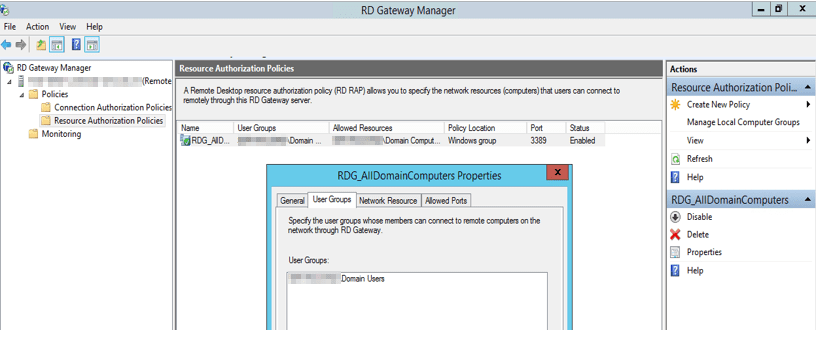
Screenshot of the RD Gateway Manager interface, displaying Resource Authorization Policies and a dialog for configuring computer properties.

Note: You can get details of connected users here from the Monitory as shown in the diagram.

I hope you found this blog post helpful on the steps to install Remote Desktop Services Setup on Windows Server. If you have any questions, please let me know in the comment session.

Rate this post

Thank you for reading this post. Kindly share it with others.

  • Share on X (Opens in new window) X
  • Share on Reddit (Opens in new window) Reddit
  • Share on LinkedIn (Opens in new window) LinkedIn
  • Share on Facebook (Opens in new window) Facebook
  • Share on Pinterest (Opens in new window) Pinterest
  • Share on Tumblr (Opens in new window) Tumblr
  • Share on Telegram (Opens in new window) Telegram
  • Share on WhatsApp (Opens in new window) WhatsApp
  • Share on Mastodon (Opens in new window) Mastodon
  • Share on Bluesky (Opens in new window) Bluesky
  • Share on Threads (Opens in new window) Threads
  • Share on Nextdoor (Opens in new window) Nextdoor
Windows Server Tags:RDP, rds, Remote Desktop Services, RemoteConnection, Terminal, Windows 10, Windows 11, Windows Server 2016

Post navigation

Previous Post: Configuring SimpleSAMLPHP
Next Post: How to launch an EC2 instance

Related Posts

  • fghj
    MDT deployment failed and Stuck at Command Prompt: Windows installation does not proceed via PXE boot Windows Server
  • enable or disable WinRM
    How to enable or disable WinRM via the command-line Windows
  • screenshot 2020 02 08 at 20.02.50
    Windows 10 Administrative Shortcut command key Windows Server
  • RDS Error
    RDP Users are unable to change Passwords Windows Server
  • PowerSehll
    How to update PowerShell and Package Management via GPO Windows Server
  • Shrink and Compact Virtual Hard Disks
    How to Shrink and Compact Virtual Hard Disks in Hyper-V Virtualization

More Related Articles

fghj MDT deployment failed and Stuck at Command Prompt: Windows installation does not proceed via PXE boot Windows Server
enable or disable WinRM How to enable or disable WinRM via the command-line Windows
screenshot 2020 02 08 at 20.02.50 Windows 10 Administrative Shortcut command key Windows Server
RDS Error RDP Users are unable to change Passwords Windows Server
PowerSehll How to update PowerShell and Package Management via GPO Windows Server
Shrink and Compact Virtual Hard Disks How to Shrink and Compact Virtual Hard Disks in Hyper-V Virtualization

Leave a Reply Cancel reply

You must be logged in to post a comment.

Microsoft MVP

VEEAMLEGEND

vexpert-badge-stars-5

Virtual Background

GoogleNews

Categories

veeaam100

Veeam Vanguard

  • Turn On Or Off Auto Unlock For BitLocker Drive
    How To Turn On Or Off Auto-Unlock For BitLocker Drive In Windows 10/11 Security | Vulnerability Scans and Assessment
  • GNS3
    How to Connect GNS3 to the internet on Windows Network | Monitoring
  • Screenshot 2022 03 15 at 10.05.53
    VMware Workstation states: What are the differences between Suspend, Power Off, and Run in Background Linux
  • domain14 1
    How To Configure a Domain Password Policy Windows
  • screenshot 2020 04 04 at 01.38.38
    Fix Failed to create scheduled task due to Windows Server Management service issue Windows Server
  • fdsdsd
    Configuring DHCP Scope: Post-deployment of Dynamic Host Configuration Protocol Windows Server
  • Featured image dataTransfer.
    How to transfer data from an old PC to a new PC Windows
  • Password Migration to ICloud Keychain
    How to import your Chrome or Firefox passwords into your iCloud Keychain Mac

Subscribe to Blog via Email

Enter your email address to subscribe to this blog and receive notifications of new posts by email.

Join 1,762 other subscribers
  • RSS - Posts
  • RSS - Comments
  • About
  • Authors
  • Write for us
  • Advertise with us
  • General Terms and Conditions
  • Privacy policy
  • Feedly
  • Telegram
  • Youtube
  • Facebook
  • Instagram
  • LinkedIn
  • Tumblr
  • Pinterest
  • Twitter
  • mastodon

Tags

Active Directory Azure Bitlocker Microsoft Windows PowerShell WDS Windows 10 Windows 11 Windows Deployment Services Windows Server 2016

Copyright © 2026 TechDirectArchive

Loading Comments...

You must be logged in to post a comment.