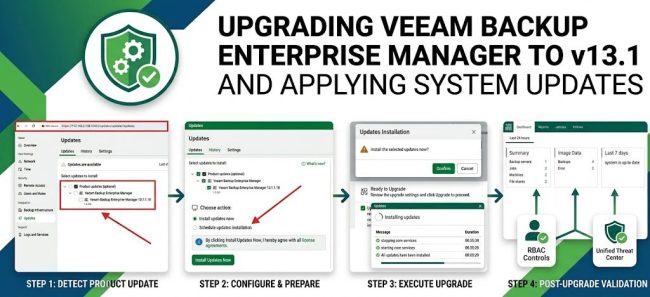
Veeam Backup Enterprise Manager (VBEM) provides centralized management, global data visibility, and Role-Based Access Control (RBAC) across multi-server backup environments. In this guide, we will walk through upgrading Enterprise Manager to version 13.1.1.18 via the web-based Veeam Host Management Console, aand applying underlying OS and security updates. Please see Veeam Enterprise Manager setup and User Role management, How to license Veeam Enterprise Manager and Add VBR Servers, and how to perform In-place upgrade of Veeam Recovery Orchestrator to version 13.1.
Note: With Veeam v13, you can choose to deploy your Veeam Backup Enterprise Manager (VBEM) using either the new “Linux-based Veeam Software Appliance (VSA)” or a traditional “self-managed “Windows-based” deployment. Both share the exact same core product code. While the VSA eliminates manual OS patching as we will see in this guide.
Note: The VSA (Veeam Software Appliance) is an application delivery image. When booting the VSA installer, it prompts you to select which core product to install: Veeam Backup & Replication (VBR) or Veeam Backup Enterprise Manager (VBEM) as discussed here “how to setup Veeam Software Appliance v13“. While the “VIA (Veeam Infrastructure Appliance)” is strictly used for secondary data-plane and fabric roles.
You can deploy a VIA to act as a Hardened Repository (VHR), backup proxy, gateway server, or mount server. Here are some key architectural rules for v13;
- Unified Installer, Separate Deployments: Even though both VBR and VBEM can now be deployed as a Linux-based VSA, they do not sit inside the same appliance instance. You deploy one VSA instance to act as your VBR server, and a separate VSA instance if you want your VBEM server on Linux.
- Cross-Platform Compatibility: A Linux-based VBEM appliance can seamlessly connect to, monitor, and manage both Linux-based VSA backup servers and traditional Windows-based VBR servers
This distinction is important because upgrading VBEM and updating the underlying operating system are two separate maintenance activities. With the above distinction established, let us proceed with the upgrade of the Veeam Backup Enterprise Manager server to version 13.1.1.18, followed by the required security updates.
Please see Set up Veeam Backup for Microsoft Azure, “Demystifying Zero Trust with Veeam: Design your Architecture“, and how to upgrade Veeam Backup and Replication v11 to 12.1.
Updating/Upgrading Veeam Backup Enterprise Manager
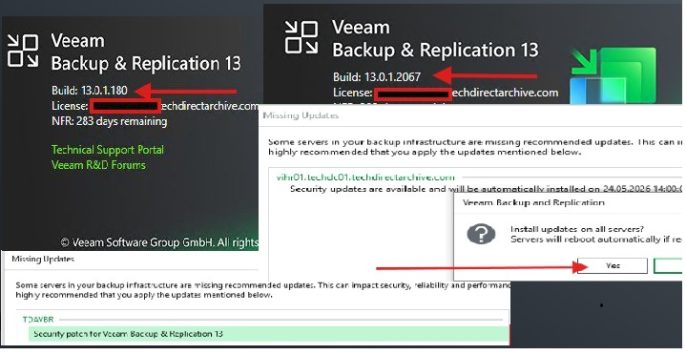
Before starting the upgrade, verify the current Veeam Backup Enterprise Manager (VBEM) version of the appliance. The upgrade can then be performed through the web-based Veeam Host Management Console without requiring a dowload of an ISO as it is for Windows based instalaltion
Next, navigate through the Veeam Host Management Console and check for available updates. As you can see below, there are updates available.

I will proceed and select the optional product updates which will in turn select all other updates and will click on “Install Updates Now”.As you can see below, this ensures that the VBEM or VEM as often referred to is brought up to date with version number 13.1.1.18

On the installation prompt, click on “Confirm”.

As you can see below, the configuration is being validated

Please, see How to upgrade Veeam Backup and Replication 12.3, how to restore MSSQL Server on Azure VMs using Azure Backup, and MSSQL Server Error 833: Synthesis of Real-World Case Studies.
Upgrading Veeam Backup Enterprise Manager to 13.1
Click to update license automatically to maintain uninterrupted workload usage reporting and click on upgrade to begin downloading package files, stopping core services, applying binary updates, and restarting services automatically.

As mentioned above, packages are being downloaded right now.

The below image are the detailed view of the process that happened during the VBEM upgrade as mentioned above.

Please see Google Drive Broken on Windows: Fix and Prevent it from happening again, how to fix Error 202: AMD Software Installer Fails to install Update, and how to Resolve Veeam ONE “The specified property cannot be found” and License Mismatch Errors During upgrade.
Installing System and Security Updates
After updating the application layer, the Host Management Console flags mandatory OS and security packages as shown below.

Select the mandatory updates and click on What’s new to see the content of the updates as shown below which are (aspnetcore-runtime-10.0, .NET Core and ASP.NET Core runtimes). Close the what’s new dialog window and click on Install.

Click on confirm as shown below.

The console logs sequential execution times as shown below.

At this stage, the core services are being started.

Click Finish as shown below.

As yoiu can see, the console confirms that the system is up to date.

Now you can access the Veeam Enterprise Manager Web UI once again.

Once signed into the Enterprise Manager Web UI (https://<IP-or-Hostname>:443), and we can see the summary widget for the last 7 days.

I hope you foudn this guide on “Upgrading Veeam Backup Enterprise Manager to v13.1 and Applying System Updates” very useful. Please feel free to leave a comment below.